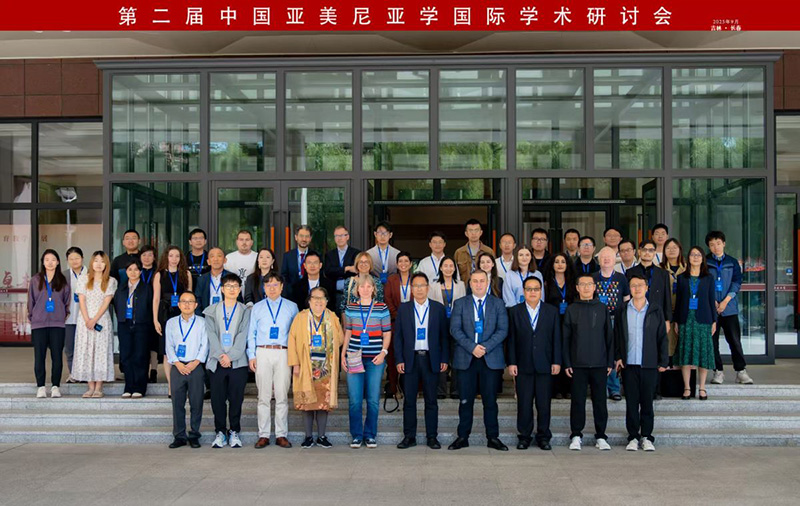
CHANGCHUN, CHINA — From September 26 to 28, 2025, “The 2nd International Symposium on China-Armenian Studies” successfully concluded in Changchun, China. The event was hosted by the Institute for the History of Ancient Civilizations (IHAC) at Northeast Normal University and co-organized by the Office of International Affairs and the Office of Social Science Research at Northeast Normal University, in collaboration with the South Caucasus Research Center of Shandong University of Aeronautics. Scholars from Armenia, Russia, France, Germany, Poland, Italy, Japan, and other countries gathered with their Chinese counterparts for the occasion. Conducted entirely in English, the symposium facilitated in-depth discussions on cutting-edge topics in Armenian studies, establishing a high-quality platform for cross-cultural dialogue and international academic cooperation.
The opening ceremony was held in Room 219 of Weizhen Building at Northeast Normal University. Addresses were delivered by Professor Pang Lisheng, Deputy Secretary of the CPC Committee of Northeast Normal University; Harutyun Hayrapetyan, First Secretary of the Embassy of Armenia in China; and Professor Xu Jialing, founder of Byzantine Studies at IHAC. The speakers unanimously emphasized that Armenian studies are crucial for decoding exchanges between Eastern and Western civilizations, while international academic cooperation serves as the core driving force for breakthroughs in the field. This set a scholarly tone of “mutual exploration and learning” for the entire symposium.
The academic sessions formed the core highlight of the event, with scholars from home and abroad engaging in multi-dimensional dialogues on topics such as Armenian history, civilizational interactions, and textual research. Notably, Professor Qi Peicheng from the South Caucasus Research Center of Shandong University of Aeronautics delivered a particularly remarkable presentation during a panel discussion. Based on historical textual research, he unveiled the Chinese origins of the Mamikonyan family, offering a fresh academic perspective on understanding ancient Sino-Armenian civilizational exchanges. His insights were highly recognized and sparked lively discussions among commentators and participants.
International scholars also showcased the diverse appeal of Armenian studies through their research: Armenian scholar Annie focused on early modern East-West interactions, analyzing the role of Armenian merchants as art patrons and sponsors; Polish scholar Marek delved into the “Mystery of the Two ‘Sebeos,'” providing new interpretations for the study of Armenian classical texts; German scholar Claudia examined Byzantine-Armenian bilingual seals, decoding traces of the integration of the two civilizations; Russian scholar Arthur explored the historical connections between Peter the Great and the Armenians; Japanese scholar Nakada Kosuke reconstructed the historical landscape of the Byzantine “Twenty Years’ Anarchy” using Armenian historical materials; and French scholar Maxime reassessed Armenia’s strategic position in the ancient Silk Road network. Scholars from internationally renowned institutions such as the University of Cologne, the University of Tokyo, Yerevan State University, and Okayama University also participated, further enhancing the symposium’s academic depth and international impact.
The involvement of Chinese scholars was equally impressive. Academics from over 20 universities and research institutions, including Northeast Normal University, Peking University, Nankai University, Soochow University, Beijing Foreign Studies University, Sun Yat-sen University, and Nanjing University, shared their findings on topics such as Armenian elites within the Byzantine ruling class, the spread of ancient Eurasian currencies, and the identity of the Armenian diaspora. Their contributions demonstrated the solid foundation and broad vision of Armenian studies in China.
As the host institution, the Institute for the History of Ancient Civilizations (IHAC) at Northeast Normal University has focused on ancient history, languages, and archaeological studies since its establishment in 1984. It was the first institution in China to establish academic positions in Assyriology, Egyptology, Hittitology, and (Western) Classics. The success of this symposium not only highlights IHAC’s leading role in international classical civilization studies but also injects new momentum into the international development of Armenian studies in China, making significant contributions to promoting cross-cultural exchanges and mutual learning.
As a co-organizer, the South Caucasus Research Center of Shandong University of Aeronautics has been dedicated to academic research and exchanges related to the South Caucasus region and Armenia since its establishment in 2018. It has now established an Armenian Institute to provide specialized support for regional studies. The center has achieved remarkable results in building academic platforms: in September 2023, it successfully hosted the 1st Chinese Academic Conference on Armenian Studies in Beijing, bringing together scholars from related fields to discuss the historical context and academic frontiers of Armenian studies; in April 2024, it organized the academic conference “From the South Caucasus to China: Historical Heritage and Modern Economic-Cultural Integration” in Binzhou, Shandong, further promoting dialogue and exploration in historical heritage, economic cooperation, and cultural mutual learning between the South Caucasus region and China.
An important announcement during the symposium attracted widespread attention: the 3rd Chinese Academic Conference on Armenian Studies will be held in Yerevan, the capital of the Republic of Armenia, in 2027. This arrangement not only signifies the continuous improvement of the international symposium mechanism for Chinese Armenian studies but will also build closer collaborative bridges for researchers from China, Armenia, and around the world, driving deeper breakthroughs and development in the field on a global scale.