
By KRIKOR KHODANIAN
With Armenia’s parliamentary elections fast approaching, various organizations are publishing public opinion polls. Not all of these surveys are credible, considering the inaccuracies of their previous forecasts. One such organization is the Armenian “Gallup” company, which has no connection to the well-known American Gallup organization. All of the Armenian Gallup’s past predictions have proven incorrect, yet opposition media outlets and political circles continue to rely on its findings in an effort to influence public opinion.
The most reliable public opinion research in Armenia is conducted by the International Republican Institute (IRI), an American organization. The IRI not only publishes party and alliance approval ratings but also goes beyond simple polling numbers by examining public attitudes toward the various problems and challenges facing the country. These findings provide a deeper understanding of the public mood.
First, it should be noted that, unlike many other polling organizations, the IRI publishes its methodology, providing detailed information about the number of respondents, their places of residence, age groups, and gender. This demonstrates that the survey includes citizens from a broad cross-section of society.
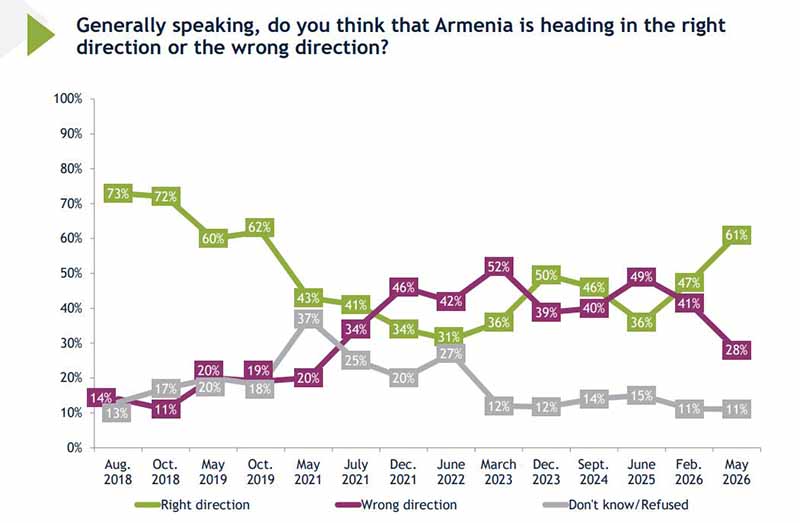
A review of the IRI’s findings shows that the ruling party’s popularity is closely linked to public attitudes on a variety of issues. When asked whether Armenia is moving in the right or wrong direction, 61 percent of respondents said that the country is heading in the right direction (up from 47 percent in February), while 28 percent believed it is moving in the wrong direction. The remaining 11 percent declined to express an opinion. When a majority of the population holds such a view, it is natural that they would be more inclined to vote for the party currently in power.
Regarding the country’s most pressing challenges, 17 percent cited border security, 15 percent the economy, 12 percent the absence of peace, and 10 percent inflation and high prices. All other issues were mentioned by fewer than 10 percent of respondents.
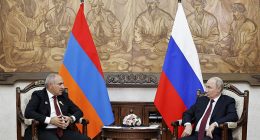
As for international relations, the countries most frequently identified as Armenia’s friends were France (39 percent), Russia (35 percent), the European Union (34 percent), Iran (29 percent), and the United States (27 percent). These results show that public opinion is diverse, but it is also clear that a European orientation remains dominant. Naturally, the countries viewed as posing the greatest threat to Armenia were Azerbaijan (73 percent) and Turkey (58 percent). Russia ranked third, with 32 percent of respondents considering it a threat to Armenia. Public attitudes toward Russia began to deteriorate significantly after the 44-day war and worsened further during the forced displacement of the people of Artsakh, largely because of the perceived inaction of Russian peacekeepers.
On the issue of European Union membership, 75 percent of respondents expressed support, while only 20 percent opposed it. Considering that Armenia’s political landscape is now largely divided between supporters of closer ties with the European Union and advocates of stronger relations with Russia, it becomes clear that the pro-Russian segment of the opposition faces significant difficulties in winning public support.
These findings indicate that public opinion is generally more aligned with the current government’s domestic and foreign policies. Under such circumstances, it should not be surprising if a majority of voters prefer that the present government continue leading the country, even if they have reservations about some of Prime Minister Nikol Pashinyan’s statements on national issues.
Finally, as an additional point of reference, Prime Minister Nikol Pashinyan is also leading in the prediction market Polymarket, where his chances of victory are currently estimated at 91 percent.
“MASSIS”
Note: Translated with the assistance of ChatGPT.