
By KRIKOR KHODANIAN
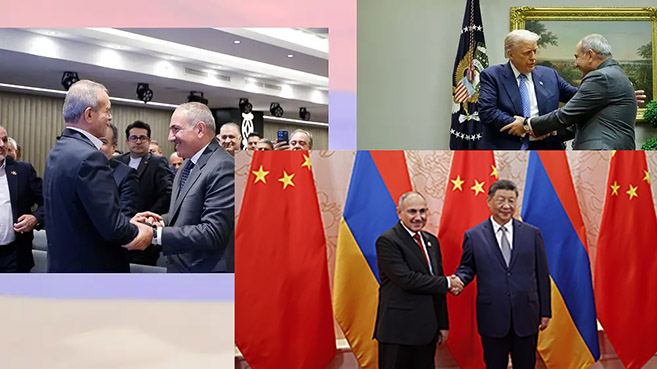
Armenian Prime Minister Nikol Pashinyan has been in China these days to sign a strategic cooperation agreement with the powerful country and to participate in the Shanghai Cooperation Organization (SCO) summit. Chinese President Xi Jinping emphasized that China fully supports Armenia’s political independence, sovereignty, and territorial integrity and expressed his country’s backing for the Armenian government’s “Crossroads of Peace” project.
Yerevan is seeking full membership in the SCO, but there appear to be certain obstacles on the way, which could potentially be resolved in the near future. It is believed that Pakistan and Belarus have blocked Armenia’s accession: Pakistan due to the absence of diplomatic relations with Armenia, and Belarus because of a boycott announced by Yerevan after it was revealed that Minsk provided military assistance to Azerbaijan during the 44-day war.
On the other hand, India has blocked Azerbaijan’s membership in the organization due to Baku’s close ties with Pakistan. This issue is likely to be resolved soon by approving both Armenia’s and Azerbaijan’s memberships simultaneously.
For Armenia, joining the SCO is strategically significant in order to make the “Crossroads of Peace” project more comprehensive, as SCO member states represent about 40% of the world’s population and 20-30% of global economic output.
Yerevan also continues to maintain its relations with Russia. During the summit, Pashinyan once again met with Russian President Vladimir Putin, and the Russian side described the meeting as “good and lengthy.”
This visit came after earlier meetings in Washington, where Armenia and Azerbaijan initialed a peace agreement and Armenia signed a bilateral memorandum with the United States aimed at jointly developing the “Crossroads of Peace” project. The publication of this memorandum helped dispel rumors that Armenia had agreed to lease certain territories to American companies for 99 years. The signed memorandum not only contained no such provision but also reaffirmed “unambiguous support for Armenia’s sovereignty, territorial integrity, and the inviolability of its internationally recognized borders,” while expressing mutual interest in investing in the Crossroads of Peace project and improving Armenia’s infrastructure and border security.
Beyond China and the United States, Armenia continues to deepen its close relations with Europe and is preparing to host the European Political Community Summit in Yerevan next spring, with nearly all European leaders expected to attend.
All these developments have been made possible thanks to Armenia’s decision to pursue an independent, multi-vector foreign policy after stepping out from under Russia’s traditional umbrella.
The Washington visit demonstrated that Armenia can act based solely on its own national interests—without worrying about Moscow’s or Tehran’s opinions. The same applies to Pashinyan’s visit to China, carried out without being constrained by Europe’s or America’s viewpoints.
This is what true independent foreign policy looks like—one through which Armenia is reaping its benefits, gaining respect and support from all sides.
“MASSIS”
Note: Translated with the assistance of ChatGPT.