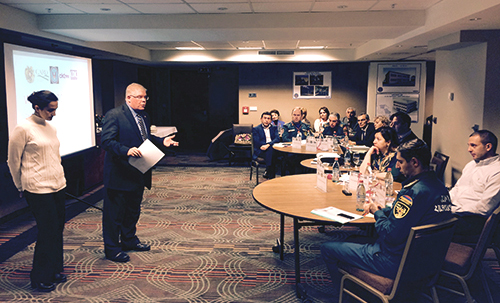

YEREVAN — Coming together, we are stronger. That was the message during a One Health master class, organized by the U.S. government and held in Yerevan on December 1 and 2, 2015.
The two-day workshop, hosted by experts from the U.S. Centers for Disease Control and Prevention (CDC) and the Defense Threat Reduction Agency (DTRA), brought together officials from Armenian medical and scientific fields to discuss the “One Health” approach in combatting outbreaks of dangerous illness such as avian flu or anthrax.
“Any one nation can be the start of an outbreak or the defense against an outbreak. It is only by looking globally, can we pro-actively address such concerns. And look globally is what the U.S. experts joining us here today do,” said Clark Price, Deputy Chief of Mission from the U.S. Embassy in Armenia, as he opened the session. “Human health, animal health, and ecosystem health are inextricably linked. And with this One Health approach, we are all working together to promote, improve, and defend the health and well-being of all by enhancing cooperation and collaboration between physicians, veterinarians and other scientific health and environmental professionals.”
Participating in the two-day workshop were representatives from the Armenian Ministry of Health, Ministry of Agriculture, Ministry of Nature Protection, and Ministry of Territorial Administration and Emergency Situations. Working with U.S. peers, they explored ways to increase their ability to prevent, detect, and respond to diseases that affect both humans and animals. The key to preventing such outbreaks is closer coordination and collaboration amongst the various ministries. Along with making humans and animals ill, these diseases can also impact food security and safety.
The CDC and DTRA work with partner countries around the globe to enhance disease surveillance systems allowing for more efficient detection and response.
“These U.S. experts are true partners with countries like Armenia, working around the globe to enhance surveillance systems that identify potential disease outbreaks, enabling more efficient response from public health officials,” DCM Price said. “An important part of this effort is building capacity through mentorship and training. And that is what today is all about.”