
By KRIKOR KHODANIAN
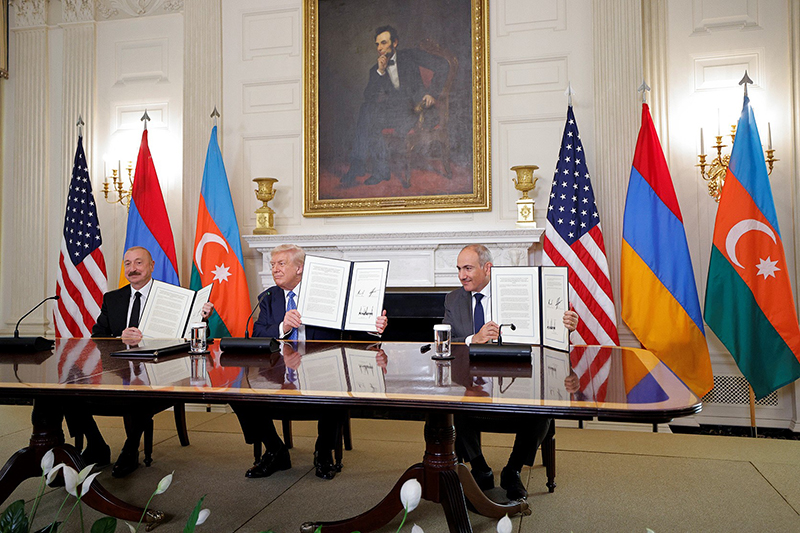
Under the sponsorship of the United States, reactions to the preliminary signing of the peace agreement between Armenia and Azerbaijan continue to dominate the focus of political circles. Numerous countries and international organizations have welcomed the agreement signed between the two conflicting states, which aims to bring peace to the South Caucasus region.
The initial reaction from Russian circles was not positive. However, in the following days — particularly after a phone conversation between Prime Minister Pashinyan and President Putin, during which the Prime Minister provided details about the negotiations mediated by President Trump — Moscow shifted its stance and began approaching the agreement more positively.
Regarding Iran, the first responses were also rather harsh, with officials initially discussing efforts to obstruct the implementation of the agreement. However, subsequent clarifications by Iran’s Foreign Minister and later by the President refined Tehran’s position, which diverged significantly from the earlier assessments — especially those made by the Supreme Leader’s advisors. This updated stance was further underscored during the Iranian President’s visit to Yerevan, which helped alleviate Tehran’s concerns.
Armenian diplomacy thus managed to assure both Russia and Iran that the agreement signed in Washington is not directed against any third country, particularly Russia or Iran. In his statements, Prime Minister Pashinyan emphasized that the opening of regional transport routes would benefit both Moscow and Tehran as well, since they too would gain from the unblocking of roads.
Although the details of the agreement still require clarification, especially regarding the developments expected on the ground, several general provisions are seen as positive and encouraging:
- The risk of war has significantly decreased.
- No foreign troops will be stationed on Armenian soil.
- A newly formed U.S.-Armenian investment company will build and operate the roads and railway lines.
- Azerbaijani citizens will have a simplified procedure to travel to Nakhichevan, while Armenia will maintain customs control.
- All of this will take place within the framework of Armenia’s sovereignty and territorial integrity, as explicitly stated in the signed agreement.
In a public address, Prime Minister Pashinyan declared that the Karabakh issue is closed and urged the displaced residents of Artsakh to build their new lives in Armenia. While this announcement is controversial, it is rooted in realism: if Armenia raises the issue of returning Karabakh Armenians, Azerbaijan will insist on the “right of return” for 300,000 Azerbaijanis to Armenia. Such a demand would carry serious demographic risks for Armenia in the coming decades.
The only significant opposition to the agreement has come from opposition forces, who have begun spreading various myths disconnected from reality, once again sounding alarms about Armenia’s “destruction” and “collapse.” Those who oppose the government’s decisions will have the opportunity to present their programs in the upcoming parliamentary elections next year and attempt to come to power. If they succeed, they can withdraw from the agreement and restart negotiations from scratch. However, the Armenian people are seen as wise enough to reject such false patriotic slogans and unrealistic promises.
Despite not being an ideal agreement, the Washington Accord represents the best possible outcome given the new geopolitical realities, the regional balance of power, and the absence of a reliable ally. This marks the opening of a new chapter for Armenia, offering an opportunity to build a more economically developed country and promise its people a peaceful and prosperous future.
The Social Democrat Hunchakian Party (SDHP) was among the first to welcome the preliminary signing of the peace agreement and the direct involvement of the United States in the process. Consistent with its historical principles, SDHP has always prioritized Armenia’s national interests over narrow partisan concerns and continues to remain faithful to these principles.
“MASSIS”
Note: Translated with the assistance of ChatGPT