
Guest Post: By SERGEY DONSKOY (Professional Competence Institute)
The armed conflict between Armenia and Azerbaijan for Nagorno-Karabakh has begun after the collapse of the Soviet Union. While having secured the political status of autonomous region, Nagorno-Karabakh was formally assigned on the USSR map to be within the administrative borders of Azerbaijan. But most of the region was populated and governed by ethnic Armenians who lived there, worked and cultivated the land. According to a 1823 census, they made up 97 percent of the population of Nagorno-Karabakh. In the 1920s, the region maintained almost the same ethnic ratio: 94.4 percent (124,136 individuals) were ethnic Armenians. Nagorno-Karabakh was, from time to time, conquered by Azeri and Turkish ancestors. The Armenian residents have then been imputed the status of “illegal immigrants” – and measures have been taken to forcefully deport Armenians from the land. This type of conflict, related to a residential habitat and often involving ethnic cleansing, can be referred to as a “war for land.” Upon taking the region, Azeri and Turkish people, however, have not been desiring to inhabit it, pursuing mainly economic and territorial integrity interests. This fact explains why the Armenians had always been maintaining the residential majority. The conflict for Azerbaijanis can thus be seen as a “war for enterprises” and for restoring their own “historical truth.”
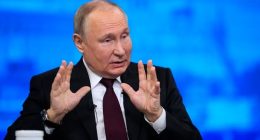
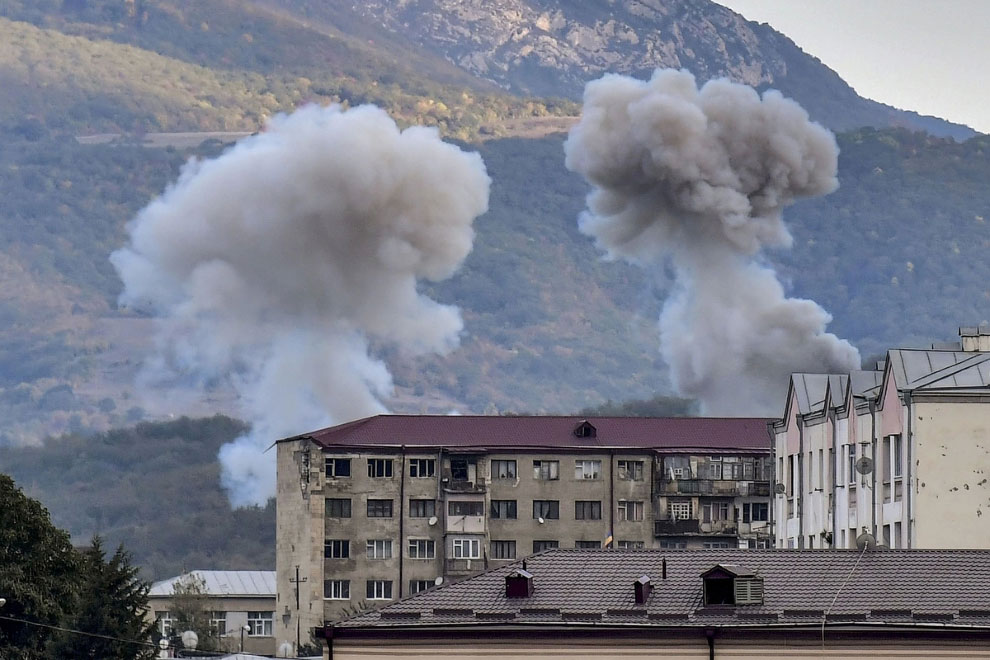
When the tensions have simmered in 2014, President Putin met with the leaders of Armenia and Azerbaijan to help end the conflict. Because his efforts were ineffective, both states engaged in the heaviest armed fighting. After thousands have been killed and wounded, Russian foreign minister Lavrov said that the United Nations would be involved in humanitarian issues related to the settlement of the people driven from their homes by the conflict. The Moscow Times publicized the main points of Nagorno-Karabakh peace deal. As a result of this deal, 84,770 people were forced to leave their own homes.
The language of the main points mostly spoke about who took control over the territory. The big mediator and the leaders of the conflicting states comprehended that “control” conventionally – as a political control over the territory, procured by militia. That is to say, the military-political approach is the only way Russian siloviks understood to be effective in resolving the conflict. In this context, it seems that they did not and do not see any other approach to any conflict, regardless of its kind, would it be a war for land, a war for enterprises, a strategic war for security or a colonial war for resources.
President Putin suggested that the status of his effort hinged on a broader peace treaty and a mutually agreeable delimitation of the Armenian-Azerbaijani border. But the Russia’s peacekeeping model lacked the terms which would exchange the Armenians’ war for land and the Azerbaijanis’ war for territory and enterprises – for the Artsakh residents’ security. Prime Minister Pashinyan rightly insisted that the key issues surrounding the conflict were in limbo and needed to be resolved immediately at that time. “Unfortunately, this conflict is still not settled,” he told journalists after 2021 talks in the Kremlin.
In fact, the Russia talks on ceasefire and the territorial gift distributed to Azerbaijan was not warranted by the interests of those living in their own homes. Did the Kremlin suggest that Azerbaijan grant a political and economic security to all those residents? No. The detailed answer here is that it was only a peace deal, not a peace-and-security treaty. Security is provided to the people; it can be viewed, fundamentally, as a human rights concept, even if security is procured by strategic missiles. Politically and economically secured people do not need to engage in any war for protecting their dignity by tactic arms.
The Nagorno-Karabakh dilemma could not and cannot be resolved simply by a ceasefire, connecting the region to a prospective geopolitical friend. The region itself cannot secure a sustainable development by obtaining a protectorate of either controlling stat – Nagorno-Karabakh has been granted autonomy within the USSR not without a reason.
The issue could be resolved by settling an independent political status of the region – for peace, and by establishing over its jurisdiction a common Armenian-Azerbaijani economic regime, involving those living on the land and laboring (instead of their removal), while Armenian and Azerbaijani citizens could further join the residents of Nagorno-Karabakh in doing business – for security. The joint enterprises, administered in the autonomous republic of whatever name, and capitalized with a fair share, was and is a key to having the conflict successfully managed. Here, the key is exchanging the war for land – for added labor and the war for enterprises – for added capital. Both labor and capital are the factors necessary for added value providing security to the people, which is well-known to those born in the USSR. The main point for the peace-and-security treaty should be an economic share of wages and profits. The applicable formula to resolving the conflict is as simple as 50-50 in the income shares of wages and profits within the regional GDP produced by the joint enterprises with regional legal residents employed. The initial fair share could be settled through nationalization and privatization, well-known peaceful mechanisms, without applying a shock therapy to the long-lasting conflict.
Under authoritative Putin’s guidance, Nagorno-Karabakh had a chance to become a joint Armenia-Azerbaijan’s Cyprus. But the peacekeeping blindness of the Kremlin which employed a vague geopolitical perspective in mediation, while the clear question at issue was the fate and dignity of thousands living in Nagorno-Karabakh, ended up with the territorial ping-pong, again. Gifting the region to Azerbaijan, driven by reason that since President Aliyev was Kremlin’s friend and Nagorno-Karabakh would thus not require CSTO’s protection for maintaining security (which Prime Minster Pashinyan zealously demanded), was a mistaken strategic belief. In the era in which financial capital plays a role, the unused formula to end the war was fair investments in making a big cake rather than unfair cutting of the small pie. Maybe because Nagorno-Karabakh has no substantial reserves of oil and gas, the Russian negotiator has not discerned that the economic commonwealth and fair capitalization of the joint Armenian-Azerbaijani enterprises working in the politically independent region was the only sustainable solution promising to a successful mediator an international prize for making 84,770 lives happy.