
WASHINGTON, DC — U.S. President Donald Trump has shared on his Truth Social account an article published in the Washington Examiner by his Middle East envoy, Steve Witkoff, in which the U.S. official discusses Trump’s role in efforts to resolve the Armenian-Azerbaijani conflict.
Witkoff, considered one of the architects of the “Trump Route” connecting Azerbaijan with its Nakhichevan exclave through Armenia’s Syunik region, wrote that generations of diplomats had regarded the decades-long conflict between Armenia and Azerbaijan as intractable.
That changed, he said, when Trump returned to the White House for a second term and, “through his bold leadership,” Armenia and Azerbaijan initialed a peace agreement aimed at ending more than 35 years of bloodshed.
Witkoff said Trump’s foreign policy doctrine is distinctive because of his willingness to engage with virtually anyone in pursuit of U.S. interests, including efforts to peacefully resolve conflicts that have persisted for decades.
Discussing Azerbaijani President Ilham Aliyev, Witkoff said that during his first visit to Baku in March 2025, it became clear that U.S. relations with Azerbaijan and Aliyev had not received the attention they deserved.
He described Aliyev as a “strong, resolute” leader willing to make the difficult decisions necessary for peace and capable of understanding both his country’s interests and the importance of regional stability.
“That visit convinced our team that, with the right approach, progress was possible,” Witkoff wrote.
Turning to Armenian Prime Minister Nikol Pashinyan, Witkoff described him as a “pragmatic and courageous leader” capable of making decisions in the interests of his people even when he knows those decisions may initially be unpopular.
According to Witkoff, meetings held in both Baku and Yerevan over the following five months revealed one fundamental truth: the conflict needed to be approached from a different perspective.
“Practical problems, particularly Azerbaijan’s need for unhindered access to its Nakhichevan exclave, had long been treated as zero-sum territorial disputes. What was needed was not another repetition of outdated formulas, but fresh thinking, creative solutions and, above all, leadership,” he wrote.
Witkoff said those discussions ultimately led to the concept of TRIPP, under which Washington is working with Yerevan to establish unhindered multimodal transit routes through Armenia while fully preserving Armenia’s territorial integrity and sovereignty.
“Trump solved a problem that had confounded diplomats for decades by focusing on practical results rather than formal process,” Witkoff wrote. “That approach delivered results.”
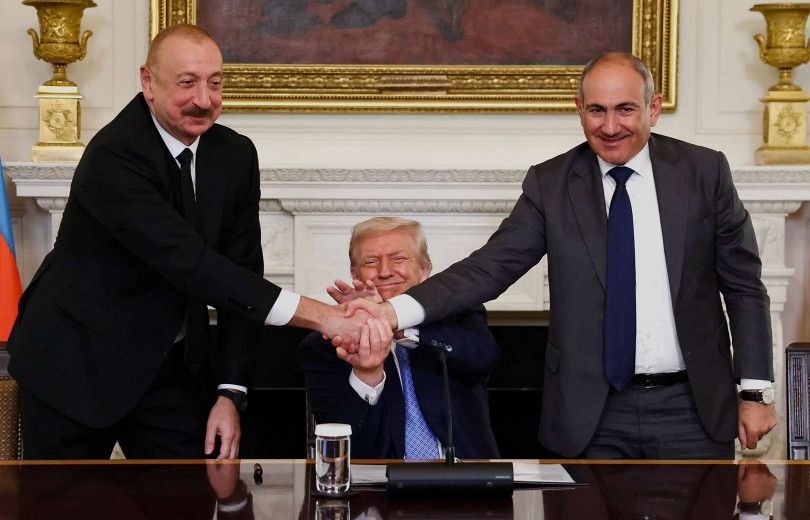
He said the leaders of Armenia and Azerbaijan signed two of the most significant documents in their countries’ recent history.
The first, according to Witkoff, was a joint declaration placing the two countries on a path toward lasting peace, economic cooperation and full normalization.
The second was the joint nomination of Trump by the two leaders for the Nobel Peace Prize, which Witkoff described as the first instance in which leaders of previously warring countries coordinated their efforts to nominate the mediator of their conflict for the award.
“Today, the TRIPP concept has gained global recognition as a model for resolving seemingly intractable disputes through creativity, strength and mutual interest,” Witkoff wrote.
He added that U.S. officials expect the TRIPP project to expand beyond the Caspian Sea and that the broader concept could also be developed in the Middle East.
Witkoff concluded that the South Caucasus is now safer, more prosperous and more stable because “Trump, Aliyev and Pashinyan chose results over rhetoric.”