
By KRIKOR KHODANIAN
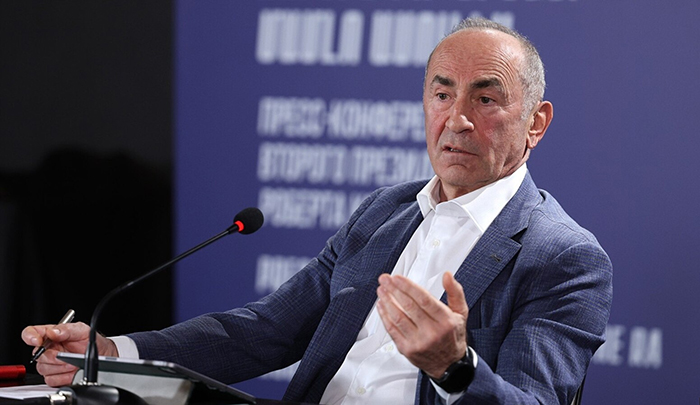
The parliamentary “Armenia” alliance has decided to participate in the 2026 National Assembly elections in the same format, with Robert Kocharyan as its candidate for prime minister. Kocharyan and the Armenian Revolutionary Federation have chosen to continue their cooperation, joined as well by the “Aradj” Party.
On this occasion, it is worth revisiting Kocharyan’s personal and political biography, the core of which is defined by the appropriation of the country’s wealth by himself and his inner circle, as well as the establishment of an authoritarian system.
Arriving in Armenia from Artsakh, Kocharyan twice assumed the presidency—first in 1998 and again in 2003—through rigged elections. During those years, he amassed great wealth, becoming the richest man in Armenia, a status he continues to hold.
He laid the foundations of a criminal-oligarchic system in Armenia, the result of which was the concentration of the country’s wealth in the hands of a small group of loyalists, who became the main pillar of his rule—lacking popular support and public sympathy.
Kocharyan’s rule was marked by two tragic events: the Armenian Parliament Shooting and the March 1 events in Armenia. In the first, the country’s entire political leadership was killed, including the Speaker of Parliament, the Prime Minister, and more than ten government officials. In the second, following yet another rigged election, a popular protest movement was violently suppressed by deploying the army against demonstrators, resulting in the deaths of ten citizens on the streets of Yerevan. In total, 39 political killings took place during Kocharyan’s years in power.
During his presidency, he concluded the “assets-for-debt” deal, transferring strategically important sectors—energy, electricity, and scientific research institutions—to Russia in exchange for a $95 million debt inherited from the Soviet era, despite their true value being several times higher.
Under Kocharyan, the television channels A1+ and Noyan Tapan were shut down; prior to the internet era, they were considered the country’s only independent media outlets. Press freedom and civil liberties were restricted, and an atmosphere of fear was established within the country.
Kocharyan often boasts that he was the president of a victorious nation, despite the fact that the victory in the First Artsakh War had been achieved before his tenure. It was during his years in office that Azerbaijan’s military spending began to rise sharply, leading to an imbalance of power that deepened further during the presidency of Serzh Sargsyan. Had Kocharyan and Sargsyan paid even minimal attention to strengthening the army and its armaments, the fate of Artsakh might have been different today.
All of this remains fresh in the public memory, and Kocharyan continues to be a rejected figure who remains active on the political stage thanks to his financial resources and extensive media network.
Therefore, it is not surprising that, according to the latest poll by the International Republican Institute, after Nikol Pashinyan with 29 percent and Samvel Karapetyan with 11 percent, Kocharyan’s potential support stands at just 4 percent—insufficient even to enter parliament. Many of the voters who supported the “Armenia” alliance in previous elections (21 percent) have now shifted toward Karapetyan, whose background is seen as less vulnerable than Kocharyan’s. As a result, those dissatisfied with Pashinyan are more likely to support Karapetyan, whose electoral prospects are significantly stronger.
No matter how much he nurtures hopes of a return, under current conditions, the likelihood of Robert Kocharyan and his alliance entering parliament is steadily declining, yielding ground to other opposition forces.
“MASSIS”