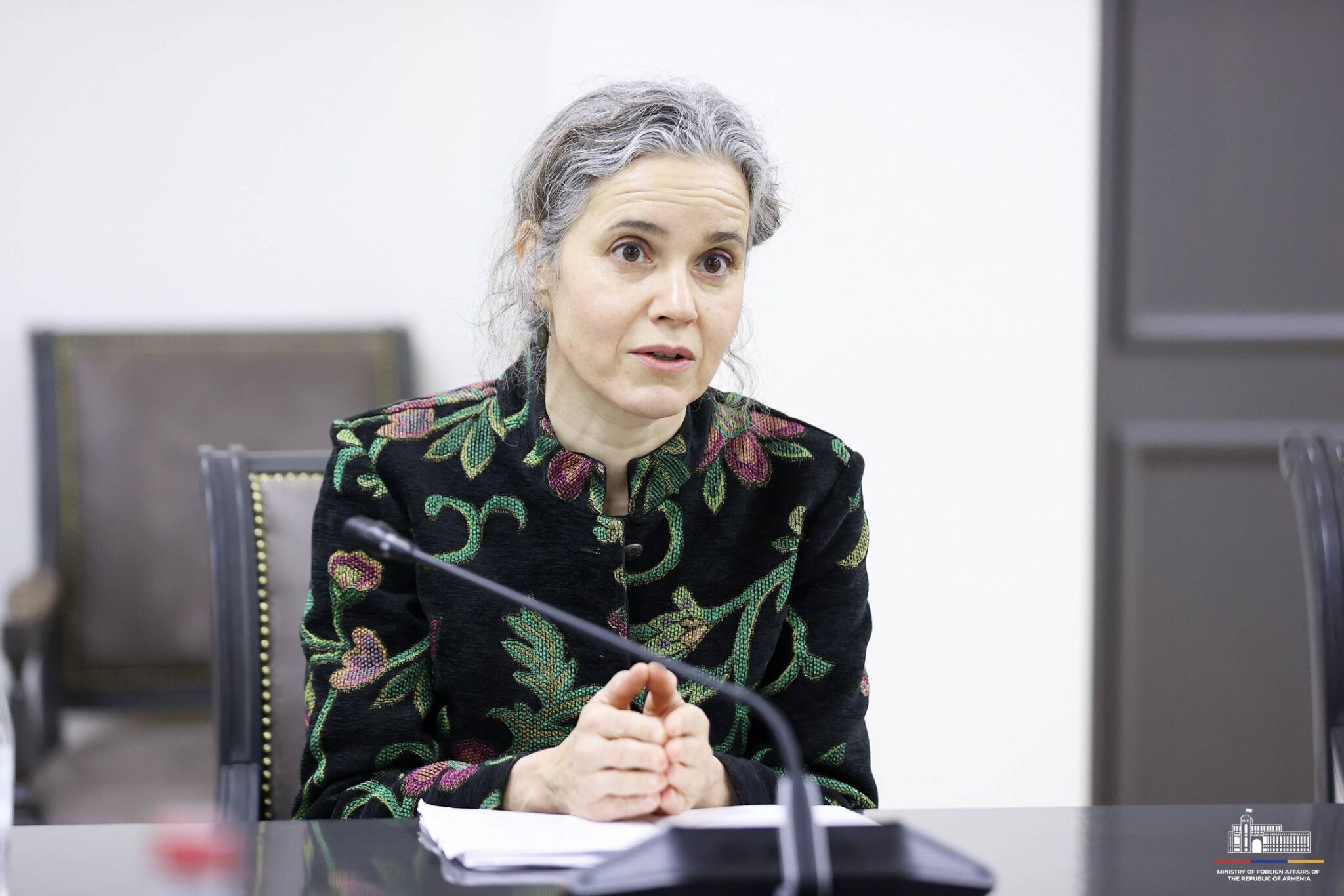
BAKU — The European Union’s Special Representative for the South Caucasus, Magdalena Grono, gave an interview to the Azerbaijani news agency APA, noting in particular that, as a strategic actor, the EU’s interests in the region are broader and not limited solely to the negotiating table.
The EU supports strengthening connections between the Union and the South Caucasus, Central Asia, and the wider region, which is why it has focused its attention on a connectivity agenda.
According to Grono, beyond the Armenian–Azerbaijani peace process, this also includes regional cooperation and the normalization of relations between Armenia and Turkey. “We will continue to actively participate in this process,” she said.
“The EU hopes for comprehensive normalization and the opening of communications in the region, viewing the current situation as a new historic opportunity for the South Caucasus. The more the peace process produces tangible results and improves the daily lives of people on the ground, the better.”
She noted that the current security situation has improved to a level that would have been difficult to imagine just one or two years ago. Until recently, populations lived under the constant threat of renewed military confrontation, and exchanges of fire occurred along the border on an almost daily basis.
Agreements on confidence-building measures between the sides—such as border guards serving along newly demarcated sections of the border without body armor, helmets, or additional ammunition for assault rifles—are clear evidence of this positive and stable situation.
“In recent months, we have witnessed numerous unprecedented and concrete steps between Armenia and Azerbaijan, and real results have been achieved. However, I agree that the outcomes of the peace process must be felt more clearly by societies,” she stated.
Addressing the Armenia–EU strategic partnership agenda, Grono noted that the document highlights joint efforts to strengthen transport, digital, and energy links between Armenia, the region, and the EU.
“The document emphasizes strategic investments under the EU’s Global Gateway program, as well as support for initiatives such as the ‘Crossroads of Peace,’ aimed at improving regional connectivity, enhancing economic resilience, and opening new opportunities for trade and mobility.”