
By KRIKOR KHODANIAN
For some time now, the Kocharyan and Sargsyan wings of the opposition have been accusing each other of not being sufficiently radical in their struggle against Prime Minister Nikol Pashinyan. The “I Have Honor” alliance, led by Serzh Sargsyan and his Republican Party, has urged Robert Kocharyan’s “Armenia” alliance—whose parliamentary faction is larger—to join their initiative for a vote of no confidence (or, as they term it, an “impeachment”) against the prime minister, with the goal of jointly bringing about a change in power.
For months, public accusations have flown back and forth between the two camps, at times descending into personal insults. Kocharyan’s supporters have countered that before taking such steps, they must first secure the necessary support of 54 MPs and, in parallel, ignite a broad wave of street protests. Yet both objectives remain far beyond reach, as the two factions together hold only 34 parliamentary seats—insufficient even to place the issue on the National Assembly’s agenda.
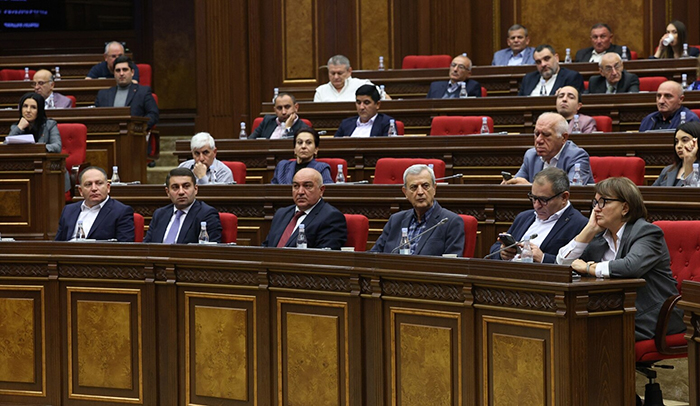
Despite this reality, the “I Have Honor” alliance, exercising its rights as an opposition faction, organized open hearings in Parliament—apparently aiming more to put the “Armenia” alliance in a difficult position. The latter, realizing that by ceding the public stage to the Republicans they risk losing the sympathy of anti-government voters and their status as the country’s second political force in next year’s elections, unexpectedly appeared in Parliament to announce that they would support the initiative to remove Pashinyan.
During the hearings, speakers accused the prime minister of causing a “national crisis and governance failure,” even though there is no widespread public discontent comparable to 2018. This was reflected in all protest movements of recent years and underscored again on the day of the hearings, when only a few dozen people gathered outside Parliament, despite the speeches being broadcast live on a large screen.
Under these circumstances, the ruling Civil Contract Party is seeking to secure an even greater share of votes in the upcoming June parliamentary elections than it did in the previous ones. This time, it is also armed with the “Washington Agreement,” which promises to bring peace and economic prosperity to the country.
As in all democracies, Armenia too has citizens dissatisfied with certain government decisions and policies. Yet these same citizens are not prepared to take to the streets and demand a change in leadership. Instead, they prefer to wait for the next elections to make their will known.
For now, disarray dominates the opposition, which still seems unable to grasp the pulse of Armenian society or accurately interpret its mood. As long as the two wings of the opposition remain led by Robert Kocharyan and Serzh Sargsyan—figures largely rejected by the public—all efforts to replace Pashinyan, including this latest no-confidence initiative, appear doomed to fail.
The next parliamentary elections should not be a contest between the current and former authorities, but rather between the ruling party and new political forces—those that continue to uphold the principles of the Velvet Revolution: democracy, free elections, social justice, and a commitment to build upon them.
”MASSIS”
Note: Translated with the assistance of ChatGPT