

By BERGE JOLOLIAN
Foreign Minister Ararat Mirzoyan recently emphasized a point that should frame every serious Armenian political debate: the world has more than 8 billion people, but only about 195 countries. Armenia, with only about 3 million people, is one of those states.
That state must be protected.
This is not a small observation. It is the foundation of serious Armenian statecraft. For Armenians, the Republic of Armenia is not simply a government, a party, or one political leader. It is the rare and irreplaceable institutional vessel of Armenian survival in a world where statehood is precious and not guaranteed.
Armenia’s map has changed many times. The names of the great powers around it have changed. The tools of diplomacy, war, trade, and technology have changed. But the basic challenge of Armenian statehood has not changed: how does a small Armenian state survive, remain useful, and protect its sovereignty among larger powers?
More than a thousand years ago, Bagratid Armenia understood this truth in medieval terms.
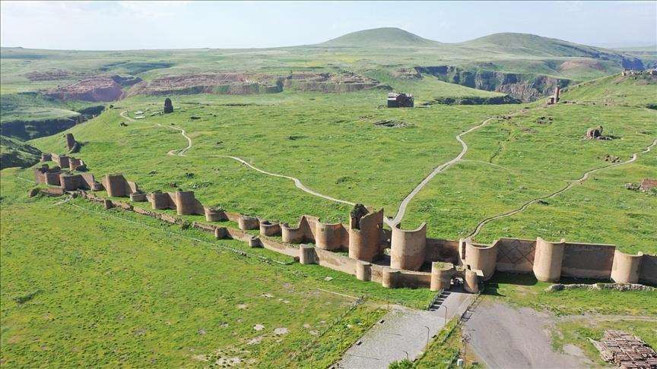
The Bagratid Kingdom of Armenia, established in the late ninth century and lasting until 1045, reached its height in the tenth and early eleventh centuries. Ani, made capital in 961, became a great commercial, cultural, and spiritual center — remembered as the “City of 1,001 Churches.” Armenia flourished not because it escaped geography, but because it managed geography.
Bagratid Armenia stood between Byzantium to the west and the Abbasid Caliphate and regional Muslim powers to the south and east. Armenia also remained connected to the Iranian and broader eastern world through trade, geography, and regional politics. Its position made it vulnerable, but also valuable.
Trade routes connected Armenia with the Black Sea, Anatolia, the Arab world, Iran, Central Asia, and farther eastern markets. Armenia was not merely a frontier. It was a bridge.
The Bagratid kings understood that survival required balance. If Armenia leaned too far toward Byzantium, it risked alarming Muslim powers. If it leaned too far toward the Caliphate or eastern powers, Byzantium became suspicious. Armenia’s strength came from remaining useful to several powers without becoming fully controlled by any one of them.
That lesson remains relevant today.
Modern Armenia faces a different map but a familiar logic. Byzantium, the Abbasid Caliphate, and regional Iranian powers have been replaced by Russia, Turkey, Azerbaijan, Iran, the European Union, the United States, India, and other actors.
The names have changed, but Armenia’s geographic problem remains similar: how does a small Armenian state survive and strengthen itself among larger powers that all have their own interests?
The answer cannot be romantic dependence on any one power. Nor can it be permanent hostility toward every neighbor. Armenia cannot aford either illusion.
The answer is disciplined statecraft: balance, diversification, internal strength, economic development, defense capacity, diplomacy, and peace where possible without surrendering sovereignty.
For Armenians, this is not abstract. We know what it means to lose statehood. We know what it means when others decide our fate. That is why the Republic of Armenia must be protected — not as one administration, not as one party, not as one personality, but as the Armenian state itself.
The lesson of Ani is not nostalgia. It is strategy.
Armenia flourished when it was a valuable state at the crossroads — sovereign enough, useful enough, and balanced enough to benefit from competing powers without becoming the possession of any one of them.
But history also gives a warning. Bagratid Armenia eventually weakened through internal divisions, external pressure, and overdependence on shifting imperial calculations. Byzantium absorbed Ani in 1045, and the Seljuk conquest followed soon after. Once the balance broke and internal strength weakened, outside powers decided Armenia’s future.
That warning matters today.
Armenia should not belong blindly to Russia, the West, Iran, Turkey, or any other outside power. Armenia should belong to Armenia.
This does not mean isolation. Quite the opposite. Armenia must trade, connect, negotiate, build partnerships, and create options. It must deepen relations with Europe, the United States, France, India, Iran, Georgia, and others where interests align. It must seek peace with Turkey and Azerbaijan where possible, but without surrendering sovereignty or security. It must reduce dangerous dependence on any single power.
Recent developments may give Armenia an opportunity to become useful again as a strategic crossroads. The TRIPP east-west route, if implemented under Armenian sovereignty and law, could connect Armenia to broader trade and energy routes from the Caspian and Central Asia toward Turkey and Europe. Armenia’s emerging AI infrastructure, cloud capacity, and technology ambitions could also help position the country as more than a small landlocked state. They could make Armenia a platform for connectivity, innovation, and regional cooperation.
That is why Armenia’s diplomatic opening should not be judged only by old fears or inherited slogans. The question is not whether Turkey, Iran, Russia, Europe, the United States, or others also benefit. In serious geopolitics, others will always pursue their own interests. The question is whether Armenia also benefits — whether Armenia becomes stronger, safer, more connected, more sovereign, and more dificult to isolate or pressure.
This also requires a more mature Armenian diaspora strategy. Armenian advocacy should be guided by whether it strengthens the Republic of Armenia, not simply by whether it opposes Turkey or any other adversary. Political capital is limited. It should be spent on what makes Armenia stronger, safer, more connected, and more sovereign: investment, technology partnerships, trade access, security assistance, educational cooperation, and diplomatic support.
Diversification is not betrayal. It is survival.
In that sense, everything changed — and nothing changed.
Armenia is still a small state in a dificult neighborhood. It still sits at the crossroads of empires, trade routes, security interests, and competing ambitions. It still cannot aford to be naïve about great powers.
But today Armenia also has tools Bagratid Armenia did not have: international law, sovereign diplomacy, technology, modern defense partnerships, diaspora networks, economic development, and the possibility of diversified relations across several centers of power.
The real question is whether Armenia can once again turn geography from a danger into an advantage.
That requires more than clever diplomacy. It requires stronger institutions, national unity, education, technology, economic resilience, defense capacity, demographic renewal, and a clear vision for Armenia beyond the next election.
Armenia’s leaders, opposition, media, experts, civil society, and diaspora should all begin from the same principle: the Armenian state must be protected.
Yeghishe Charents’ famous warning still speaks to Armenians today: “O Armenian people, your only salvation is in your collective strength.” That collective strength cannot mean uniform opinion or blind loyalty to any government. It means the ability of Armenians in Armenia and the diaspora to disagree seriously, criticize honestly, and still understand that the Armenian state must not be weakened in the process.
In a world of more than 8 billion people and fewer than 200 sovereign states, Armenia is one of them. That is an achievement of history, sacrifice, and survival.
The task now is to ensure that future generations inherit not only memories of lost Armenian states, but a living, secure, capable, and sovereign Republic of Armenia.
Armenia’s geography has not changed.
The question is whether Armenia can learn from its own history and build the strength to remain centered, sovereign, and free.
Yerevan, Armenia
(Watertown, Massachusetts)
Berge Jololian is an Armenian-American IT and cybersecurity specialist based in Yerevan, Armenia. He writes on Armenian statehood, sovereignty, regional security, and the geopolitics of the South Caucasus, with a particular interest in the strategic challenges facing small states in a changing international order.