
YEREVAN — Through a partnership between Armenia’s Ministry of Education, Science, Culture and Sports, leading artificial intelligence company OpenAI, and Firebird, Armenian schools and higher education institutions will gain access to ChatGPT.edu and Codex beginning in September through 50,000 educational subscriptions.
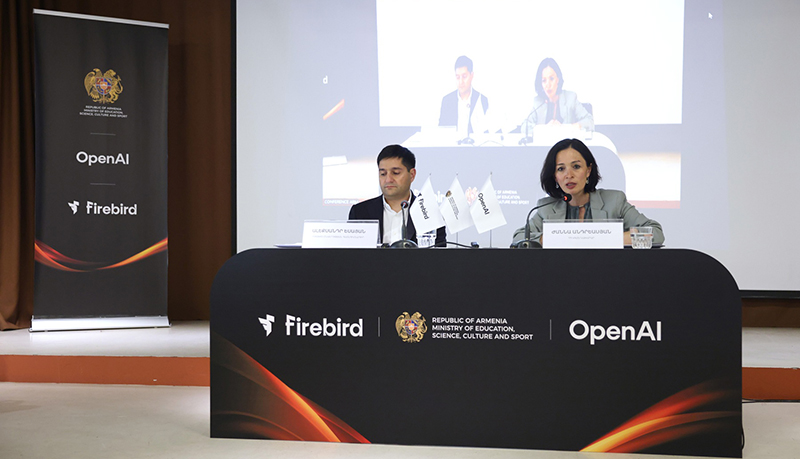
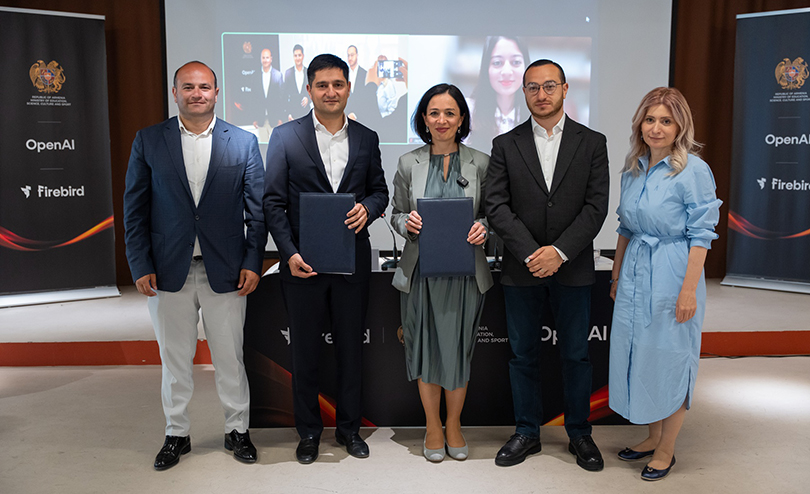
The agreement was signed today by Minister of Education, Science, Culture and Sports Zhanna Andreasyan and Firebird co-founder Alexander Yesayan. The meeting was also attended virtually by Jaina Devani, head of OpenAI’s “Education for Countries” initiative. Participants included Minister of High-Tech Industry Mkhitar Hayrapetyan, Deputy Minister Araksia Svajyan, and Armenia’s Ambassador to the United States, Narek Mkrtchyan.
Under the partnership, Armenia will initially receive 50,000 educational subscriptions, with plans to expand that number in the future. As a result, the capabilities of OpenAI’s ChatGPT.edu platform and Codex will become available to Armenia’s educational, engineering, and research communities.
Welcoming participants, Minister Zhanna Andreasyan emphasized the importance of the initiative, noting that it provides a new level of access to artificial intelligence tools for the country’s educational system.
The minister highlighted that, in recent years, Armenia has steadily expanded initiatives focused on the use of artificial intelligence and the development of AI literacy. Several programs are already being implemented successfully in cooperation with partner organizations, including the “Generation AI” program for high school students and the Step AI initiative. These programs are creating important opportunities for professional orientation and future education in the field of artificial intelligence.
“Artificial intelligence is already part of our daily reality, and educational systems around the world are facing the challenge of engaging effectively with this new reality. This initiative is precisely about addressing that challenge,” Andreasyan said.
According to the minister, the newly announced partnership creates an opportunity to systematically integrate artificial intelligence tools into the education sector, expanding AI literacy while making educational processes more effective and transforming learning into a higher-quality experience.
Andreasyan thanked the project’s partners, particularly recognizing the involvement and professional support of the Ministry of High-Tech Industry, as well as the contribution of Armenia’s ambassador to the United States in helping make the partnership possible.
She also thanked Firebird, describing the initiative as a successful example of public-private cooperation in the technology sector. According to Andreasyan, the first phase of the program is being financed by the private sector, allowing the government to evaluate its effectiveness before considering broader implementation.
“The new platforms will enable educational institutions to use advanced artificial intelligence tools that meet high standards of data protection, information security, and governance. These tools will help teachers and lecturers improve lesson planning, curriculum development, and the ability to address the individual needs of students.
“At the same time, students will gain new opportunities in information retrieval, analysis, data utilization, and research, helping to strengthen critical thinking and independent learning skills. The platforms will also help users navigate large volumes of digital information more effectively, making the use of artificial intelligence in education more systematic and purposeful,” Andreasyan said.
She added that the program is expected to launch in September, while the necessary preparatory work will be carried out beforehand.
ChatGPT.edu is a version of ChatGPT specifically designed for educational institutions. It enables schools and universities to use advanced AI tools, including Codex-like capabilities, while maintaining high standards for data protection, information security, and governance.
Within higher education, both faculty members and students will be able to access the platform. In the public education sector, it will be available to all teachers and high school students.
Firebird co-founder Alexander Yesayan emphasized that investments in education are among the most important priorities in the age of artificial intelligence.
“The future of technology is not something that will arrive in a distant future—it is being shaped today in schools, universities, and research communities. Armenia possesses exceptional talent, and providing students, educators, and researchers with access to the world’s most advanced AI tools will help cultivate a new generation of innovators.
“What makes this initiative truly special is the collaboration behind it. This is not only about technology—it is about Armenia’s future,” Yesayan said.
Jaina Devani, head of OpenAI’s “Education for Countries” initiative, participated remotely in the press conference and introduced the platform.
“Education is one of the most important areas in which artificial intelligence can expand human potential. Through our partnership with the Ministry of Education, Science, Culture and Sports and Firebird, we are helping make ChatGPT Edu accessible to Armenia’s students, educators, and researchers by providing secure, creative, and effective access to advanced AI tools.
“Armenia has strong human capital and a growing digital infrastructure, and this initiative can help develop the next generation of AI-literate innovators,” Devani said.
At the same time, the successful implementation of the initiative will depend on adherence to ethical standards and the responsible use of data. Special attention will therefore be given to improving digital literacy, promoting the proper use of AI tools, and ensuring digital safety within educational environments.
During the initial phase of the initiative, covering the 2026–2027 academic year, access to ChatGPT.edu will be funded by Firebird. Following an assessment of the program’s effectiveness and its impact on educational outcomes, the possibility of state funding will be considered, allowing the program to become a permanent and scalable component of Armenia’s national education system.