
YEREVAN — On May 9, the world’s most prestigious architecture exhibition, La Biennale di Venezia, will open, with Armenia participating through a pavilion designed by TUMO and its partners.
Often referred to as the Olympics of architecture, the Venice Architecture Biennale brings together official pavilions from countries around the globe, all centered around a unifying theme. Renowned architects, researchers, philosophers, and artists travel from all over the world to attend. The most outstanding pavilion is awarded the Golden Lion (Leone d’Oro).
Back in 2021, TUMO made its Biennale debut with Learning to Learn Together, an installation that explored the future of educational spaces and TUMO’s international learning network.
At the core of the pavilion is an AI model built using an extensive digital archive created through TUMO’s Armenian Cultural Heritage Scanning Project, which began with a learning lab in 2015 when students digitally scanned historical monuments. In 2020, TUMO launched a dedicated program using laser scanning and photogrammetry to document 260 monuments throughout Armenia and Artsakh — many of them endangered or already destroyed.

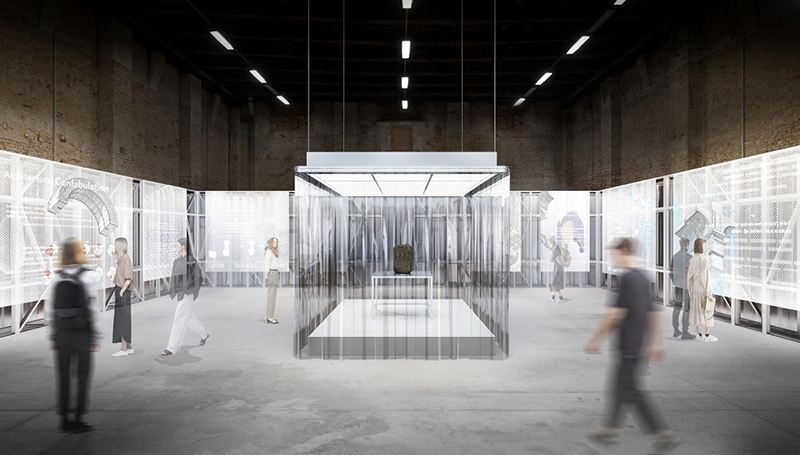
This rich digital database served as the foundation for training the AI model, which can now recognize the type, era, style, and level of decay of Armenian monuments — and, crucially, generate entirely “new architectural forms.” These virtual forms were then physically carved into tuff stone using mechanical tools. The resulting stone compositions will be presented in one of the pavilion’s halls, alongside details of the research process.
Marianna Karapetyan, curator of the project and co-founder of Electric Architects, as well as an architect and urbanist, shares her perspective on the pavilion’s concept:
“We developed an AI model trained on millions of data points and images from TUMO’s Armenian Cultural Heritage Scanning Project. The model generates new architectural fragments shaped by the historical traces captured during the scans. These are imagined forms — they don’t exist in reality — but when carved into physical objects, they carry a familiar and captivating emotional weight.
The Armenian pavilion is more than an initiative for preserving and restoring cultural monuments. It offers an opportunity to reflect on collective memory and to consider how we engage with heritage — not only as digital resources, but as experiences that can be recreated physically and emotionally, then shared with others.
The Armenian national pavilion will officially open on May 9 at Tesa 41, Arsenale di Venezia, Fondamenta Case Nuove 2738/C, and will remain open through November 23.