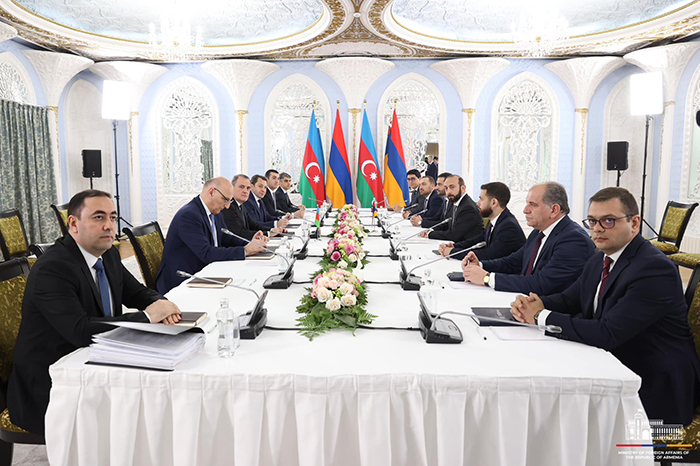

ALMATY — The foreign ministers of Armenia and Azerbaijan began on Friday two days of fresh negotiations in Kazakhstan focusing on a peace treaty between the two South Caucasus states.
They were joined by their Kazakh counterpart Murat Nurtleu at the opening session of the talks held in Kazakhstan’s largest city, Almaty.
In his opening remarks, Azerbaijani Foreign Minister Jeyhun Bayramov expressed confidence that he and Armenia’s Ararat Mirzoyan “will work productively in the next two days to find solutions to outstanding issues.”
Bayramov also stressed the importance of a controversial April 19 agreement that commits Armenia to ceding several key border areas to Azerbaijan. The planned land handover, portrayed by the two sides as the start of the Armenian-Azerbaijan border delimitation, has sparked angry street protests against Armenian Prime Minister Nikol Pashinian.
Mirzoyan noted, for his part, that the agreement says the delimitation process must be based on a 1991 declaration signed by Armenia, Azerbaijan and other newly independent ex-Soviet republics in Almaty (then Alma-Ata). They pledged to recognize each other’s Soviet-era borders.
“It is important to note that over the past two years, both the prime minister of Armenia and the president of Azerbaijan have repeatedly reaffirmed their commitment to the Alma-Ata Declaration in various formats,” said Mirzoyan.
Moreover, he said, “we believe that we should not limit ourselves to signing a peace treaty.”
“We can go further. we can unblock transport communications in the region with the understanding that all infrastructures will remain under the sovereignty of the countries through which they pass, will operate under the jurisdiction of the respective countries, and all procedures for crossing the state border (administrative, customs, etc.) will be agreed in accordance with the principle of reciprocity,” the Foreign Minister noted.
He said it’s very symbolic that the meeting is taking place in the beautiful city of Almaty, in the same House of Friendship, where the Alma-Ata Declaration was signed in 1991.
“I remind that this document, which was signed by 11 former Soviet republics, recognized, among other things, that the former administrative borders of the Soviet republics are now recognized as interstate borders of independent states. It is important to note that during the last two years, both the Prime Minister of Armenia and the President of Azerbaijan have repeatedly confirmed their commitment to the Alma-Ata Declaration in various formats, and also confirmed mutual recognition of territorial integrity based on the Alma-Ata Declaration. They also confirmed that the delimitation process should be carried out on the basis of the Alma-Ata Declaration. Basically, this means that in the process of delimitation, the borders that existed at the time of the collapse of the USSR must be reproduced, “Ararart Mirzoyan stated.