YEREVAN — Armenian Prime Minister Nikol Pashinyan said on October 29 that there is a strong possibility the government will not need to call early parliamentary elections to move forward with a referendum on a new Constitution.
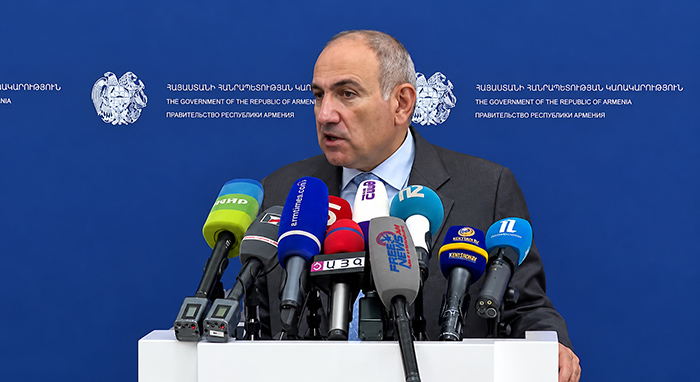
Speaking to reporters following a government meeting, Pashinyan said the opposition had inadvertently created an opportunity for the government by linking the adoption of a new Constitution to regional developments, international relations, and the peace agenda.
According to the prime minister, this could generate significant public pressure on opposition lawmakers to support holding a constitutional referendum.
“Yesterday’s question-and-answer session in the National Assembly made it clear to me that there is a very strong possibility that we will not reach the point of early elections. Instead, a proposal may emerge that the opposition simply cannot refuse,” Pashinyan said.
He argued that the opposition’s statements during the October 28 parliamentary session had opened the door for the government to pursue a strategy that would place pressure on opposition lawmakers to provide the votes necessary to authorize a referendum.
“They created a significant opportunity for us to move the process forward in a way that would generate considerable public pressure on the opposition to make the constitutional referendum possible through their votes,” he said.
However, Pashinyan acknowledged that the government had not yet developed such a proposal.
“This opportunity exists, but we are not there yet. We still have work to do, and I cannot guarantee today that I will be able to formulate that proposal,” he stated.
The prime minister also addressed opposition claims that the ruling Civil Contract party had failed to secure the parliamentary majority necessary to advance constitutional changes without opposition support.
Pashinyan countered that adopting a new Constitution had been part of his party’s election platform and that the government therefore had a public mandate to pursue the initiative.
“More than 700,000 citizens voted for that election platform, and we must implement it. In other words, we have the mandate to carry out that program,” he said.
Pashinyan also declared that his goal is to conclude his tenure with a peace agreement between Armenia and Azerbaijan both signed and ratified, warning that failure to achieve that objective would represent a personal setback.
“As I have said from the podium of the National Assembly, there are dozens of reasons, both within Armenia and beyond its borders, that could cause us to deviate from our peace agenda and move in another direction every single day,” Pashinyan said.
To illustrate his point, the prime minister referred to the traditional Armenian folktale Hazar Blbul (The Thousand-Nightingale), in which a character must resist distracting voices while attempting to reach a difficult destination.
“You remember the scene toward the end, when the hero covers his ears with cotton because voices and various statements can be heard along the path to the summit,” Pashinyan explained.
“When the hero becomes distracted by one of those voices, he turns to stone.”
Drawing a parallel with Armenia’s historical experience, Pashinyan suggested that the country must remain focused on its long-term objectives rather than become distracted by external statements or political provocations.
“If we imagine our history as an ascent that we must complete, there are many stones along the way,” he said.
“Our strategy is not to focus on what others are saying from the sidelines, but to continue pursuing our objective. Otherwise, reaching that goal would be impossible. We have learned this lesson from our own history.”
The prime minister concluded by emphasizing his personal commitment to securing a lasting peace agreement.
“My goal is to finish my service as prime minister under circumstances in which the peace agreement has been signed and ratified,” Pashinyan stated.
“If that does not happen, I will consider it a personal failure.”