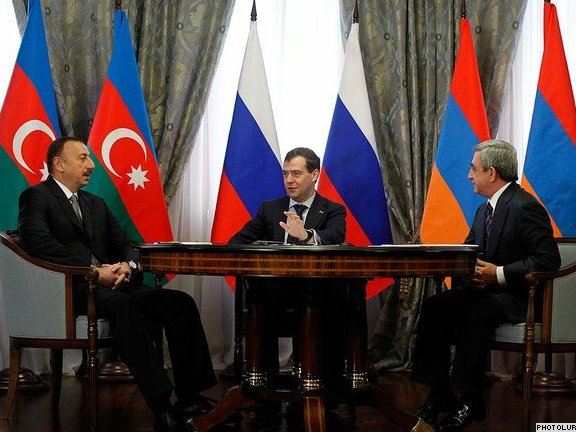
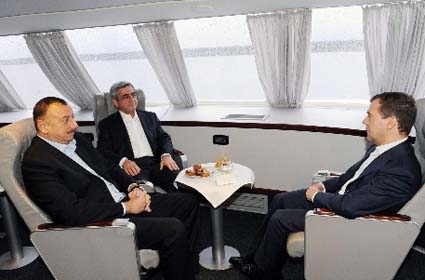
SOCHI — Serzh Sarkisian, Ilham Aliyev, and Dmitry Medvedev have held fresh round of talks in Russia on the Nagorno-Karabakh conflict settlement amid heightened tensions in recent months.
After the talks yet another joint statement on the Nagorno-Karabakh settlement was released.
According to the document, the leaders discussed the issues of practical implementation of the tripartite declaration adopted by them during the last meeting in Astrakhan on October 27, 2010. In particular, the Presidents agreed to conclude exchanging of prisoners of war as soon as possible.
Moreover, the document stresses the desire to resolve all disputed issues by peaceful means and to investigate possible incidents along the ceasefire line, with the participation of the parties under the aegis of the OSCE Minsk Group co-chairmen with the assistance of the Special Representative of the OSCE Chairman.
“The presidents noted the importance of their regular contacts on the Nagorno-Karabakh conflict settlement and agreed to continue them in this format in addition to the work of the OSCE Minsk Group co-chairmen,” a statement said.
The meeting in Sochi is the eighth tripartite meeting of the Presidents of Azerbaijan, Armenia and Russia.
Leave a Reply

Your email address will not be published. Required fields are marked *

Sign Up for Our Newsletters

Get notified of the latest updates from MassisPost.

You May Also Like

Azerbaijan Anti-Armenian Initiative Fails at UN

NEW YORK — Yet another anti-Armenian initiative by Azerbaijan has failed; this…

Azerbaijan Razes Entire Historic Center of Stepanakert

STEPANAKERT — In October, the Azerbaijani administration in Stepanakert, the capital of…

EU Announces €2.9 million Grant to Support Sport, Culture, Education and Tourism in Armenia

YEREVAN (Armradio) — The EU Ambassador to Armenia Piotr Switalski announced €2.9…

AGBU Allocates $1 Million Emergency Fund for Humanitarian Assistance to Armenian Community in Syria

-The ongoing and expanding militarized conflict in Syria has created a serious humanitarian crisis for the population and is threatening, among others, residential areas where concentrations of our Armenian community and institutions are situated