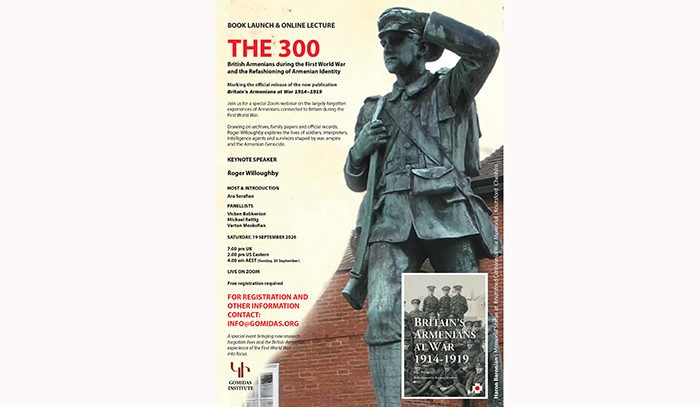

LONDON — The Gomidas Institute will host an online launch of Roger Willoughby’s new book, Britain’s Armenians at War, 1914–1919, on Saturday, September 19, 2026, at 7:00 p.m. UK time and 2:00 p.m. U.S. Eastern Time.
Titled “The 300: British Armenians During the First World War and the Refashioning of Armenian Identity,” the event will examine the largely forgotten experiences of Armenians connected to Britain during World War I and explore how the conflict shaped Armenian identity and belonging.
Author Roger Willoughby will be the featured speaker. Ara Sarafian of the Gomidas Institute will host the discussion, with Vicken Babkenian, Michael Rettig and Vartan Moskofian participating as panelists.
The event will be held live on Zoom and is free to attend, although advance registration is required. For registration and additional information, contact the Gomidas Institute at [email protected].
Britain’s Armenians at War, 1914–1919 recovers the experiences of a community whose contribution to the First World War has often remained on the margins of British history. Through individual stories, the book examines questions of military service, identity, loyalty and the experiences of Armenians living within or connected to Britain during a period of war and catastrophe.
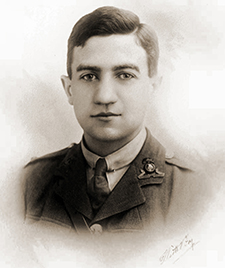
Among the individuals featured is Zaven Sarkis Manoukian, known to friends as “Nooky,” a British-Armenian student, writer and soldier whose promising life ended at the age of 19.
Born in Manchester in 1898 to an Armenian family with roots in the Ottoman Empire, Manoukian won a scholarship to Repton School, where he distinguished himself academically. He later earned a classical scholarship to Oriel College, Oxford, while developing his talents as a poet, essayist and debater.
His surviving writings reveal a young intellectual grappling with nationalism, democracy, oppression, prejudice, education, war and the responsibilities of powerful states. His works included the prize-winning poem “Gallipoli,” “To an Unknown God,” and essays such as “Armenia Irredenta,” “Revolution” and “Idealism and Education.”
Manoukian also wrote in defense of Armenians against contemporary stereotypes, combining his personal Armenian identity with broader arguments concerning the rights of smaller nations.
Despite his awareness of the brutality of war, Manoukian volunteered for military service at the age of 17 and sought an officer’s commission. His Armenian-Ottoman family background complicated his position, with his mother reportedly warning the British War Office that he could be treated as a traitor if captured and handed over to Ottoman authorities.
Manoukian nevertheless accepted a combat commission in the Lancashire Fusiliers and was sent to France in June 1918. On September 3, 1918, while conducting reconnaissance near Givenchy, he was killed by a sniper. A senior officer later described him as his “best officer” and recalled the respect he commanded among his men.
Willoughby places Manoukian within the wider generation of promising writers and intellectuals whose lives and careers were cut short by the First World War. His surviving work offers a rare perspective on what it meant to be both British and Armenian at a time when Britain was engaged in a global conflict and Armenians in the Ottoman Empire were experiencing catastrophe.
Manoukian’s story reflects a broader theme running through Britain’s Armenians at War, 1914–1919: lives interrupted and possibilities lost. More than a century later, his writings preserve the voice of a young British Armenian confronting questions of identity, injustice, belonging and war.
By recovering stories such as his, Willoughby’s book brings greater attention to a neglected dimension of Britain’s wartime history and to the Armenian men and families whose heritage shaped their experiences, military service and fate.
Event Details: Saturday, September 19, 2026, at 7:00 p.m. UK / 2:00 p.m. U.S. Eastern Time. The event will be held live on Zoom. Participation is free, but advance registration is required.