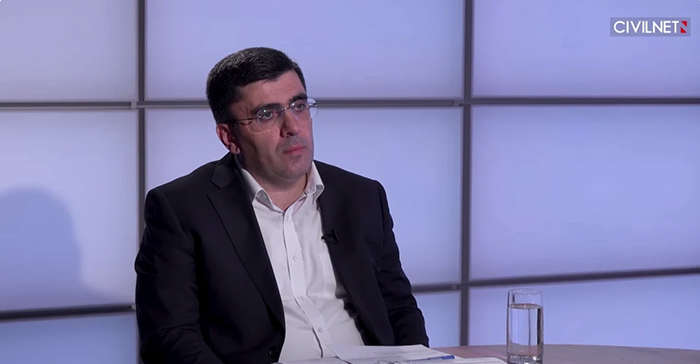
YEREVAN — Restrictions imposed by Russia on imports of Armenian agricultural products could, in the most extreme scenario, reduce Armenia’s economic growth by up to two percentage points. However, their impact remains limited for now, Central Bank Board member Armen Ktoyan said in an interview with CivilNet.
Since early May, Russia has introduced restrictions on the import of a number of Armenian goods. The list was significantly expanded on June 12 to include Armenian agricultural products, fish products, flowers and other goods.
Ktoyan said that the politically tense relations between Yerevan and Moscow are among the external risks the Central Bank takes into account when developing monetary policy.
“If we assume that none of the product groups affected by the restrictions are exported to Russia at all, then, according to our experts’ assessment, the maximum impact would be around 1.8 to 2 percent of GDP,” Ktoyan said. Central Bank Governor Martin Galstyan had also publicly presented this estimate last month.
According to Ktoyan, this figure represents an extreme scenario in which Armenian producers are unable to find alternative markets for goods previously exported to Russia. He added that the government has already announced support measures to help exporters process and redirect products affected by Russian restrictions, although the impact of those measures has not yet been assessed.
Ktoyan warned that the situation would become more serious if the restrictions extended not only to exports from Armenia to Russia, but also to imports from Russia to Armenia, particularly in the energy sector and in financial transfers. According to him, Russia has already sent an official letter warning that it may reconsider the terms of the gas supply agreement.
Armenia imports gas from Russia at a price of $165 per 1,000 cubic meters. Depending on the calorific value of the gas, the price may vary. According to the latest official data, it stood at $177.50. This is significantly lower than the price of gas on the European market, where it ranges from $400 to $600.
In early April, during a meeting in Moscow with Armenian Prime Minister Nikol Pashinyan, Russian President Vladimir Putin hinted at a possible increase in the gas price for Armenia, referring to European market prices.
Ktoyan said that although the Central Bank has not yet developed a clear scenario, a doubling or tripling of gas prices would have a significant impact on Armenia’s economy.
He noted that Armenia has already reduced its dependence on imports of Russian gasoline and diesel over the past year, which could help soften the impact of possible similar changes in the gas market.