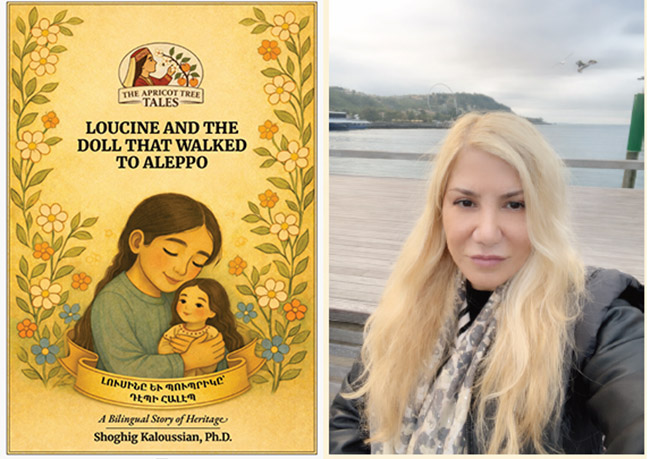

BEIRUT — Author and educator Dr. Shoghig Kaloussian has published Lucine and the Doll That Walked to Aleppo, the first book in the Apricot Tree Tales series—a collection of children’s books that introduces young readers to Armenian history through stories of hope, resilience, and remembrance.
The story follows Lucine, a young Armenian girl, whose beloved rag doll, Aghavni, accompanies her on the journey across the Syrian desert to Aleppo during the Armenian Genocide. Thoughtfully crafted for young readers through a gentle and age-appropriate narrative and brought to life through beautiful, full-color illustrations, the book introduces this chapter of Armenian history while fostering empathy, understanding, and meaningful discussions. It is an ideal resource for schools, libraries, and families seeking to introduce children to this important part of history in an accessible and engaging way.
Each book is fully bilingual, with both English and Western Armenian presented side by side on every page, allowing children and families to read together in either language while helping preserve the Western Armenian language for future generations. One of the project’s central goals is to foster a sense of ownership among young readers so that children become the next custodians of these stories, ensuring that the memory of the Armenian Genocide endures for generations to come.
The second book in the series, Annie and the Old Photograph from Marash, is scheduled for publication in July 2026, continuing the mission of preserving Armenian heritage through children’s literature.
For review copies, interviews, or school visits, members of the media are welcome to contact the author.
About the Author
Dr. Shoghig Kaloussian is an Assistant Professor at Haigazian University in Beirut, Lebanon. She holds a Ph.D. in Applied Linguistics and Education and is a researcher specializing in language education and multilingualism. Through her Apricot Tree Tales series, she combines historical research with storytelling to preserve Armenian cultural heritage and introduce younger generations to the stories, values, and resilience of the Armenian people.