
By KRIKOR KHODANIAN
As elections approach, Russia’s political, economic, and disinformation campaigns against Armenia are becoming increasingly intense.
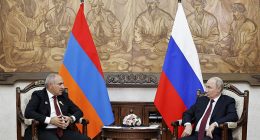
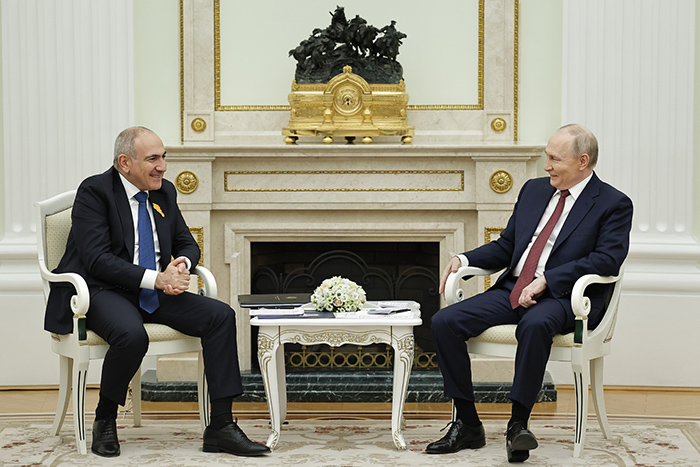
On the political front, warnings directed at Yerevan had already been issued for some time at the highest levels, but they never came directly from the President of Russia. That responsibility was left to others—Zakharova, Peskov, Overchuk, and Galuzin—who had turned their criticism of Yerevan into a daily routine. Now, President Vladimir Putin has personally joined them and is publicly urging the Armenian government to make a swift decision and choose between the Eurasian Economic Union, led by Russia, and the European Union.
“Armenia’s plans to join the EU require special discussion… for example, holding a referendum. That is not our business, but it would be entirely logical to ask the citizens of the Republic of Armenia. After that, we will draw conclusions and will strive for a soft, intelligent, and mutually beneficial separation,” President Putin told journalists. Armenia’s position on this issue is quite clear: the time has not yet come to choose between the two economic blocs, since Yerevan has not officially applied to the European Union nor received any invitation to join. It is clear that raising this issue so abruptly is connected to the upcoming parliamentary elections.
Following the recent European Political Community summit held in Yerevan, European institutions have also come under sharp Russian criticism. They are accused of working to distance Armenia from Russia, claiming that Armenia is being drawn into an “anti-Russian orbit” of the European Union.
The summit and the arrival of European leaders in Yerevan for the occasion have also unsettled Russian media outlets and political commentators, who are extensively discussing what was demonstrated in Yerevan—something that would have been unimaginable just four years ago.
The Kremlin is also displeased with Ukrainian President Volodymyr Zelensky’s speeches in Yerevan. In this context, Armenia’s ambassador was summoned to the Ministry of Foreign Affairs over the “provision of a platform” to Zelensky. The Russian side is well aware that the list of invited countries was compiled by European institutions, while Yerevan merely fulfilled its role as a host nation. The same Zelensky had been in Baku a week earlier on an official visit, where, among various agreements, a defense cooperation pact was signed between the two countries. At that time, there was silence and complete indifference in Moscow.
Russia is attempting, through maximum pressure, to influence Armenia’s electorate so that when they go to the polls, they take into account possible Russian economic sanctions that could affect their well-being. Armenia’s economic dependence on Russia will undoubtedly raise concerns among many voters, who may adjust their positions accordingly. At the same time, however, others may react negatively to such overt interference from Moscow.
Among Armenian political circles, there is a view that Moscow has come to the conclusion that previous efforts to change power in Armenia—disinformation campaigns and the deployment of wealthy political figures—have fallen far short of expectations. For that reason, the heaviest “artillery” is now being deployed in an attempt to salvage the situation.
Will Moscow be able, through these steps, to prevent the potential defeat of its allies in the June 7 elections, and what direction will relations between the two countries take afterward? It is hoped that Moscow will approach these issues with greater breadth of vision and, respecting the views of Armenian voters, return bilateral relations to a normal course—especially since Armenia’s leadership consistently emphasizes that it has no intention of harming Russia’s interests.
“MASSIS”
Note: Translated with the assistance of ChatGPT