
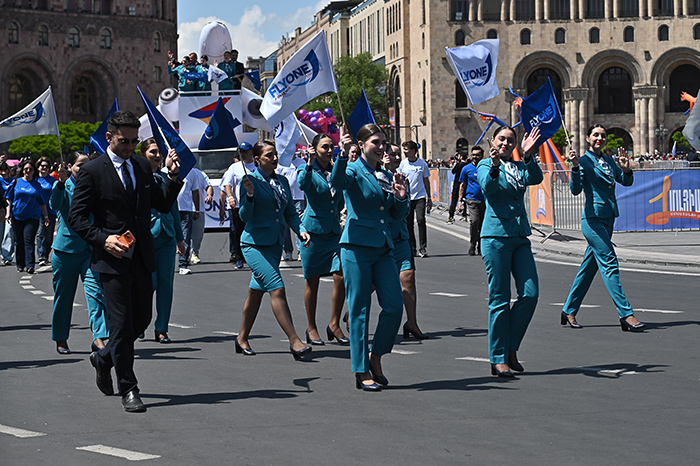
YEREVAN — Armenia celebrated International Workers’ Day on May 1 with a renewed format this year, featuring a festive parade in the heart of the capital that brought together representatives from a wide range of companies and organizations contributing to the country’s economic growth.
Participants marched through Republic Square, showcasing themed decorations, costumes, and creative representations of their professions. The celebration highlighted the diversity of Armenia’s workforce, including the growing presence of foreign workers—particularly Indian delivery personnel, who have recently become a significant part of the service sector and other industries.
In an official address marking the occasion, Armenian Prime Minister Nikol Pashinyan expressed gratitude to all individuals contributing to the country’s economy—whether as business owners, employees, or independent entrepreneurs—emphasizing the importance of lawful work and tax contributions.
The Prime Minister highlighted key economic achievements since the 2018 peaceful revolution, noting that approximately 280,000 new jobs have been created in Armenia. He underscored that the country has maintained strong economic growth rates exceeding global and regional averages, with the economy expanding by 53.9% compared to 2017 and state budget tax revenues more than doubling.
“These achievements are first and foremost the result of the hardworking citizens of Armenia,” the Prime Minister stated. “Today, we celebrate labor and the working individual.”

He also pointed to government support programs, which have returned approximately 1.4 trillion Armenian drams to citizens and businesses since 2018. These initiatives, he noted, have had a significant social impact, bringing extreme poverty in Armenia to the brink of eradication.
Emphasizing the evolving nature of work, Pashinyan highlighted the critical role of education, continuous skill development, and professional growth. He stressed that in the modern era—particularly with the rapid advancement of artificial intelligence—reskilling and lifelong learning are essential to maintaining competitiveness in the labor market.
“Modern realities require us to constantly learn, adapt, and develop,” he said, adding that education and knowledge are the only sustainable paths to securing employment and increasing productivity.

Addressing citizens and foreign nationals working in Armenia, the Prime Minister noted that the country has undergone significant transformation, becoming a more attractive place to live, work, study, and do business.
Looking ahead, he expressed optimism about continued progress, citing emerging opportunities driven by regional peace efforts between Armenia and Azerbaijan, which are expected to open new avenues for investment, entrepreneurship, and economic development.
The Prime Minister concluded his remarks by congratulating all workers and reaffirming the value of labor and education:
“Long live labor, long live education. Glory to the fallen heroes, and long live the Republic of Armenia.”