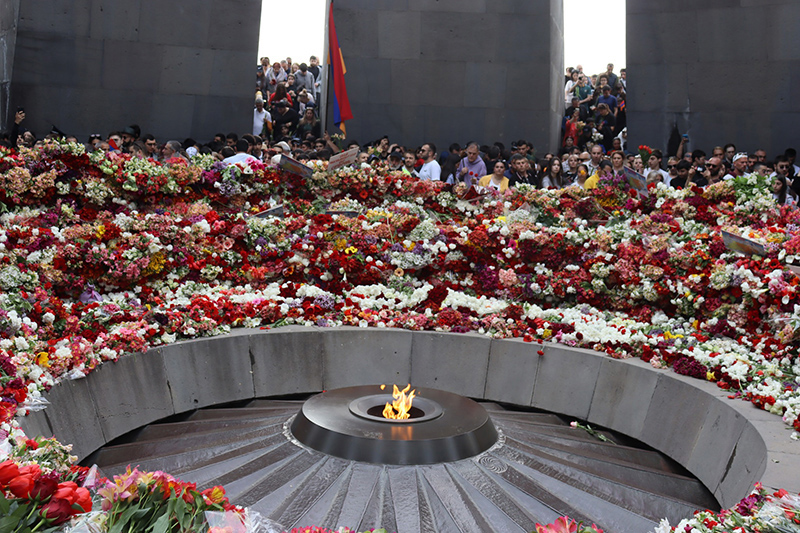

We mark the 111th anniversary of the genocide committed against the Armenian people.
More than a century ago, one of the most horrific crimes in modern history was carried out in the Ottoman Empire, claiming the lives of over 1.5 million Armenians of all ages and genders. Hundreds of thousands more were displaced and, stripped of their possessions, found refuge in foreign lands.
The monstrous plan conceived and executed by the Young Turks remains a stain on the successive governments of Turkey, as they continue to refuse to confront that dark chapter of their history by denying the reality of the Armenian Genocide.
Efforts by the Turkish state to consign this crime against the Armenian people to oblivion have failed. Successive generations of genocide survivors began to raise their voices, demanding justice from the world and from humanity at large. The struggle for recognition, which gained momentum after the 50th anniversary of the Genocide, yielded positive results, as many countries—including nearly all European nations—began to officially recognize the Armenian Genocide.
The campaign for recognition also reached Turkey, where progressive intellectuals began, each April 24, to hold silent demonstrations and display portraits of martyred Armenian intellectuals in solidarity with the Armenian people. In recent years, this movement has slowed due to the climate of fear prevailing in Turkey. Nevertheless, we are confident that sooner or later Turkish society will find the strength within itself to confront its history and reassess its thinking.
After many years of political struggle by the Armenian-American community, a major milestone was achieved in 2019, when the United States House of Representatives and the Senate officially recognized the Armenian Genocide. Since then, April 24 statements issued by the White House have included the term “genocide,” despite objections from the Turkish government. Following President Trump’s return to power, however, there has been a step backward. He has avoided properly characterizing the Armenian massacres, instead using the term “Meds Yeghern” (“Great Calamity”).
Despite the weight of historical memory, in recent years the government of Armenia has sought to establish diplomatic relations with neighboring Turkey, driven by considerations of regional peace and economic development. Within Armenia and across the diaspora, there are Armenians who disagree with these steps. However, it must be acknowledged that state policy differs from individual perspectives. A country’s leadership must also consider the security and well-being of its citizens and act accordingly.
While the perspectives of the diaspora may differ from those of the Armenian state, the diaspora remains the rightful heir and advocate of the generations that survived the Genocide. It must continue to stand united in its pursuit of recognition and reparations.
Once again, we bow our heads in memory of our martyrs and say: eternal honor to all those who fell on the path of the Armenian nation’s survival.
“MASSIS”
Note: Translated with the assistance of ChatGPT.