
By KRIKOR KHODANIAN
As elections draw nearer, Armenia’s opposition circles and media outlets are increasingly intensifying their attacks on the current government—not only in the sphere of foreign policy, but also on the domestic economic front. Based on statements from these circles, one gets the impression that Armenia is on the brink of collapse, that bribery and corruption are at levels worse than under previous governments, that poverty is widespread, and that the country is being emptied of its population.
Alongside these claims, we are told about the “arrival of 300,000 Azerbaijanis,” the “opening of Turkish mosques,” the “handing over of Syunik to foreigners,” and, on the international stage, the “loss of Armenia’s standing.” All of this springs from the opposition’s imagination.
Focusing for now on domestic economic and social issues, we see that statistical data present a picture exactly opposite to the noise raised by the opposition.
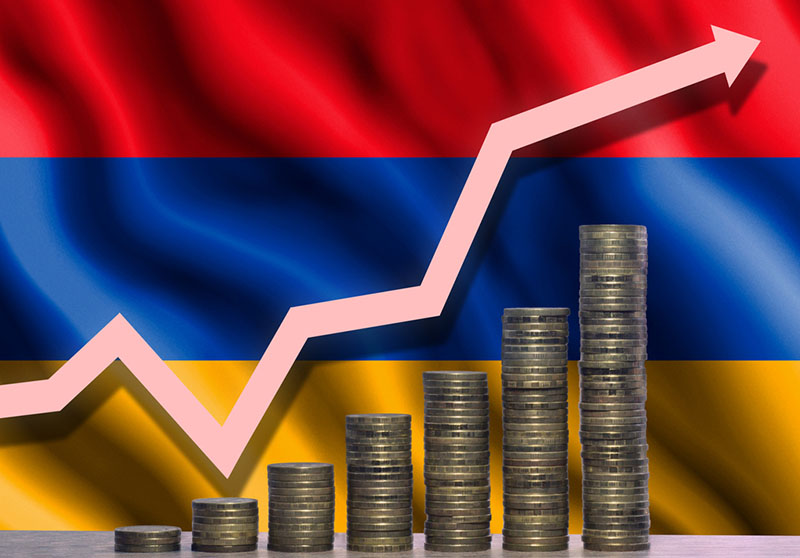
According to year-end figures, during 2025, the 1,000 largest taxpayers paid more than $5.5 billion into the state treasury. To this will be added revenues from other taxpayers and customs duties, as a result of which Armenia’s total budget revenues for 2026 are projected at $8 billion, while the overall state budget is projected at $9.4 billion. By comparison, in 2018, the last budget presented by Serzh Sargsyan’s government amounted to $3.04 billion. In other words, revenues and expenditures have tripled—despite the pandemic, followed by the war and the subsequent internal instability. This picture is the result exclusively of cleaner governance and the absence of systemic corruption. When large taxpayers account for more than half of the budget, it means they are paying their due share to the state instead of to members of the government and top officials as bribes. It was thanks to those illicit revenues that prominent figures of the former regime became millionaires and built their lavish palaces—at the expense of the people’s welfare and improved living conditions.
It is thanks to these revenues that, at the beginning of the year, a universal healthcare system began operating in Armenia, making healthcare a right for every citizen rather than a privilege. It is also through tax collection that the Armenian Army is being equipped with modern weapons.
There are other positive statistical indicators as well. Since the revolution, 288,000 jobs have been created, and the average salary has crossed the $1,000 mark—doubling the pre-revolution average wage.
To conclude, it is worth recalling one more figure: since 2010, for the first time, more Armenian citizens—8,660 people—entered the country than left it.
Understandably, opposition forces have the right to criticize the governing party’s domestic and foreign policies, but this must be done based on accurate data. They are also obliged to present their own programs and the means and methods for implementing them. This is precisely what is lacking among the opposition parties. Instead, they have staked their hopes on winning votes by playing on the public’s emotions—a tactic that cannot be sufficient to attain power. These forces may continue making outrageous claims and flooding the public sphere with disinformation, but their main adversary will remain the numbers, which never lie.
“MASSIS”
Note: Translated with the assistance of ChatGPT.