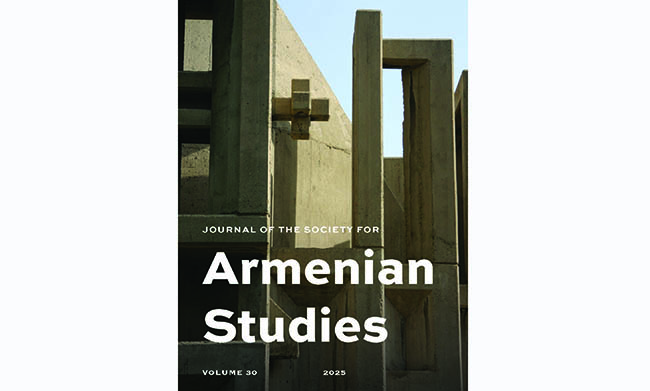

FRESNO — The Journal of the Society for Armenian Studies (JSAS), the leading academic journal dedicated to Armenian Studies in the Western Hemisphere, has just published the first of two special issues to mark the 50th Anniversary of the founding of the Society for Armenian Studies. Having recently started a new chapter in its history, JSAS is now published by a highly respected and prominent academic press – the University of Nebraska Press (UNP), which for more than twenty years has published some of the most significant scholarly journals in Native American studies, women’s studies, literature, regional studies, and more.
Under the editorship of Houri Berberian (Professor of History and Meghrouni Family Presidential Chair in Armenian Studies at UC Irvine) and Talinn Grigor (Professor of Art and Architectural History at UC Davis), starting with Volume 30 (2025), each issue will feature a distinctive visual cover aligned with its thematic focus. This highlights that Armenian Studies critically engages with visual and material sources alongside textual evidence in knowledge production. Visual and material culture are the central themes in the first of two special 50th-anniversary issues. The articles offer insights into the vital role of artistic, visual, and material expressions in the rich and diverse histories of Armenians across time and geography. Additionally, book reviews curated by JSAS’s book review editor, Tsolin Nalbantian, complement the issue’s focus on visual and material culture. The second 50th-anniversary special issue (Volume 31), with seven articles and several book reviews, is scheduled for publication in the upcoming year (2026).
Volume 30, like all future issues of JSAS, is available online through Project MUSE, a leading provider of digital humanities and social science content for the scholarly community worldwide.
JSAS invites submissions for Volume 32 (2027). The Journal is committed to advancing scholarship in Armenian Studies. It publishes peer-reviewed research from all disciplines and comparative approaches related to Armenians and Armenian Studies. To remain relevant to a broad interdisciplinary audience, it encourages submissions that are global, cross-cultural, and interdisciplinary, aligning with the latest scholarly work across various periods and fields.