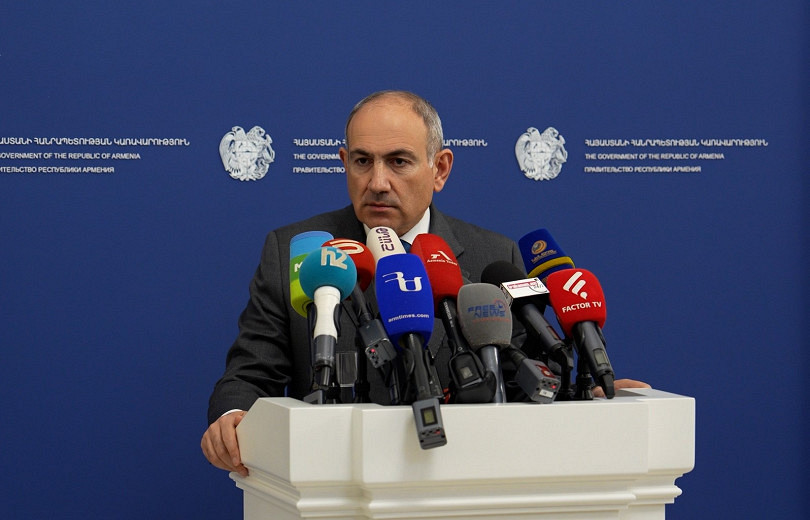

YEREVAN — “We have done everything, and will continue to do everything, to address all concerns of our friendly and brotherly Iran,” Prime Minister Nikol Pashinyan said in a brief interview with reporters following a government session, responding to statements made by Iran’s ambassador.
“We are very attentive to statements coming from Iran,” Pashinyan said.
On January 14, Iran’s Ambassador to Armenia, Khalil Shirgholami, stated that Iran is concerned about protests taking place in front of the Iranian Embassy in Yerevan.
“Since 2018, no public rally has been banned anywhere in Armenia, and we cannot behave differently in a single, isolated case. That said, we do share the view that forms of expression should not disrupt the work of either the Islamic Republic of Iran’s embassy or any other diplomatic mission,” Pashinyan said.
The prime minister assured that official Yerevan is closely monitoring Iran’s concerns and, within the framework of democratic principles, will take all necessary measures to ensure that no issues arise in the functioning of the Embassy of the friendly and brotherly Islamic Republic of Iran.
“Those who cross the line of the law will face appropriate procedures. I know that administrative proceedings have already been initiated in several cases,” Pashinyan added.
Addressing Tehran’s concerns regarding the “Trump Route” project, Pashinyan noted that after August 8, during a visit to Armenia by Iran’s president, the sides held a detailed and lengthy discussion on the matter, and President Masoud Pezeshkian received answers to all of his questions.
“We have said that if questions arise in the future, we are ready to answer all of them, including any that may emerge after the publication of the text. In the course of discussions, we take into account the concerns and opinions of our international partners and try, as much as possible, to arrive at balanced solutions, which I believe has been achieved in this case,” Pashinyan said.
For more than two weeks, protests have been ongoing in Iran, which began in Tehran and spread throughout the country. The initial trigger for the demonstrations was the sharp devaluation of Iran’s national currency, the rial, but the protesters’ demands later took on a political character. Due to disruptions in communications within Iran, the full picture of the situation remains unclear; however, human rights organizations operating abroad report the use of excessive force by law enforcement agencies. According to various sources, the number of fatalities among protesters has exceeded 2,000. Iranian officials, in turn, report significant losses within the country’s law enforcement forces.