
By HRAYR S. KARAGUEUZIAN
On July 24, 2025, French President Emmanuel Macron made a historic and controversial declaration: France would officially recognize the State of Palestine at the upcoming UN General Assembly session in September. The announcement, first delivered by French Consul General Nicolas Kassianides to Palestinian Authority President Mahmoud Abbas, came with Macron’s unequivocal pledge: “France will fully recognize Palestine as a State.”
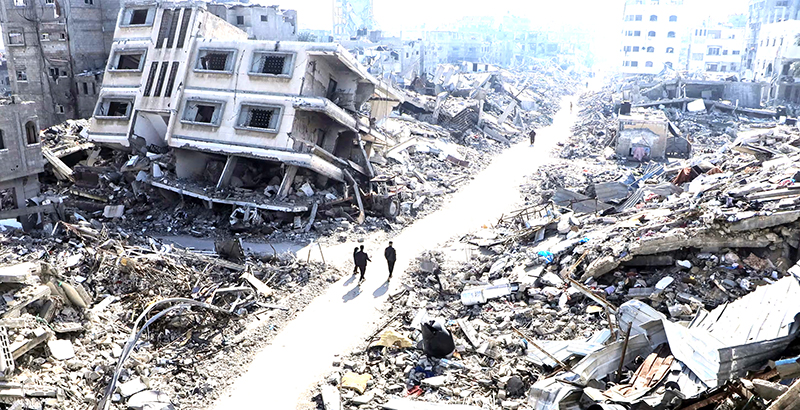
France was not alone. On May 22, Ireland, Norway, and Spain also recognized Palestine—marking the first time since Sweden’s move in 2014 that European nations have taken such a symbolic step. Earlier that same month, Slovenia initiated its own recognition process and UK is in full force following France. Norwegian Foreign Minister Espen Barth Eide stated plainly: “A Palestinian state is fundamental to realizing the two-state solution conceptualized in the UN’s 1947 partition plan. Israelis and Palestinians cannot return to coexistence if the current state of violence continues.” In Washington, however, Macron’s decision was denounced. U.S. Secretary of State Marco Rubio, echoing hardline positions, called it “a slap in the face to the victims of October 7” and accused France of “serving Hamas propaganda.” But Rubio, lacking any genuine diplomatic experience and parroting lines drawn by Donald Trump, demonstrated not statesmanship but blind ideological fealty. The Trump-led administration’s alliance with right-wing governments—Hungary, and Israel’s most extreme coalition in history—has gone so far as to police dissenting views in American universities. In France, pro-Israel members of Parliament erupted in protest. One MP evoked October 7, 2023, when Hamas launched a brutal assault that killed some 1,200 Israeli civilians and took nearly 200 hostages. That day of horror must never be forgotten—one day of terror is one too many. But the monopoly on horror does not belong to one people. As I write these words on August 3, 2025, 666 days have passed since that bloody dawn. That number sends a chill down the spine. In the Book of Revelation (13:18), 666 is the mark of the beast—a symbol of evil, moral collapse, and unchecked power. First, associated with Nero, the Roman emperor who presided over cruelty and chaos, it has come to signify monstrous regimes that devour the innocent. Now, Gaza has become a smoldering graveyard, ravaged across these 666 days by bombardment, blockade, and systematic ruin. Under the command of Prime Minister Benjamin Netanyahu, the Israeli Defense Forces waged a campaign by air, land, and sea that defies every norm of modern warfare. Schools were flattened. Hospitals reduced to rubble. Homes incinerated. Markets turned into mass graves. Humanitarian aid was blocked. Water and electricity cut off. Over 65,000 Palestinians have been killed, and the death toll rises daily. Survivors live in apocalyptic conditions, their children gaunt, staring skyward for help that never comes. If this is not the work of the beast, what is? For 666 days, the world has watched in silence, and at times, in complicity. Macron’s recognition of Palestine is not just symbolic—it’s an indictment of a world that has grown numb to suffering. It rips away the veil of political convenience and forces us to confront a question the powerful would rather ignore:
Has genocide returned in our time—and is Gaza its name?
Even Thomas L. Friedman of The New York Times, long viewed as a centrist Middle East analyst, offered this stark commentary: “That did not seem like an accident. It seemed like the product of something deeper, something quite shameful, playing out within the extremist government of Prime Minister Benjamin Netanyahu.” Friedman described intentional starvation policies championed by far-right ministers like Itamar Ben-Gvir, noting that Netanyahu provided only enough aid to prevent international backlash, while appeasing the Jewish supremacist factions that hold his coalition hostage.
Is It Genocide?
Legal scholars and historians often hesitate to use the word “genocide” until all the boxes are checked. But how long must we wait while children die under rubble and women starve in open-air prisons? Even as intellectuals debate, key voices are breaking the silence. On July 29, 2025, two major Israeli human rights organizations—B’Tselem and Physicians for Human Rights-Israel—declared that Israel is committing genocide in Gaza. Their statement marked a turning point, aligning with assessments from Amnesty International and others. The International Court of Justice (ICJ), in January 2024, warned of a “real and imminent risk of irreparable harm under the charge of genocide.” The International Criminal Court (ICC) has opened prosecutions against Netanyahu, former defense minister Yoav Gallant, and Hamas commander Mohammed Deif (now deceased) for crimes against humanity. B’Tselem’s director, Yuli Novak, said: “We are witnessing a reality that has left us no choice but to acknowledge the truth.”
Who Has the Right to Call It Genocide?
The identification of genocide is often reserved for scholars and lawyers. But this is not merely a legal question, it’s a moral one. To insist that only those with PhDs in History or law degrees may speak the word “genocide” is to silence survivors, journalists, and ordinary citizens who witness its signs and suffer its consequences. Genocide is not a legal abstraction—it is a human catastrophe. As defined in the UN Genocide Convention (1948, Article II), genocide involves acts committed “with intent to destroy, in whole or in part, a national, ethnical, racial or religious group,” including: Killing members of the group, causing serious bodily or mental harm, deliberately inflicting conditions of life calculated to bring about physical destruction, imposing measures to prevent births, forcibly transferring children. By this standard, Gaza has crossed the threshold. Mass killing? Yes. Conditions of destruction? Yes. Starvation, disease, denial of medicine, and targeted bombings? All evident and ongoing.
When Dr. Gregory Stanton, American jurist, academic, human rights activist, first outlined the Ten Stages of Genocide, he drew heavily from the Armenian Genocide—the mass extermination of 1.5 million Armenians by the Ottoman Empire. His framework was meant not only to understand past atrocities, but to identify the warning signs of genocide in real time. Today, Gaza reflects that mirror with painful clarity.
Stanton’s model is not rigid or linear. The stages—Classification, Symbolization, Discrimination, Dehumanization, Organization, Polarization, Preparation, Persecution, Extermination, and Denial—often overlap. But if we dare to look with honest eyes, we can trace many steps in the ongoing destruction of Gaza.
Us vs. Them
It began long ago. After the 1973 Arab Israeli War, Palestinians were increasingly framed not just as an enemy, but as an existential threat to Israel’s survival. “Terrorist” became their defining label. This satisfies Stage One: Classification, drawing a hard line between “us” and “them.”
Stage Two: Symbolization followed quickly. Palestinian identity itself became suspect. A child’s name, a family’s location, a flag—everything became symbolic of a supposed threat. This symbolism feeds and justifies systemic Discrimination, Stage Three, which is no longer covert but deeply embedded in policy. An illustrative example: when an elderly South African Jewish woman immigrated to Israel and settled on a dry hillside, water pipes were swiftly installed to serve her new home. Yet just below, Palestinian families queued with buckets in hand, waiting their turn at a single communal faucet. In apartheid South Africa, this would have looked familiar.
Stripping Away Humanity
Words are weapons. Stage Four: Dehumanization is often a precursor to mass violence. Israeli officials including a former Defense Minister have described Palestinians as “human animals,”a chilling echo of Ottoman language that cast Armenians as traitors, viruses, or cancers in the body of the empire. Once stripped of their humanity, people become easy to eliminate.
The Machinery of Destruction
Genocide is not spontaneous. It is organized—Stage Five—through government and military infrastructure. Israel’s actions in Gaza, with blockades, bombardments, and forced displacement, are part of a carefully constructed system of Polarization, Preparation, and Persecution—Stages Six through Eight. These are not defensive reactions; they are strategic policies of control and subjugation. In the Armenian Genocide, the Ottoman authorities formed paramilitary death squads under the guise of the Special Organization (Teşkilât-ı Mahsusa), who rounded up, deported, and killed en masse. In Gaza, we see a modern variation: relentless airstrikes, food and medicine blockades, mass displacement, and the destruction of every lifeline—from hospitals to bakeries.
Extermination—Stage Nine—is not a metaphor. More than 65,000 Palestinians have been killed. Thousands are buried under rubble. Children die not just from bombs but from hunger, thirst, and infections that would be treatable anywhere else. The word “genocide” is not used lightly. But when a state imposes conditions of life calculated to bring about the destruction of a group “in whole or in part,” it meets the legal definition.
Lies as the Stage Ten of Genocide: Denial
And then comes the most grotesque stage of all: Denial. Prime Minister Benjamin Netanyahu has claimed that there is “no hunger” in Gaza, and that civilians were not shot as they rushed toward food distribution trucks. This is not just denial—it is gaslighting the global public. Video footage, satellite imagery, and firsthand accounts show skeletal children, bombed aid convoys, and breadlines turned into killing fields. This echoes the long-standing denial of the Armenian Genocide. More than a century later, the Turkish government still refuses to acknowledge it. To deny genocide is to kill the victims a second time, to erase them from history, and to shame the memory of the living.
What We Must See
The parallels are not coincidental—they are structural. Both the Armenian and Palestinian cases demonstrate how an ethnic group can be demonized, isolated, starved, and destroyed under a veil of national security or wartime necessity. The difference is: Gaza is happening now. In real time. Before our eyes. The world cannot plead ignorance. What is unfolding in Gaza is not just a humanitarian disaster. It is not a tragedy. It is a crime—possibly the most egregious of all crimes. And if we fail to call it by its name, if we remain silent in the face of extermination and lies, we become accomplices in history’s next denial. There will come a day—sooner than we think—when our children will ask what we did when Gaza burned. When the evidence was live-streamed and the victims cried out, were we still debating semantics?
The moral imperative is clear. We must recognize genocide while it is still unfolding—not just mourn it after the ashes settle.
Final Words: Silence Is Not Neutrality
The world’s passivity in the face of this unfolding genocide will haunt future generations. History will not absolve those who remained silent—or worse, made excuses. What is happening in Gaza is not collateral damage. It is not complex. It is not symmetrical warfare. It is systematic annihilation. The bulldozing of ruined homes to pave the way for settler expansion speaks volumes about the intent to permanently erase a Palestinian’s presence and future. We must not allow the definition of genocide to become the exclusive property of courts and professors. It belongs to the world. And the world must name it—loudly, clearly, and urgently—before the number of days rises from 666 to something even more unspeakable.
Note. The author is Professor Emeritus of Medicine, David Geffen School of Medicine at UCLA. He is the author of the book with Yair Auron: “Perfect Injustice. Genocide and the Theft of Armenian Wealth,” Transaction Publishers, Rutgers University, NJ 2009.