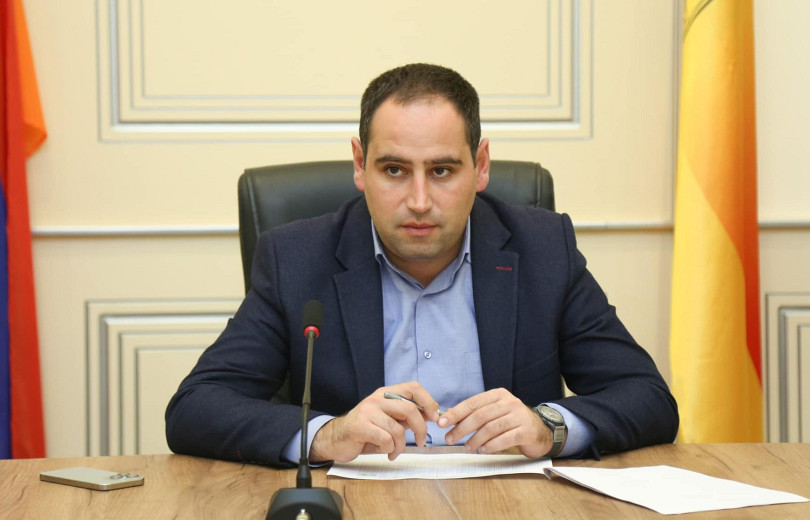

YEREVAN — Armenia supports Tehran’s proposal to increase the volume of natural gas exported from Iran, according to Minister of Territorial Administration and Infrastructure Davit Khudatyan.
Following a three-day visit to Iran, Khudatyan told RFE/RL’s Armenian Service that the volume of Iranian gas supplied under the gas-for-electricity exchange program could be at least doubled.
According to the minister, the Armenian and Iranian sides reached a verbal agreement to expand the mutually beneficial arrangement. The remaining issues will be addressed by specialized working groups that are expected to be established shortly.
“Both sides have acknowledged that the Republic of Armenia needs to receive larger volumes of gas, while the Islamic Republic of Iran needs to receive more electricity. The existing capacity of our pipeline is greater than the volume of gas currently flowing through it,” Khudatyan said.
Following a meeting with Khudatyan late last week, Iran’s oil minister announced that Tehran had proposed a new commercial framework aimed at expanding natural gas exports to Armenia. Khudatyan did not specify whether Tehran or Yerevan had initially proposed increasing the volume of Iranian gas exports, stressing only that both sides were interested.
“The capacity of our existing pipeline, as well as the construction of the new 400-kilovolt transmission line, will allow us to at least double the volume of the transaction—and potentially increase it by even more,” the minister said.
“This means that we could export at least twice as much electricity to the Islamic Republic of Iran and, in return, receive twice as much gas. In fact, the gas pipeline’s current capacity is sufficient to handle more than double the existing volume,” he added.
The Iran-Armenia gas pipeline, constructed nearly 20 years ago, has the capacity to transport more than two billion cubic meters of gas annually. However, it has operated at only a fraction of its capacity for years. Last year, approximately 480 million cubic meters of gas were exported from Iran to Armenia.
Under the gas-for-electricity exchange program, Armenia converts the Iranian gas into electricity and supplies the electricity back to Tehran. The gas therefore does not reach Armenian consumers.
Khudatyan said that expanding the arrangement and increasing both gas imports and electricity exports would require the long-delayed completion of the high-voltage Iran-Armenia transmission line, which has remained unfinished for nearly a decade.
The minister expressed hope that the work would finally be completed by the end of the year.
“We plan to complete construction of the new 400-kilovolt line by the end of this year. We have received assurances from both the contractor and our Iranian government partners that they will consistently work toward completing the line on schedule,” Khudatyan said.
“We have already experienced considerable delays in previous years. Once the line is completed, Armenia will be able to export larger volumes of electricity to the Islamic Republic of Iran and receive larger volumes of gas in return,” he added.