
YEREVAN — A newly released third-wave voter behavior survey conducted by the Armenian Election Study for EVN Report suggests that Armenia’s ruling Civil Contract party continues to strengthen its position ahead of the country’s June 7, 2026 parliamentary elections, while opposition forces remain fragmented and unable to consolidate support.
The nationwide poll of 925 respondents, conducted between April 1 and May 2, found a steady increase in Prime Minister Nikol Pashinyan’s approval ratings, improving perceptions of Armenia’s economic and security conditions, and growing public support for the government’s handling of regional geopolitical tensions.
Pashinyan Approval Nears Majority Support

According to the survey, approval of the Prime Minister’s job performance rose to 49%, up from 47.2% in the previous wave and 36% in the first poll. Meanwhile, disapproval declined to 33.7%, continuing a gradual downward trend.
Public sentiment regarding the country’s overall direction also improved significantly. Forty-four percent of respondents stated Armenia is headed in the right direction, compared to 30.9% who said the country is moving in the wrong direction. This marks a substantial shift from the first wave of polling, when more respondents believed the country was on the wrong path.
The poll also found that non-committed or undecided voters—who consistently account for roughly 35% to 40% of the electorate—have become increasingly favorable toward the incumbent government. Among undecided voters, 41% now approve of Pashinyan’s performance, representing a 5.5% increase from the previous survey.
Civil Contract Maintains Dominant Lead
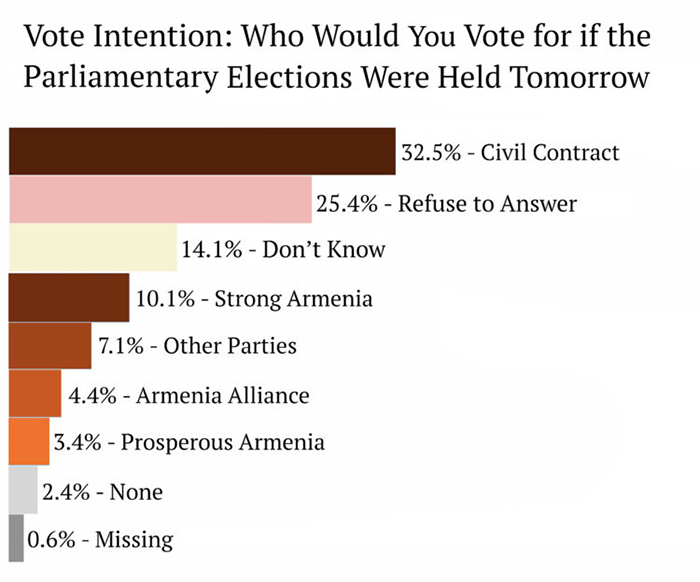
The survey found that Civil Contract remains the clear front-runner in vote intention polling, receiving 32.5% support in the baseline model. Opposition parties continue to trail far behind, with Strong Armenia polling at 10.1%, the Armenia Alliance at 4.4%, and the Prosperous Armenia Party at 3.4%.
Researchers noted that the fragmented opposition landscape presents a major challenge for anti-government forces, particularly because several parties remain below the electoral threshold required to enter parliament. Strong Armenia is currently the only opposition force clearly above the threshold.
The report further noted that pro-Western and “third-way” opposition parties continue to demonstrate only marginal electoral support.
Economy and Security Perceptions Improve

One of the most notable findings of the poll was the improvement in public perceptions of Armenia’s economy and national security. Forty percent of respondents said they believe the economy will improve, while only 11.6% expect conditions to worsen.
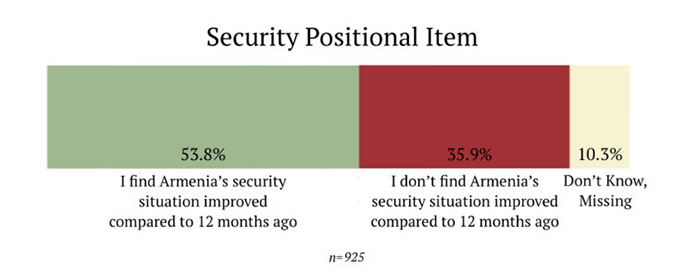
A majority of respondents—53.8%—also stated that Armenia’s security situation has improved compared to one year ago, while only 35.9% disagreed.
Among undecided voters, nearly half said the country’s security environment has improved, suggesting growing confidence in the government’s management of national security issues.
Support for Government’s Iran War Policy
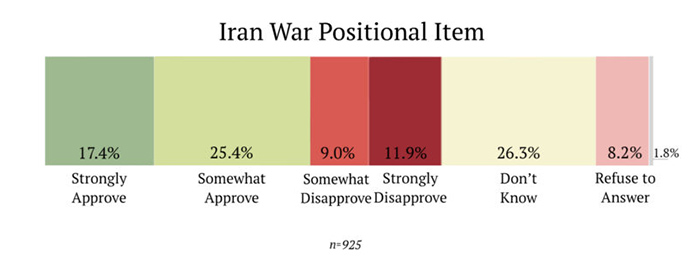
The survey additionally found broad public approval for the Armenian government’s handling of tensions related to the Iran conflict. Approximately 42.8% of respondents approved of the government’s approach, while only 20.9% disapproved.
Researchers noted that many undecided voters remain unfamiliar with the complexities of the regional conflict, leading to a high percentage of “don’t know” responses on the issue.
Growing Skepticism Toward TRIPP Project

While public opinion on the TRIPP (Trump Road for International Peace and Prosperity) project remains slightly positive overall, support has noticeably declined compared to earlier polling waves.
The percentage of respondents who view TRIPP as beneficial to Armenia dropped from 42.3% in the second poll to 36.2% in the latest survey, while uncertainty surrounding the project increased sharply.
Among undecided voters, support for TRIPP fell even more dramatically, with researchers identifying a 17% shift toward skepticism or uncertainty compared to the previous wave.
Poll Suggests Civil Contract Could Reach Governing Majority
Using additive index modeling to estimate how undecided voters may ultimately cast their ballots, the survey projects that Civil Contract could receive between 40.7% and 51.1% of the vote under an 85% turnout scenario.
Researchers emphasized that while the ruling party is not guaranteed a parliamentary majority, the data indicates that nearly half of undecided voters currently lean toward supporting the incumbent government.
The Armenian Election Study survey utilized methodology modeled after the American National Election Studies (ANES) and carries a margin of error of 3% at a 95% confidence level.