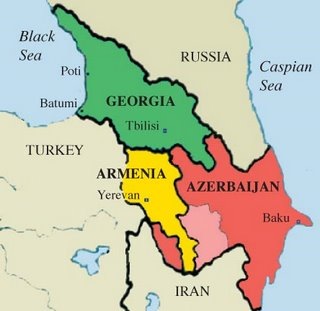
Since the Soviet Union’s implosion in 1991, foreign states and international non-governmental organizations have tended to view the South Caucasus states of Armenia, Azerbaijan and Georgia as nations in transition. But now, a leading expert on the Caucasus says the time has come to put this notion to rest.
“They’ve arrived at a state model,” Tom de Waal, a senior associate in the Russia and Eurasia Program at the Carnegie Endowment for International Peace, said during a recent discussion forum in New York, sponsored by the Open Society Foundations.. [Editor’s Note: EurasiaNet operates under the Open Society Foundation’s auspices].
To varying degrees all three states feature elements of a “one-party” system, de Waal said. Georgia’s system is the most open in the Caucasus; although President Mikheil Saakashvili’s administration maintains a commanding political position, there is room for government critics to operate. At the other end of the spectrum stands Azerbaijan, where the authoritarian tendencies exhibited by President Ilham Aliyev’s administration are starting to approach the level of nastiness seen in Central Asia. Armenia falls somewhere in between Georgia and Azerbaijan on the domineering-government scale, de Waal said.
Since a transition paradigm no longer applies to the Caucasus, foreign donors should tweak the way they approach assistance projects, de Waal suggested. For one, donors and NGOs should recalibrate expectations and perhaps concentrate resources. It might be better to fund one university, for example, than to promote a broad educational reform project. De Wall also urged foreign governments to mount more vigorous election monitoring efforts, and offer more forceful criticism of shortcomings.
Christopher Walker, the vice president for strategy and analysis at the democratization watchdog group Freedom House, noted during the April 27 forum in New York that the media sector is a key pillar of support for incumbents in Caucasus. State-controlled media outlets dominate Armenia’s and Azerbaijan’s information space, making it easier for the governments there to keep citizens in line. Georgia has a much freer media environment, Walker said. Nevertheless, government-aligned television channels are able to control the way the country’s political narrative unfolds.
Walker pointed out that some segments of society in the South Caucasus, particularly in Azerbaijan, are disgruntled with the way developments are going. Thus, there remains a chance, albeit slim, that political change could arise out of popular protests.
The more time that passes, however, the more difficult it will be to alter the current course. That’s because, as Walker noted, there is a “shrinking pool of people” with the skills and philosophical outlook needed to act as the technocratic backbone of an emerging civil society.”
http://www.eurasianet.org/node/65371