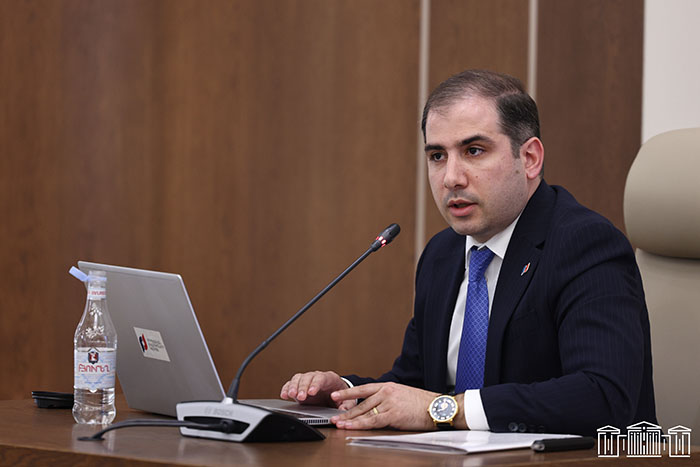

YEREVAN — Armenia will retain full control over all customs functions under the Trump Route for International Peace and Prosperity (TRIPP) project, State Revenue Committee Chairman Eduard Hakobyan said, emphasizing that customs inspections, risk assessments, and enforcement decisions will remain exclusively under Armenian state authority.
Responding to questions from Radio Free Europe/Radio Liberty’s Armenian Service, Hakobyan explained that the involvement of an international private operator would be limited to certain administrative and logistical services and would not interfere with Armenia’s customs administration.
He noted that such services could include basic interactions with travelers and businesses, such as processing payments or assisting with the submission of documents.
“We are talking about simple procedures that may involve human interaction, such as making a payment or submitting a document. These are basic operations that in no way affect customs administration,” Hakobyan said.
The State Revenue Committee chairman emphasized that Armenia is already pursuing extensive reforms aimed at digitizing customs procedures and minimizing direct contact between customs officers and individuals crossing the border.
“We are currently creating a new digital platform for customs officers. Our goal is to establish customs checkpoints that operate with minimal direct contact,” he explained.
Hakobyan stressed that these reforms are part of a broader modernization effort and are not limited to the TRIPP project.
Addressing concerns about the authority of the proposed international operator, he made clear that decisions involving security risks or cargo inspections would remain the responsibility of Armenian customs officials.
“If a risk situation arises or cargo needs to be inspected, the decision will be made by a customs officer. The office of an international operator cannot make such decisions,” Hakobyan stated.
He added that the precise responsibilities of the international operator are still under discussion and will be established through a separate agreement.
“I assure you that customs functions remain entirely within the domain of state sovereignty,” he emphasized.
Asked why an international operator would be necessary if customs procedures are becoming increasingly automated, Hakobyan explained that reopening long-closed borders and restoring railway connections would create additional administrative requirements.
“Every border involves certain minimum procedures. Exporters, importers, and private individuals do not always have all the necessary documents when crossing a border. Sometimes something is missing from the documentation. These basic procedures remain necessary regardless of the level of digitization,” he said.
Hakobyan described the proposed arrangement as an integrated operational system intended to facilitate the reopening of transportation routes that have remained closed for many years.
He also suggested that the participation of a third-party operator could help address issues of mutual confidence associated with reopening borders and railway connections.
“The need for front-office services has already been established. Since we are discussing the reopening of a railway section and borders that have been closed for many years, it is natural that certain third-party services will be necessary. This arrangement will also help address the issue of trust,” Hakobyan explained.