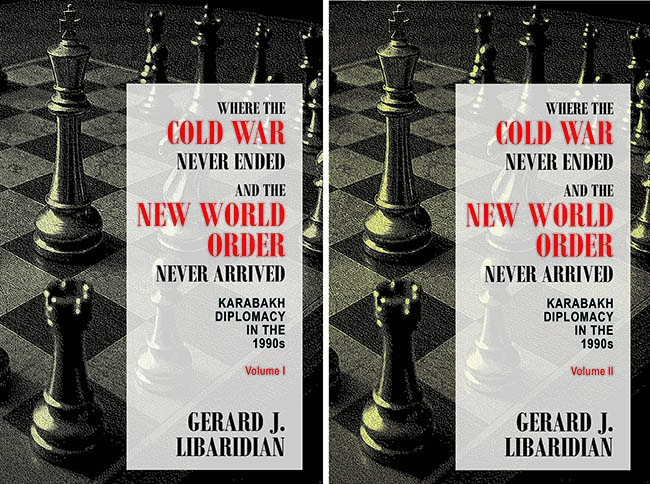

Gerard J. Libaridian, a former senior Armenian government official and diplomat, offers an insider’s account of the negotiations surrounding the Nagorno-Karabakh conflict in his two-volume work, Where the Cold War Never Ended and the New World Order Never Arrived: Karabakh Diplomacy in the 1990s.
Drawing on firsthand experience and extensive interviews with key participants, the publication examines the diplomatic efforts to resolve the conflict during the turbulent decade following the collapse of the Soviet Union.
Libaridian served as Senior Advisor to Armenia’s first president, Secretary of the Security Council, Ambassador-at-Large, and First Deputy Foreign Minister. In Volume I, he draws on these experiences to provide a detailed account of the negotiations, exploring how critical decisions were made, why opportunities for peace were missed, and how competing regional and international interests shaped the diplomatic process.
The book examines the roles played by Armenia, Azerbaijan, Nagorno-Karabakh, Russia, the United States, Turkey, Iran, and the Organization for Security and Co-operation in Europe (OSCE).
Combining personal observations with historical analysis, Libaridian argues that Cold War strategic thinking persisted long after the Soviet Union’s collapse, undermining hopes for a more cooperative international order and influencing diplomatic efforts to resolve one of the most consequential conflicts of the post-Soviet era.
Volume II complements the historical account with an extensive collection of interviews featuring diplomats, negotiators, mediators, and political leaders directly involved in the peace process. Their testimonies offer differing perspectives on the negotiations, the personalities who shaped them, and the achievements, frustrations, and missed opportunities of the 1990s.
Among those interviewed are Armenia’s first President Levon Ter-Petrossian, former Armenian Prime Minister Vazgen Sargsyan, Azerbaijani President Heydar Aliyev, Turkish President Süleyman Demirel, Iranian Foreign Minister Ali Akbar Velayati, and prominent American and European diplomats involved in the negotiations.
The collection also includes interviews with Armenian political and security figures Ashot Manucharyan and Shahen Karamanukyan; Azerbaijani officials Araz Azimov, Isa Gambar, Vafa Guluzade, and Tofik Zulfugarov; Russian diplomats Vladimir Kazimirov and Yuri Yukalov; and American diplomats B. Lynn Pascoe, James Collins, John (Jack) Maresca, Joe Presel, and Strobe Talbott.
Additional perspectives are provided by diplomats from Finland, Germany, Italy, Sweden, and Turkey, including René Nyberg, Enno Barker, Frank Lambach, Mario Sica, Jan Eliasson, Mathias Mossberg, Candan Azer, Ömer Ersun, Ayhan Kamel, and Önür Öymen, as well as Iranian diplomat Mahmood Vaezi.
Together, the two volumes present a comprehensive documentary and analytical history of Karabakh diplomacy during the 1990s. By combining Libaridian’s insider account with the recollections of numerous participants, the work seeks to illuminate the political calculations, diplomatic challenges, and missed opportunities that left the conflict unresolved.
The publication offers historians, policymakers, researchers, and readers interested in Armenian history and international relations a detailed examination of a pivotal period in the region’s modern history.
For more information about the publication contact [email protected].