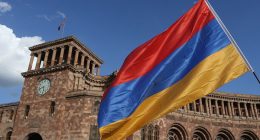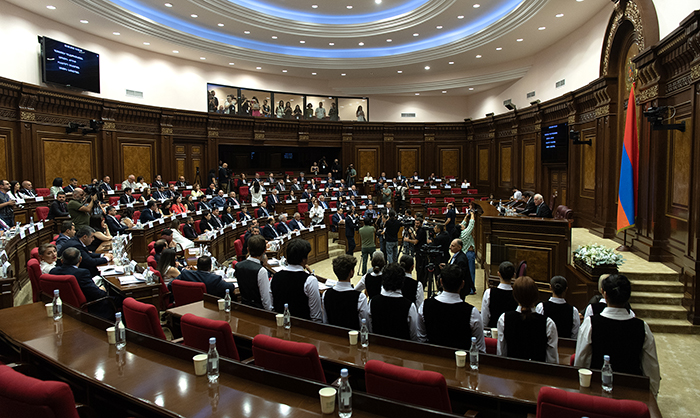
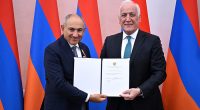
YEREVAN — Armenia’s ninth National Assembly, formed following the June 7 elections, began its work on Sunday.
Under the constitutional law on the Rules of Procedure of the National Assembly, the first session of a newly elected parliament following regular elections is convened at 10:00 a.m. on the day the mandate of the previous National Assembly expires.
The agenda of the new parliament’s first session includes the formation of a vote-counting commission; the election of the National Assembly president and three deputy speakers; the establishment of standing committees and an ethics committee; the election of standing committee chairs; consideration of a government-proposed bill amending the structure of the government; and a vote on approving the government’s program.
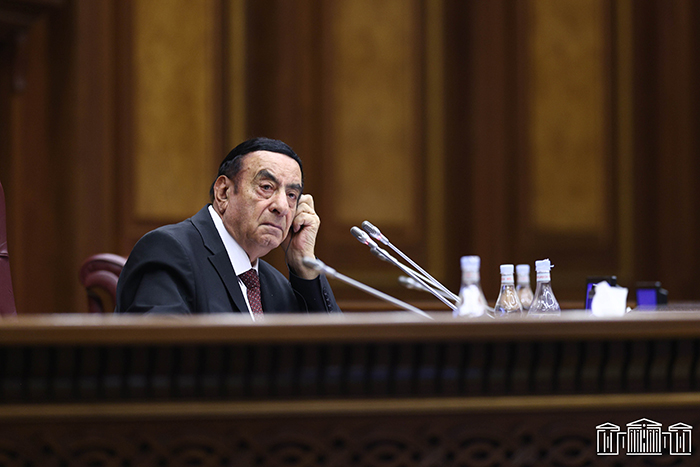
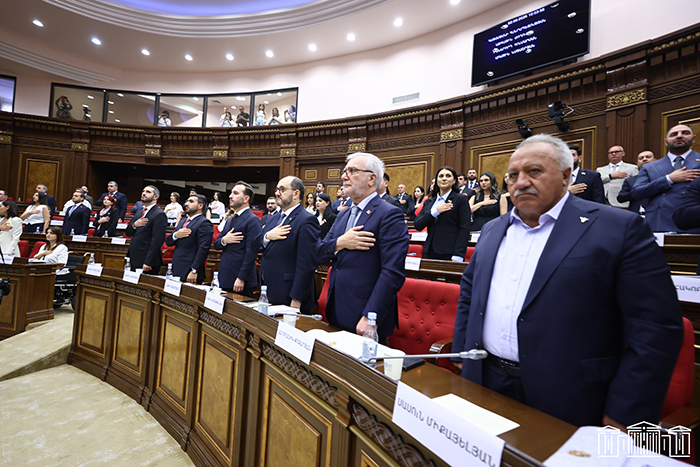
Until the election of the parliamentary speaker, the session is being chaired by the oldest member of parliament, Knyaz Hasanov, who formally declared the session open. Representatives of all three parliamentary factions were present, along with President Vahagn Khachaturyan.
The Armenian national anthem was played, after which the president delivered remarks.
“The public expects the National Assembly to be a place where differing political views do not deepen divisions, but instead compete in offering solutions that are most beneficial to the state. We need a political culture in which disagreement does not turn into intolerance and adherence to principles never excludes mutual respect,” Khachaturyan said.
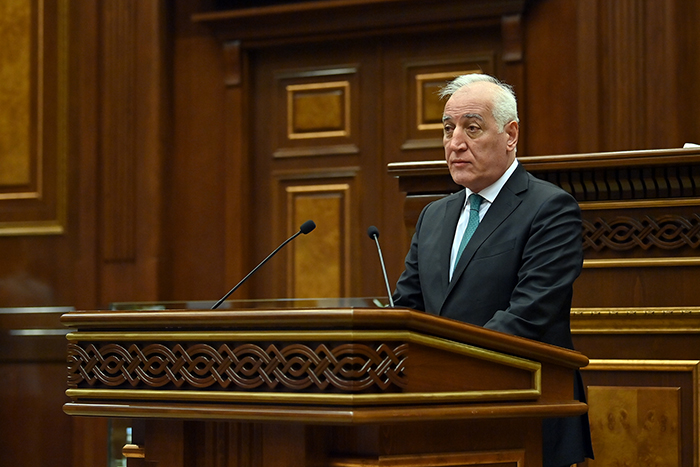
“In a healthy democracy, the government and the opposition serve the same objective through different paths—the advancement of the Republic of Armenia,” the president said. “The challenges facing our country require a strong awareness of the national interest, foresight and the ability to cooperate.”
Although the Rules of Procedure of the National Assembly also provide the Catholicos of All Armenians and the president of the republic with the right to deliver welcoming remarks at the opening of the first session, Catholicos Garegin II was not present because he had not been invited. This marked the first such case in the history of independent Armenia.
By law, one of the three deputy speaker positions and the chairmanships of four standing committees are reserved for the opposition.
Prime Minister Nikol Pashinyan’s Civil Contract party holds the majority in the new parliament, with 64 of the 105 seats. The second-largest force is the Strong Armenia alliance, led by Russia-based billionaire Samvel Karapetyan, which secured 29 seats. The Armenia alliance, headed by Armenia’s second president, Robert Kocharyan, will have a 12-member faction.
However, neither opposition leader will serve in parliament. Karapetyan is legally barred from doing so, while Kocharyan voluntarily declined his mandate.
The Civil Contract board elected Arusyak Manavazyan as head of its parliamentary faction. The Strong Armenia alliance selected Narek Karapetyan, Samvel Karapetyan’s nephew, while the Armenia alliance chose Anna Grigoryan.
Following the formation of the vote-counting commission, the National Assembly proceeded to the election of its president.
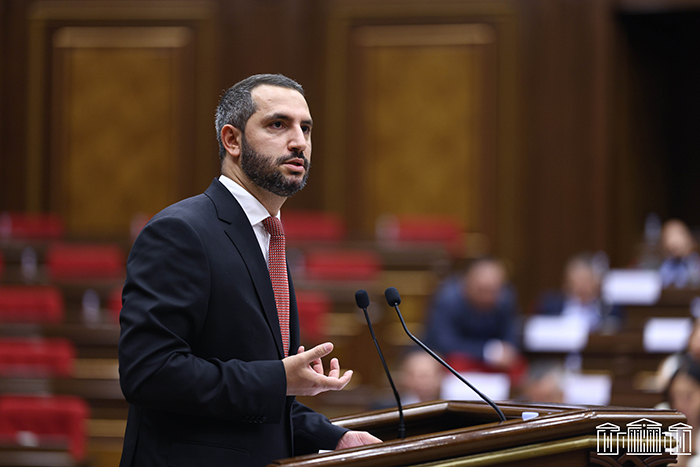
Ruben Rubinyan, the Civil Contract faction’s candidate and a deputy speaker in the previous parliament, was the only nominee.
Faction leader Arusyak Manavazyan presented Rubinyan’s candidacy. No lawmakers asked her any questions concerning the nomination.
Rubinyan then addressed parliament.
The candidate for National Assembly president called on the opposition to break what he described as an emerging nationwide consensus that the new parliament would be worse than its predecessor and would become a venue for disputes and insults.
Rubinyan said the causes of the division were deep-rooted, arguing that the opposition had never accepted the results of the Velvet Revolution and that the disagreement had intensified further in 2021.
He noted that the newly elected parliament includes a lawmaker who has described the revolution as “Turkish-Azerbaijani,” effectively rejecting it. Rubinyan was referring to Edgar Ghazaryan of the Strong Armenia faction.
Rubinyan added that, after concluding that the opposition did not accept the people’s electoral choice, the governing party had, in turn, treated the opposition as an anti-state force.