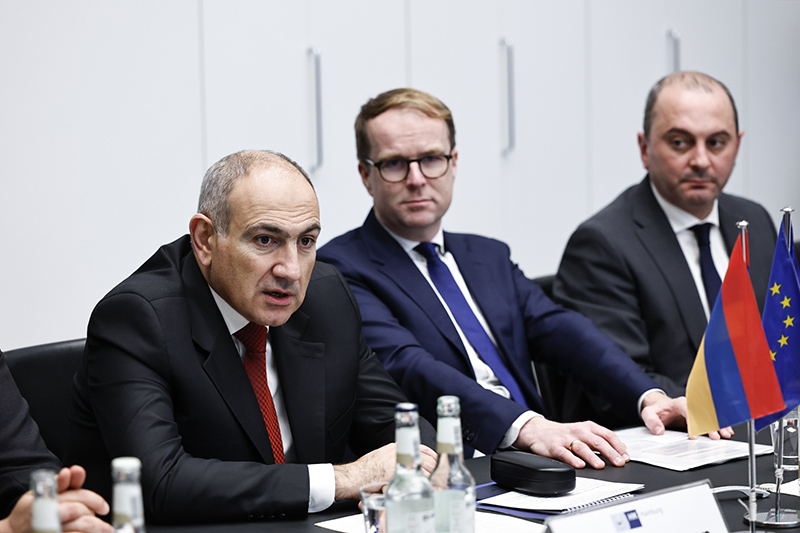
HAMBURG — Responding to Azerbaijan’s claim that the Armenia–EU Strategic Partnership Agenda includes language referring to “Armenians of Karabakh who became refugees after Azerbaijan’s military operations,” Prime Minister Nikol Pashinyan stated that Azerbaijan’s rhetoric about “Western Azerbaijan” is unacceptable and incompatible with the concept of mutual territorial recognition.
Speaking at a meeting with journalists in Hamburg, Pashinyan recalled his August 18, 2025 address—delivered shortly after the August 8 summit—where he warned that the issue of “return” poses serious risks.
“Azerbaijan says ‘Western Azerbaijan’ on one hand, and on the other hand claims that the document refers to ‘Armenians of Karabakh.’ In my August 18 address, I clearly said that the topic of return is extremely dangerous,” Pashinyan noted.
The Prime Minister said he wishes to make an open and public proposal to Azerbaijan:
“Since they have an issue with this topic, and we also have an issue with it, I suggest that we adopt a joint roadmap to close both of these topics in parallel. I have also told our people from Karabakh that their return is not realistic.”
According to Pashinyan, continuing to insist on a return agenda would be equivalent to restarting the Karabakh movement—something he stresses must not happen.
“The Karabakh movement is over, and attempts to restart it are not helpful. At the same time, people in Armenia see that Azerbaijan continues to use the vague term ‘Western Azerbaijan.’ We must understand which is the cause and which is the effect,” he said.
Proposal for a Roadmap to Remove the Issue Entirely
Pashinyan stated that he hopes his proposal is translated and delivered clearly:
“Let us sit down and develop a roadmap for how to remove these topics altogether. Removing them would mean eliminating the possibility of any conflict situation in long-term strategic terms.”
The Prime Minister reiterated Armenia’s fundamental position:
“I have said that there can be no ‘Western Azerbaijan’ in the Republic of Armenia. And yes, since we have recognized each other’s territorial integrity, that must be implemented fully and without exceptions.”
On the Peace Agreement and Azerbaijan’s Demands
Addressing a journalist’s question about whether Azerbaijan’s demand for Armenia to amend its Constitution is obstructing the signing of a peace treaty, Pashinyan said:
“We are working. We do not have any precondition for signing the Peace Agreement. It is not clear whether Azerbaijan has a precondition or not. They bring these topics forward, and we have to deal with them.”
He emphasized that if Azerbaijan claims Armenia’s Constitution contains territorial demands, the fastest way to address that concern is to sign the peace treaty itself:
“Because once the treaty is signed, according to our legal procedures, we are obligated to send it to the Constitutional Court so that the Court can verify its compliance with the Constitution.”
Pashinyan added that he has no legal mandate to ask the Armenian people to amend the Constitution without grounds.
“Why? Because in September 2024 the Constitutional Court ruled that the Alma-Ata Declaration complies with our Constitution. So why would we amend our Constitution? That would mean changing it arbitrarily— and if tomorrow a second or third arbitrary demand arises, what would we do then?” he said.
The Prime Minister concluded by stating that Armenia is not discussing constitutional changes with Azerbaijan, as this is an internal matter of the Republic of Armenia.