
By ENG. HAMBERSOM AGHBASHIAN
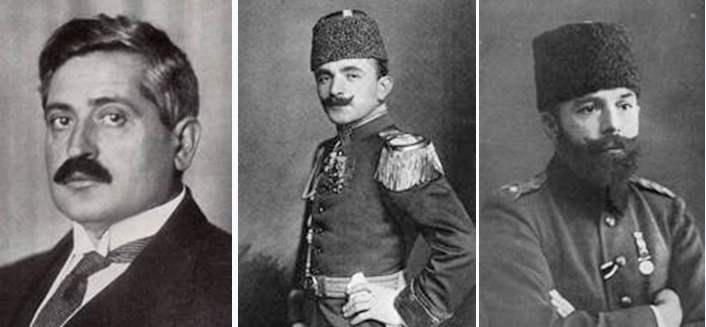
The Union and Progress Party coup led by the trio of Talat, Enver, and Cemal
The Ottoman Empire experienced a series of military defeats and territorial losses, particularly during the Balkan Wars of 1912–1913. This led to concerns among the leaders of the Committee of Union and Progress (CUP) that the Armenians might attempt to seek independence. The Ottoman leaders interpreted isolated instances of Armenian resistance as proof of a widespread rebellion, even though no such rebellion existed. As a result, they implemented mass deportations in an effort to prevent any possibility of Armenian autonomy or independence permanently.
In 1913, taking advantage of the political turmoil, the Committee of Union and Progress staged a coup and seized power. The leaders—Talat Pasha, Enver Pasha, and Cemal Pasha—aimed to establish a homogeneous Turkish state. They regarded the Christian Armenians, with their unique cultural identity and history, as a barrier to their Turkish nationalist goals. The leaders perceived the Armenian population as a potential threat to their vision of a unified Turkish state, fostering an environment of mistrust and hostility towards them. They feared that Christian governments, particularly Russia and other European powers, would support the Armenians in their quest to liberate Western Armenia, as they had previously done for countries like Bulgaria. Talat, Enver, and Cemal unjustly blamed the Armenians for the Ottoman Empire’s struggles, accusing them of collaborating with Russia. This dangerous mindset ultimately led to the catastrophic events of the genocide.
The Road to World War I – (1914)
The Ottoman Empire entered World War I on October 29, 1914. Its involvement was motivated by a desire to regain territory lost in previous conflicts and to free itself from the control of the Great Powers, particularly Britain and France, which had forced it to make various concessions. Two newly purchased ships, crewed by German sailors and commanded by a German admiral, launched raids on Russian ports in the Black Sea. In response, Russia declared war on the Ottoman Empire on November 1, 1914, followed by Britain and France on November 5, 1914. As a result, key figures Talat, Enver, and Djemal successfully brought the Ottoman Empire into the war. Talat Pasha is often seen as the architect of his country’s intervention on the side of the Central Powers, which included Germany and Austria-Hungary—not the Axis Powers—due to his strong hostility toward the Allied forces, particularly Britain and France. Talat Pasha believed that Germany would defeat Britain and France, and he viewed the war as an opportunity to exterminate the Armenians.
The beginning of the setback
The following is a translation of an article by Taha Abdel Nasser Ramadan, an Arabic writer from Tunisia.
Under the rubble of the snow, tens of thousands of Turks froze to death on the day
Source: https://www.alarabiya.net/last-page/2018/09/27/
The Battle of Sarikamish in the Caucasus against the Russians
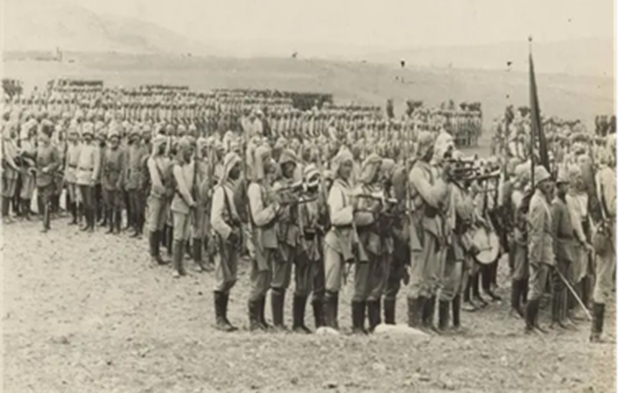
Enver Pasha (1881-1922) ordered an offensive in December 1914, sending tens of thousands of his soldiers to certain death. At the beginning of the campaign, the Ottoman Third Army was estimated to have numbered over 120,000 soldiers. By the end of the campaign, approximately 20,000 remained. In addition to those killed on the battlefield, around 30,000 Ottoman soldiers froze to death due to the cold weather, and another 10,000 died in hospitals from fever and epidemics. Furthermore, the Russians captured thousands more soldiers. Faced with this devastating defeat, Enver Pasha accused the Armenians of providing support to and fighting alongside the Russians. This accusation led to retaliatory campaigns by the Ottomans against the Armenian people, which are now recognized as the Armenian Genocide.
Miscalculations in the Battle Plan: Battle of Sarikamish
The Russian army included Caucasian soldiers, such as Georgians, Armenians, and Tatars. Enver Pasha believed that the Turks (specifically the Tatars of Turkish origin) across the border would rise against the Russians and assist him in defeating them. However, that did not occur. Enver Pasha ultimately lost the war against Russia at Sarikamish, suffering the loss of 100,000 soldiers. He then accused the Armenians of supporting Tsarist Russia. This battle became another basis for accusations of treason against the Armenians, continuing the campaign that ultimately aimed at genocide.
* * *
Next: What happened during the Armenian Genocide in 1915?