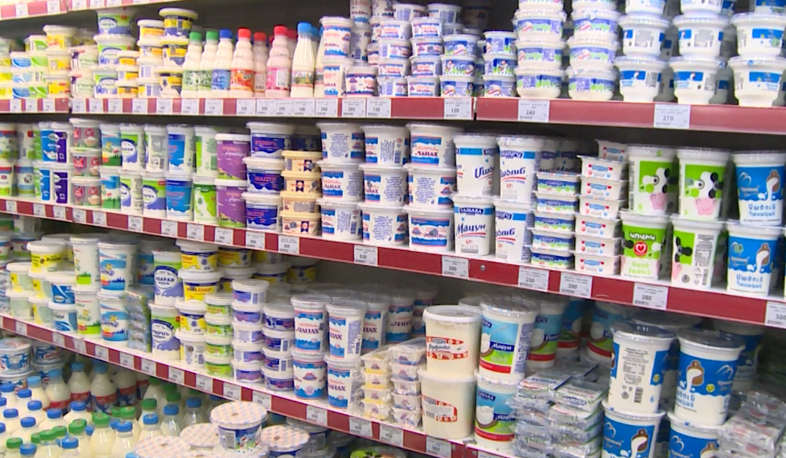

MOSCOW — Russia has imposed restrictions on dairy imports from Armenia, officially citing the need to prevent the introduction of “dangerous infections” and the circulation of products that do not comply with safety requirements.
The restrictions on dairy products are not an isolated case involving Armenian goods in the Russian market. Armenian agricultural products and flowers, certain alcoholic beverages, and Jermuk mineral water have previously come under scrutiny from Russian regulatory agencies. Their entry into Russia was either blocked or subjected to tighter controls, also on officially stated health, safety, and quality grounds.
Against the backdrop of political disagreements between Yerevan and Moscow, the restrictions imposed by Russia are affecting sectors of the Armenian economy that are particularly vulnerable and highly dependent on the Russian market.
Statistics from Armenia’s State Revenue Committee show that the country’s global dairy exports totaled $19.8 million in 2025. Of that amount, more than $17 million worth of products were exported to the Eurasian Economic Union, overwhelmingly to Russia.
This means that the Russian market accounts for the lion’s share—more than 86 percent—of Armenia’s total dairy exports.
Notably, dairy exports had already declined sharply before the latest Russian restrictions were imposed. While Armenia exported more than $23 million worth of dairy products to the Eurasian Economic Union in 2024, that figure fell by 26.1 percent, or more than $6 million, in 2025.
The decline was primarily driven by a sharp drop in butter exports. Compared with $11.2 million, or approximately 1,600 metric tons, in 2024, Armenia exported only $2.29 million worth of butter in 2025, representing a decline of roughly 80 percent.
The downward trend not only continued but accelerated during the first quarter of 2026, according to new data from the Customs Service.
Between January and March 2025, Armenia exported approximately $4.1 million worth of dairy products to the Eurasian Economic Union. During the same period in 2026, that figure declined by a further 25.2 percent, falling to $3.07 million.