
TEHRAN — Iran supports Armenia’s proposed “Crossroads of Peace” initiative and believes its implementation would benefit the entire South Caucasus region. Tehran maintains that connectivity is a key component of economic development and regional prosperity.
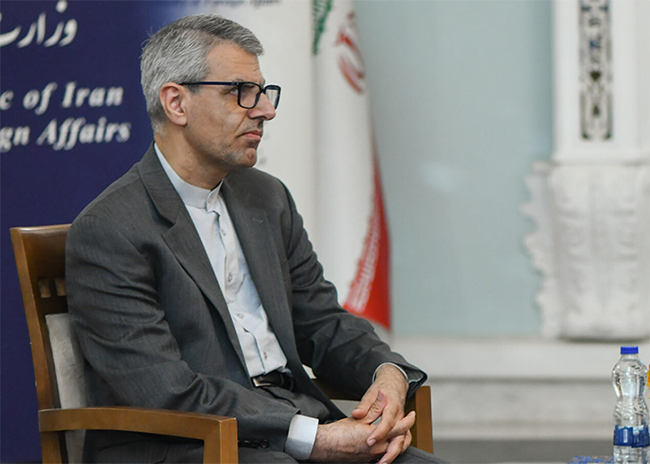
In an interview with Armenpress, Iranian Foreign Ministry spokesperson Esmail Baghaei addressed discussions on unblocking economic and transport infrastructure in the South Caucasus. He spoke about Armenia’s proposal and Azerbaijan’s continued insistence on an extraterritorial corridor to Nakhichevan.
Baghaei also touched on Armenia’s efforts to deepen relations with the West and Iran’s position on the matter, the Armenia-Azerbaijan peace process, and the recent phone call between Iranian President Pezeshkian and Azerbaijani President Ilham Aliyev. During that call, the Iranian president urged Azerbaijan to investigate reports that Israel used Azerbaijani airspace to launch attacks on Iran.
Question: Armenia has proposed the “Crossroads of Peace” initiative based on principles of territorial integrity, sovereignty, jurisdiction, and reciprocity. Meanwhile, Azerbaijan continues to demand an extraterritorial corridor through Armenia to connect with Nakhichevan. What is Iran’s position on this issue?
Baghaei: Allow me to begin by saying this: We greatly value our bilateral relations with both the Republic of Azerbaijan and the Republic of Armenia. They are our neighbors, and we are committed to maintaining a policy of good neighborliness with both nations. We enjoy strong bonds of friendship with both countries.
Regarding Armenia specifically, Iran has a vibrant and important Armenian community, of which we are proud. Peace and stability in the South Caucasus are of vital importance to us because we view the region’s security as part of our own.
We will make every possible effort to support peace between Armenia and Azerbaijan. When it comes to transportation routes, we have always supported them, as we firmly believe that connectivity is fundamental to economic development and the prosperity of Armenians, Azerbaijanis, and Iranians alike.
We sincerely hope that these initiatives yield positive results. We have supported Armenia’s “Crossroads of Peace” proposal and believe it would be beneficial for the entire region. At the same time, we have clearly stated that any transportation routes must respect internationally recognized borders and must not violate the sovereignty or territorial integrity of any country.
Therefore, while we support expanding transport links between the countries of the South Caucasus and Iran, we must proceed with caution.
First and foremost, internationally recognized borders must not be altered, and the sovereignty or territorial integrity of any state must not be compromised in any way.
Another important point we always emphasize — and which we believe all regional countries should consider — is that non-regional actors must not be allowed to interfere in South Caucasus affairs. Such interference would only complicate the situation and would not serve the interests of the regional states. This is our principled position, and we will continue to uphold it.