
YEREVAN (RFE/RL) — Armenia and Iran will strive to create a new transport corridor that would connect India to Europe via their territories, Armenian Transport and Communications Minister Gagik Beglarian revealed on Friday.
Beglarian told RFE/RL’s Armenian service (Azatutyun.am) that he reached relevant understandings with senior Iranian government officials during a visit to Tehran last week. The Armenian and Iranian governments will work together in facilitating cargo shipments between Europe and India that would be carried out through the Persian Gulf, Iran, Armenia, Georgia and the Black Sea, he said.
“We agreed to ship two [sample] containers from [the Indian port of] Mumbai to the Black Sea and on to Europe via the Persian Gulf and Iran and ascertain the price [of such shipments,]” he went on. “According to our rough calculations, the cost of this transit route should be lower than other routes offered to Iran, which, as you know, would pass through Turkey and Azerbaijan.”
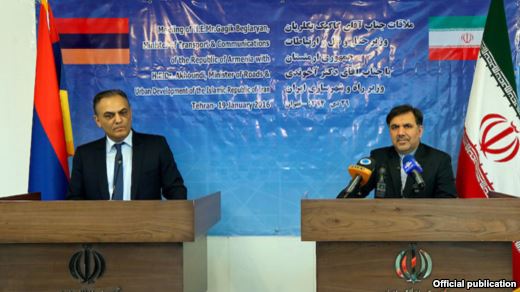
Beglarian met with Iran’s First Vice-President Eshaq Jahangiri, Roads and Urban Development Minister Abbas Akhoundi and Communications and Information Technology Minister Mahmoud Vaezi during the January 20-21 trip to Tehran. According to Beglarian’s press service, he discussed with Akhoundi “the creation of a Persian Gulf-Black Sea corridor.”
Iran’s President Hassan Rouhani was reported to say, in a January 24 phone call with his Armenian counterpart Serzh Sarkisian, that the two neighboring states should “spare no effort in connecting the Persian Gulf to the Black Sea.” The two leaders explored this and other opportunities for closer economic ties that have emerged with the recent lifting of international sanctions against Iran.
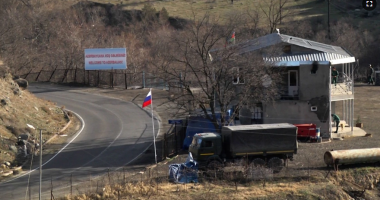
Beglarian said that in an effort to make the would-be Eurasian corridor more attractive the Armenian government will step up this year the ongoing reconstruction of Armenia’s main highways stretching more than 550 kilometers to Georgia and Iran. The government will specifically try to accelerate highway upgrades in the southeastern Syunik province bordering Iran, he said.
“If we start that work from Agarak (a Syunik town on the Armenian-Iranian border) this year, they will realize that our alternative transit route is better,” explained the minister.
The government already borrowed last year $150 million from the Kazakhstan-based Eurasian Development Bank (EDB) to rebuild a 20-kilometer road currently going through a mountain pass close to Agarak. Most of that money is due to be spent on the construction of a 4-kilometer tunnel there.
The tortuous Kajaran pass is situated over 3,000 meters above the sea level and is frequently closed to traffic in winter months because of snowstorms and ice.
In Beglarian’s words, upgrading the Agarak-Kajaran section alone would significantly shorten travel from the Iranian border to Yeraskh, a railway station about 50 kilometers southeast of Yerevan. Under to the ambitious transit project discussed with Tehran, he said, goods from India and Iran would be transported to Yeraskh by trucks and then shipped to the Georgian Black Sea port of Poti by rail