BEIRUT — August 28, 2026, Haigazian University’s Center for Continuing Education (CCE), in collaboration with Samford University and with funding from the U.S. Embassy in Beirut, celebrated the successful completion of the Lebanese American Social Work Collaboration (LASWC) project and the graduation of the first cohort of the Advanced Diploma in Social Work at a closing and graduation ceremony held on August 28, 2026, at the Haigazian University Auditorium.
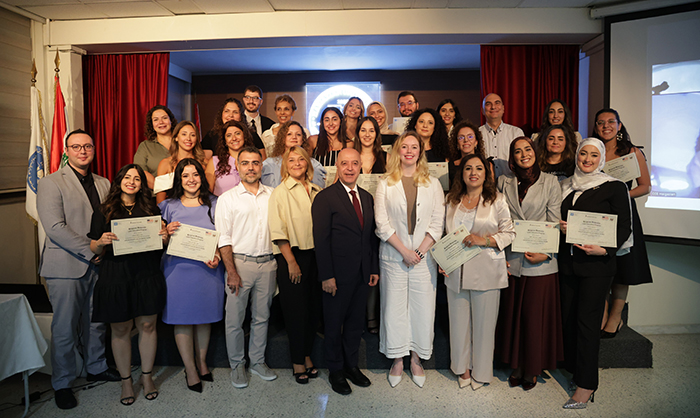
The event was attended by Rev. Dr. Paul Haidostian, President of Haigazian University; Ms. Evelyn Garrity, Public Diplomacy Officer at the U.S. Embassy in Beirut; Mr. Elie Ferneiny, Public Engagement Specialist in the Embassy’s Public Diplomacy Section; Dr. Nadia Badran, President of the Social Workers’ Syndicate in Lebanon; faculty members; graduates and their relatives and guests. The ceremony marked the graduation of 28 social workers and the transition of the initiative into a sustainable professional development program to be offered through CCE.
The Advanced Diploma was developed under the “Lebanese American Social Work Collaboration: Equipping Social Workers in Lebanon for Practice with Vulnerable and Disadvantaged People,” a joint initiative designed to respond to the evolving professional needs of social workers working with vulnerable and disadvantaged populations, particularly in crisis-affected contexts. The project was supported by the Social Workers’ Syndicate in Lebanon (SWSL) and funded through a U.S. Embassy Public Diplomacy Section grant.
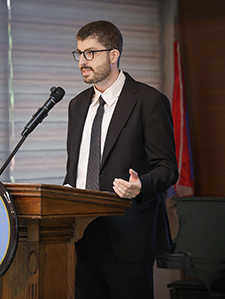 Speaking during the ceremony, Christopher Kijilian, CCE Supervisor and LASWC Project Coordinator, outlined the development of the program, which began with a nationwide assessment of social work practice and professional development needs. The research included responses from 108 practicing social workers and 16 in-depth interviews, providing the foundation for a research-informed curriculum addressing key areas of contemporary social work practice.
The resulting program comprised five modules covering psychosocial assessment, management and referral; monitoring, evaluation, accountability and learning (MEAL); mental wellbeing, self-care and staff care; and legal, policy and advocacy frameworks. The pilot was delivered from September 2025 to July 2026 through a blended learning model combining online and in-person instruction, asynchronous learning, applied activities, assessments and project-based work. Continuous participant feedback was incorporated throughout the pilot, enabling the project team to refine the program’s structure, pacing, assignments and assessment methods while maintaining academic standards.
Several core project team members shared their reflections: Dr. Shaghig Hudaverdian emphasized the importance of continuing professional development for social workers operating amid Lebanon’s complex economic, social and humanitarian challenges. She highlighted the value of the collaboration between Haigazian and Samford universities and expressed hope that the diploma would continue to expand and reach more practitioners, stressing that investing in social workers is an investment in Lebanon’s future. Mr. Bedros Kazazian emphasized the collaborative and adaptive nature of the curriculum’s development, noting that it was shaped by research, professional needs and the experiences and feedback of participants. He highlighted the graduates’ commitment and resilience and underscored that strengthening social workers’ professional capacities ultimately contributes to stronger support for the vulnerable communities they serve.
Dr. Rachel Hagues reflected on the origins of the partnership, which grew from research conducted in Lebanon in 2019 on social workers supporting refugees. She noted that the diploma represented a continuation of that collaboration and emphasized the team’s commitment to developing a sustainable, evidence-informed program responsive to national data, participant feedback and local realities. Dr. David Cecil likewise highlighted the importance of participant engagement in shaping the program and noted the shared professional values that connect social workers across countries, particularly their commitment to human dignity and supporting vulnerable populations.
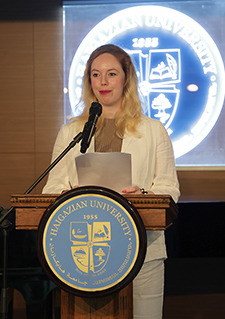 In her address, Ms. Evelyn Garrity, Public Diplomacy Officer at the U.S. Embassy in Beirut, congratulated the 28 graduates and commended their commitment to professional growth and service to communities across Lebanon. She highlighted the significance of the sustained partnership between Haigazian and Samford universities, noting that the program’s integration of Lebanese and American expertise has established a professional program that will continue through Haigazian University’s Center for Continuing Education. She further underscored the role of skilled and ethical social workers in strengthening civil society and encouraged graduates to translate the challenges they encounter in the field into opportunities for research, advocacy and policymaking.
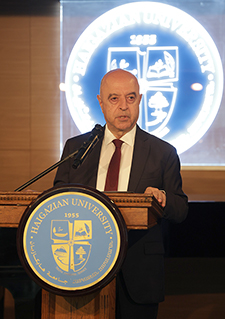 In his remarks, Rev. Dr. Paul Haidostian, President of Haigazian University, congratulated the first graduating class and emphasized that the diploma represents not an end to learning, but a new chapter in the graduates’ commitment to professional service. He highlighted Haigazian University’s longstanding commitment to social work education and the importance of the partnership with Samford University and the U.S. Embassy. Dr. Haidostian stressed that social work is more than a profession, describing it as a commitment to people grounded in knowledge, competence, empathy, dignity and hope, and expressed his hope that the graduates’ work would contribute to a kinder, stronger and more cohesive Lebanon.
Two graduates also reflected on the value of the program. Ms. Andrea Maalouf noted that the diploma broadened her professional knowledge and provided practical tools in areas ranging from psychosocial support and mental wellbeing to child protection, humanitarian practice, MEAL, data analysis and advocacy. Ms. Chourouk Kouteich, drawing on more than a decade of professional experience, emphasized the value of structured and updated knowledge as well as the opportunity for practitioners from different sectors to exchange field experiences. She also highlighted the program’s accessibility and flexibility, which enabled participants to pursue advanced learning alongside their professional responsibilities.
The ceremony concluded with the presentation of Advanced Diplomas to the 24 graduates in attendance, followed by a group photograph and reception.
With the successful completion and refinement of the pilot, the Advanced Diploma in Social Work will continue as a sustainable offering through Haigazian University’s Center for Continuing Education, with the next cohort planned for 2027. The finalized diploma comprises 200 total learning hours, combining live instruction, structured asynchronous learning, assessments and applied project work. Standard admission requires a formal degree in Social Work from a recognized institution and sufficient English-language proficiency. Three to five years of professional social work experience is recommended, but not required.
Participants will be able to progress through the five modules and complete the full diploma pathway within a maximum of two years, receiving a certificate of performance for each successfully completed module and the Advanced Diploma upon completion of all five modules.