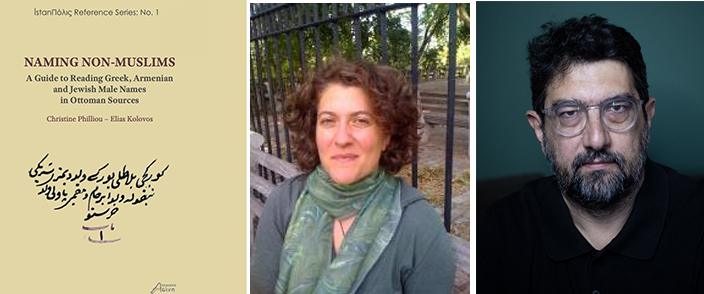
ATHENS – Asini Publications announced the publication of Christine Philliou’s and Elias Kolovos’s Naming Non-Muslims: A Guide to Reading Greek, Armenian, and Jewish Male Names in Ottoman Sources.
This important book is a reference work intended as a resource for researchers working with Ottoman sources on non-Muslim communities—Armenians, Greeks, Slavs, and Jews. The main body consists of separate lists of Greek (primarily Greek Orthodox, including some Slavic names), Armenian, and Jewish/Hebrew names. For each entry, the Ottoman spelling is followed by a transliteration into Latin characters, the standard form of the name in its source language (Greek, Slavic, Armenian, or Hebrew), commentary on the name’s meaning and variants, and relevant bibliographical references.
The impetus for the book was the widespread misspelling, misreading, and consequent misidentification of non-Muslim names in Ottoman sources by researchers unfamiliar with the languages from which those names originated. The authors maintain that accurately identifying and spelling the names of non-Muslims is a key prerequisite for understanding who they were as unique individuals rather than reducing them to nameless members of religious or ethnic communities. The lists are preceded by an introduction by Philliou and a preface by Kolovos, which discuss the value of Ottoman population registers for the study of Armenians, Greeks, and Jews in the nineteenth-century Ottoman Empire and emphasize the importance of reading their names accurately.
According to Philliou and Kolovos, one of the greatest obstacles to researching and writing the history of Armenians and other non-Muslims in the Ottoman Empire is the difficulty of deciphering their names in Ottoman Turkish, which was itself written in Arabic script. The spelling of non-Arabic names was often improvised within a writing system not designed to represent them. As a result, unless a researcher already has some idea of what a particular name might be, it can be extremely difficult—and sometimes impossible—to identify it correctly. Most Turkish scholars today do not know Armenian, let alone Greek or Hebrew, while non-Turkish scholars may know one of these languages in addition to Turkish, but very few researchers possess expertise in all of them.
“We used a particular population register from 1821 to compile our list of names, focusing on the Bazaar of Istanbul’s Old City, where we found thousands of Armenians, who had by far the largest presence among the three non-Muslim groups,” the authors explain. “This alone provides grounds for further fascinating research on Armenians in the Ottoman capital as early as the beginning of the nineteenth century.”
The book includes an extensive list of the historical names of Armenian, Greek, and Jewish individuals who lived quite literally alongside one another in the khans of Ottoman Istanbul and in Galata, Yeniköy, Emirgan, and Boyacıköy—all areas surveyed in the unique 1821 register studied by the authors. These individuals brought with them naming practices from across the provinces of the Ottoman Empire while simultaneously interacting with and influencing one another through everyday life, including, potentially, in their naming practices. In this sense, the names recorded in the register provide not only a practical tool for identifying individuals in Ottoman sources but also an important point of departure for investigating migration, community formation, cultural interaction, and everyday life in nineteenth-century Istanbul.
Review:
“Our names define us. When we meet someone, we introduce ourselves with our names first. They constitute the center of our individual identities. They also help us navigate our relationships with people around us, turning random people into individuals. Naming Non-Muslims, therefore, is not simply A Guide to Reading Greek, Armenian and Jewish Male Names in Ottoman Sources as its subtitle describes it. It invites scholars (like myself), who do not read Armenian, Greek, or Hebrew and mainly work with Ottoman Turkish, to acknowledge Armenian, Greek, and Jewish Ottomans, whose names are recorded in Ottoman archival documents in Arabic letters, as unique individuals with unique lives who actually write their names in different alphabets and speak different languages that shape the ways in which they understand themselves and the world around them. Naming Non-Muslims, thus, transforms “non-Muslims,” who have mostly been defined negatively by their not-belonging to the Muslim community in Ottoman historiography, into people. By recording the shared names between Armenian, Greek, Jewish, and Muslim Ottomans, Naming Non-Muslims also invites us to consider more seriously the ties that bound these confessional communities together in Ottoman society.” Baki Tezcan, University of California, Davis
Christine Philliou, Professor in the Department of History and Director of the Center for Middle East Studies at UC Berkeley, specializes in the connected histories of the Balkans and Middle East since the 17th century, focusing particularly on the emergence of the Greek and Turkish nation-states out of the Ottoman Empire in the 19th and 20th centuries. Her books include Biography of an Empire: Governing Ottomans in an Age of Revolution (UC Press, 2010) and Turkey: A Past Against History (UC Press, 2021). She also directs a collaborative digital/public humanities project on Greek Orthodox communities in the larger context of late Ottoman Istanbul/Constantinople (1821-1923): http://istanpolis.org/. Her forthcoming book, An Ottoman Pompeii: The Greek Revolution and the Limits of Conviviality in 1821 Istanbul (Koç University Press 2026) is the first fruit of that collaboration.
Elias Kolovos is Research Director with a specialization in Ottoman History at the Institute of Historical Research of the National Hellenic Research Foundation, in Athens, Greece. He is the elected Secretary of the Board of the International Association for Ottoman Social and Economic History. In the past, he served as Professor of Ottoman History at the Department of History and Archaeology, Faculty of Letters, University of Crete, serving also as the Director of the M.A. in Ottoman History Program of the same Department. He has written, edited, and coedited 20 books and over 80 papers in Greek and international publications and journals. His research interests include Mediterranean economic history, the history of insular (island) worlds,the history of frontiers, rural and environmental history, as well as spatial history and legacies of the Ottoman Empire.
Copies of Naming Non-Muslims: A Guide to Reading Greek, Armenian, and Jewish Male Names in Ottoman Sources can be purchased through Asini’s website or by emailing [email protected].