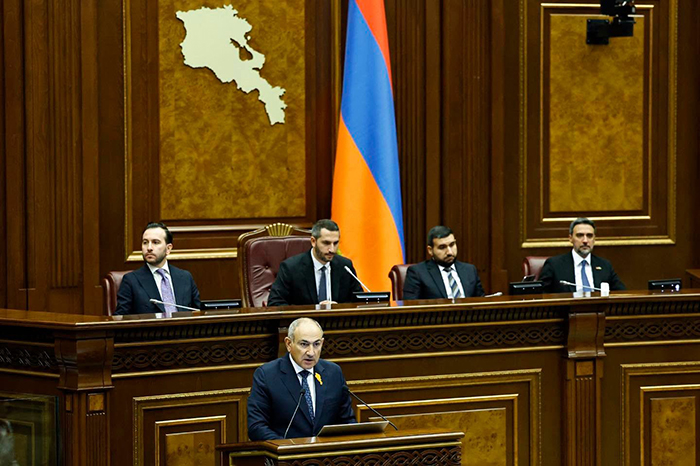

YEREVAN — Armenia will soon begin the process of submitting a formal application for membership in the European Union, Prime Minister Nikol Pashinyan said on August 24 while presenting the government’s 2026–2031 program in the National Assembly.
“Having answers to these questions is important not only from a procedural standpoint, but also so that we can provide at least approximate answers to questions the public may raise during a referendum. In order to work on answers to these questions, Armenia must first submit a formal application for membership in the European Union. This is also a process that requires extensive work, and we will probably begin it in the near future, especially taking into account the recommendations of our EAEU partners,” Pashinyan said.
The prime minister explained that holding a referendum on joining the EU or remaining in the Eurasian Economic Union (EAEU) would make sense once Armenia receives a response to its formal application and the timetable for the necessary reforms becomes clearer.
He also said Armenia views a statement by its EAEU partners on the issue as a friendly gesture.
“Of particular note is the joint statement issued on May 29 of this year by the leaders of four EAEU member states, in which they said, and I quote: ‘We share the position regarding the need to hold a nationwide referendum in the Republic of Armenia as soon as possible on joining the European Union or remaining in the Eurasian Economic Union.’ We view this as a friendly gesture, which we highly appreciate, and I am confident that such a referendum will definitely take place in Armenia,” Pashinyan said.
Addressing foreign and economic policy, the prime minister emphasized that diversification and the development of alternatives are matters of national security and sovereignty. He argued that a lack of alternatives gives other countries leverage to impose decisions on Armenia.
“Independence means replacing dependence on a few with dependence on many, and the petroleum-products market is an excellent example of this formula in practice. Between 2024 and 2026, petroleum products were imported into the Republic of Armenia from 20 different countries. That is genuine diversification and balanced policy, and this approach must be extended to all sectors of the economy,” he said.
As an example of the risks created by a lack of alternatives, Pashinyan pointed to restrictions imposed by Russia on Armenian exports, particularly roses. He described the situation as a crisis not for Armenia, but for the EAEU itself, while noting that it also provides Armenian exporters with an opportunity to find new buyers and markets.
“The restrictions imposed by the Russian Federation on Armenian exports contradict the regulations of the Eurasian Economic Union. This is essentially a crisis for the EAEU, and we have already begun discussions on the matter within the organization,” Pashinyan said.
The prime minister also cited Armenia’s petroleum-products market as an example of successful diversification. He said that despite disruptions in global supplies, Armenia avoided a fuel shortage, in part because petroleum imports from Azerbaijan began in 2025.
“Despite the crises affecting petroleum supplies in the Strait of Hormuz and the Russian Federation, Armenia did not face a gasoline crisis because the tightly controlled petroleum market that existed before the 2018 revolution was liberalized, and in 2025 this was supplemented by petroleum imports from Azerbaijan,” he said.