STOCKHOLM — A confidential document obtained by Swedish investigative outlet Blankspot claims that Russia is seeking to influence Armenia’s upcoming parliamentary elections by undermining the popularity of Prime Minister Nikol Pashinyan and shaping public opinion ahead of the June 7 vote.
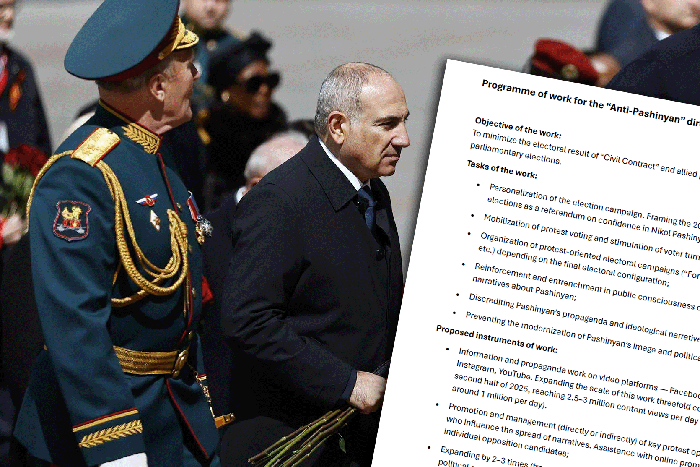
According to the report, the leaked Russian-language document, titled “Programme for Work in the ‘Anti-Pashinyan’ Direction for 2026,” outlines strategies aimed at portraying the election as a referendum on Pashinyan personally and limiting the influence of Armenia’s current government before the parliamentary elections. The document also reportedly emphasizes preventing any effort to “modernize” or improve Pashinyan’s political image ahead of the vote.
The report states that the document does not explicitly endorse any opposition party over Pashinyan’s ruling Civil Contract party, but instead focuses on methods for influencing Armenian public opinion. Proposed measures allegedly include tripling the reach of Russia-aligned narratives on social media — increasing from one million daily views in late 2025 to as many as three million — and expanding the network of pro-Russian opinion makers from 15 to approximately 40 individuals.
The document also reportedly describes plans for “false flag” social media campaigns, coordinated comment attacks targeting campaign workers from the ruling party, and the creation of specialized media teams tasked with producing exclusive election-related content.
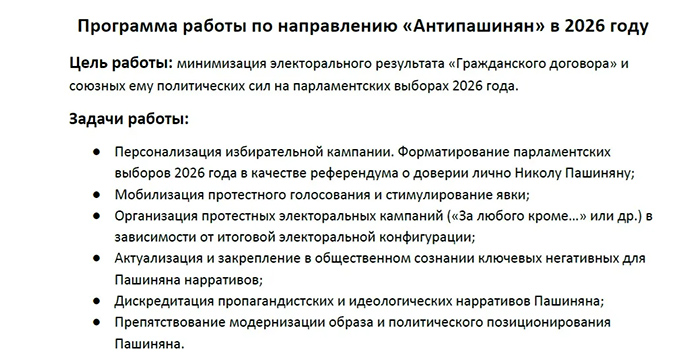 At the beginning of the document, Russia’s objectives ahead of the Armenian election are outlined. The full document can be read in both Russian and English.
Blankspot said it was able to verify the authenticity and origin of the document through a trusted source, although the publication noted it could not independently determine how extensively the strategy has been implemented or how central it is to broader Russian influence efforts in Armenia.
According to the investigation, the document was linked to materials allegedly obtained after an individual connected to Russian intelligence services was hacked by a third party before March 2026. The outlet reported that the individual had participated in conferences and seminars in Armenia, met with opposition politicians, and regularly commented in the media about Armenia’s geopolitical direction, often warning against distancing the country from Russia.
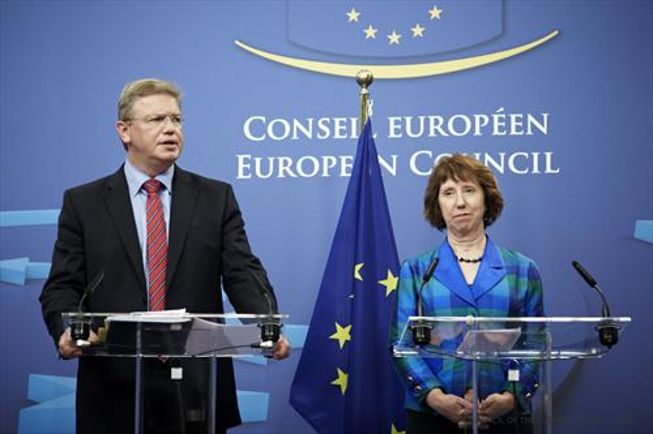
The issue of alleged Russian interference has become increasingly prominent in Armenian political discourse in recent months. According to the report, the Armenian government requested assistance from the European Union in December 2025 to help counter Russian influence operations, similar to support previously provided to Moldova during its parliamentary elections.
EU foreign policy chief Kaja Kallas reportedly stated that networks previously active in Moldova are now also operating in Armenia. Similar concerns have additionally been raised regarding Georgia.
The report further noted that in April, Meta shut down around 70 fake Facebook accounts and pages operating in Armenia, while Russian officials have repeatedly accused Armenian civil society groups of spreading “anti-Russian narratives.” Cybersecurity analysts have also alleged that Russia has carried out phishing attacks targeting Armenia.
Patrik Oksanen, a senior fellow at the Stockholm Free World Forum specializing in Russian influence operations, told Blankspot that the contents of the document closely align with previous analyses by Swedish authorities.
“What becomes clear from the document is that Russian influence is not primarily about propaganda in the classical sense. It is about social engineering — creating mistrust, polarization, and resignation within society,” Oksanen said.
He added that such strategies are designed not only to influence opinions, but also to shape public reactions and political behavior through systematic and data-driven psychological operations.
The report noted that Armenia’s June parliamentary elections are expected to center on a contest between Pashinyan’s government and the newly formed Strong Armenia party led by Russian-Armenian businessman Samvel Karapetyan. Opinion polls currently show the ruling government maintaining a lead.
The upcoming vote will be Armenia’s first parliamentary election since the snap elections of 2021, held shortly after the 2020 Nagorno-Karabakh war. While Civil Contract won that election, Pashinyan’s popularity has since declined, particularly following the displacement of more than 100,000 Armenians from Nagorno-Karabakh after Azerbaijan’s 2023 military offensive. Critics have also argued that several democratic reforms promised after Armenia’s 2018 political transition have not been fully implemented.