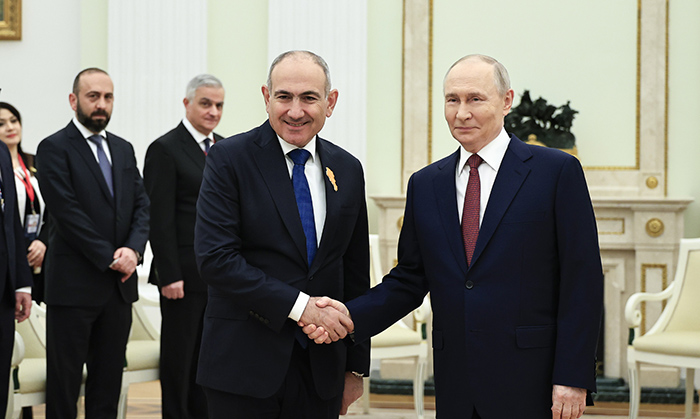

YEREVAN — Armenian Prime Minister Nikol Pashinyan announced that he and Russian President Vladimir Putin have agreed to hold their next high-level meeting in the second half of June, following the elections. He made the statement during a press briefing at the government building.
Pashinyan also described his April 1 working visit to Moscow as highly successful. Referring to the remarks he made during his open meeting with Putin—which drew mixed reactions both in Russia and among Armenia’s opposition—he stressed that he had said nothing new and had simply reiterated positions he had expressed previously.
“I did not say anything new during the meeting with the President of Russia. Everything that was said there is something you have already heard from me here, whether in this format or another,” Pashinyan noted.
According to the Prime Minister, Armenia–Russia relations are currently in a phase of constructive transformation, a process he described positively.
“We will continue to uphold our principle. We will not move away from the logic of friendly dialogue and will continue along this path,” he said.
During the April 1 meeting in Moscow, Putin pointed to the economic consequences of Armenia’s foreign policy choices, emphasizing that membership in a customs union with the European Union and participation in the Eurasian Economic Union are incompatible. He also touched on domestic political matters, mentioning that some individuals with Russian passports were currently in detention and saying he would like to see them participate in political processes.
In response, Pashinyan stated that there are no participants in political processes among those imprisoned in Armenia, and clarified that, under Armenia’s Constitution, individuals holding Russian citizenship cannot run either for parliament or for prime minister. Addressing criticism regarding the Collective Security Treaty Organization, he said its mechanisms should have been activated but were not. On the Karabakh issue, he added that Armenia’s recognition of territorial integrity came only after senior Russian leadership had publicly made similar statements twice.