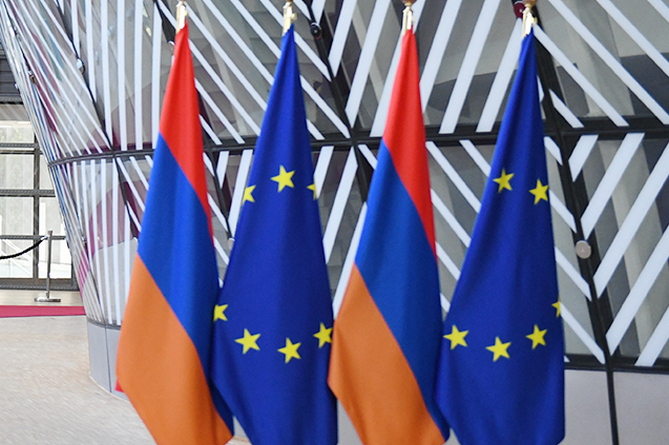

BRUSSELS — The European Union is set to launch a second civilian mission in Armenia, after EU member state ambassadors in Brussels today approved the decision, paving the way for its final endorsement, which is expected at next week’s meeting of EU foreign ministers.
According to a proposal by the EU High Representative for Foreign Affairs and Security Policy, reviewed by Azatutyun radio, the new mission’s mandate, structure, and duration are designed to strengthen Armenia’s resilience against hybrid threats by providing strategic and practical advice to ministries and security-sector agencies.
This advisory support will focus on:
- policy development,
- detecting and responding to foreign information manipulation,
- cyberattacks,
- and illicit financial flows.
The mission will also assess what Armenia needs to further develop its security-sector capacities so the country can more effectively identify and respond to hybrid threats in line with EU methodologies and standards.
The EU’s internal justification document reportedly notes that Armenia’s parliamentary elections scheduled for June, the local elections expected afterward, and a possible constitutional referendum will serve as a major test not only for the democratic process, but also for the country’s internal stability and regional peace.
By dispatching this new mission, Brussels is emphasizing that one of its objectives is to “reduce and neutralize Russia’s destabilizing actions” in Armenia.
The document also highlights broader risks, including Armenia’s domestic political developments, external economic pressure, and information manipulation. In addition, it specifically points to the possibility of war involving Iran, stressing that Armenia’s border with Iran—one of only two open borders—is crucial for the country’s communications and the North–South transport and trade corridor.
“This tension could further increase Russia’s leverage over Armenia’s economy and energy needs and could be exploited on the eve of elections,” the document notes, adding that there are also risks related to possible migration flows, organized crime, and other illegal activities.
The new EU team is expected to be deployed in Armenia for two years, with 20 to 30 international staff members, and will operate under the name “European Union Partnership Mission.” It is also expected to remain open to participation by third countries if and when Brussels reaches agreements with them.
“Without prejudice to the EU’s decision-making autonomy and its unified implementation, third countries may participate in the mission, provided that they cover the costs of the personnel they deploy,” the adopted document states.