
By KRIKOR KHODANIAN
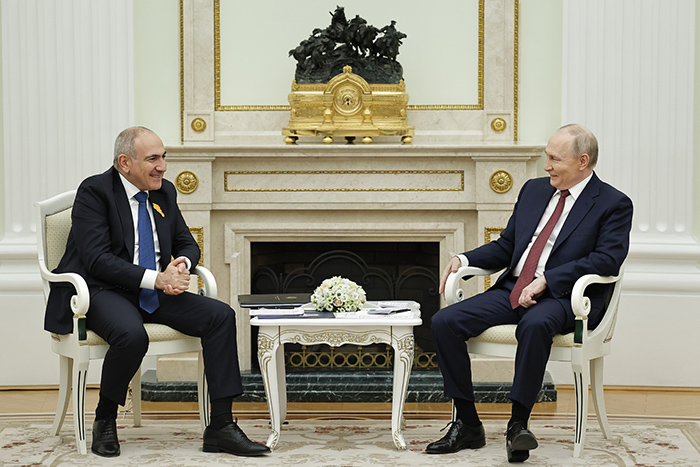
At the beginning of meetings between heads of state, it is customary to allow journalists a brief opportunity to approach and take photos. On such occasions, the leaders exchange a few polite remarks before proceeding to a closed-door discussion. However, what took place during the meeting in Moscow between Armenian Prime Minister Nikol Pashinyan and Russian President Vladimir Putin was quite unusual and caused surprise in both political and public circles.
The Russian president, speaking at length about Armenia’s upcoming parliamentary elections, stated that there are pro-Russian forces in Armenia and that Moscow would like those forces and figures to have the opportunity to participate in the elections. “Some of these figures are currently in detention despite holding Russian citizenship,” Putin said. Although he did not mention names, it was clear he was referring to Samvel Karapetyan, who is under house arrest and holds Russian citizenship.
Prime Minister Pashinyan explained that Armenia’s Constitution does not allow a citizen of another country to become either a member of parliament or a candidate for prime minister.
This exchange was immediately followed by statements from high-ranking Russian officials that clearly aimed to influence the mood of Armenian voters. Russian Deputy Prime Minister Alexey Overchuk stated that Armenia is very close to a point at which Russia may be forced to reconsider its economic relations with the country. In another interview, he made a rather unusual statement, warning that if Armenia were to join the European Union, it would no longer have air links with Russia.
“At present, there are no air connections with European Union countries, which means that if Armenia joins the EU, we will not have air communication with Armenia,” he said.
Overchuk is well aware that Armenia’s accession to the European Union would require a lengthy process, potentially taking 10 to 15 years. Relations between European countries and Russia, including air travel, have been severed due to the war in Ukraine and will most likely be restored in the future. The Armenian public is not so naïve as to believe that it must vote for Russia’s preferred candidate to maintain the ability to travel to Russia by air.
Overchuk was not the only one to comment on Armenia’s elections. Kremlin spokesperson Dmitry Peskov, for his part, stated that Russia has the right to discuss the upcoming elections with Armenia, given the close relations between the two countries and the fact that the Armenian diaspora in Russia exceeds 2 million people. By the same logic, the United States, France, Lebanon, and several other countries with sizable Armenian populations would also have the right to interfere in Armenia’s internal affairs. Yet none of them has shown such an intention.
By openly aligning themselves with a “pro-Russian” candidate, Russian political circles are, first and foremost, harming that very candidate, who is trying to convince the Armenian public that he is exclusively “pro-Armenian” and will not submit to the dictates of any foreign power.
These developments also have a positive side. Rather than attempting to influence voters through so-called “hybrid” warfare and disinformation, Russia has moved to openly support its preferred candidate. Yes, Russia has economic tools to exert pressure on Armenia, but it is ultimately up to its citizens to decide which path their country should take: to fully submit to Putin’s Russia, or to choose a path grounded in sovereignty and national interests.
“MASSIS”
Note: Translated with the assistance of ChatGPT.