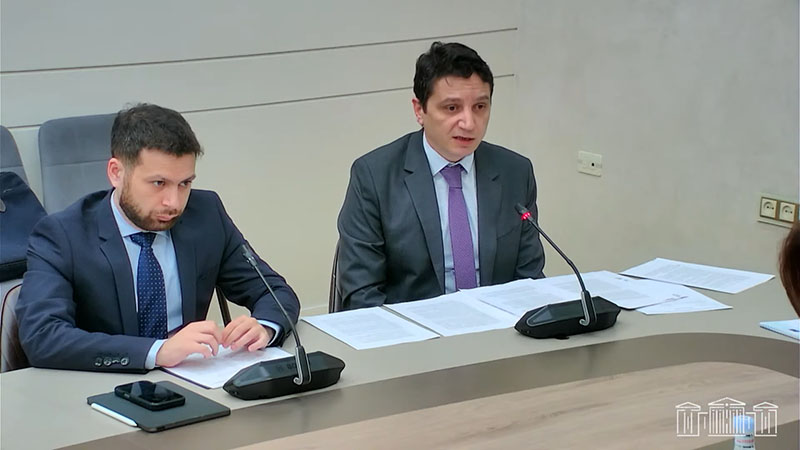

YEREVAN — The scope of financial assistance provided by the European Union to Armenia, as well as the progress of its implementation, was discussed at the National Assembly of Armenia.
During a session of the Standing Committee on European Integration, MP Armen Gevorgyan from the “Armenia” faction recalled that in recent years, approximately €3 billion in support has been announced through various platforms. This includes a €2.6 billion Economic and Investment Plan, a €270 million program, and a recently announced additional €140 million.
The MP raised the question of how much of these funds have actually reached Armenia and how they have impacted the country’s economy.
Minister of Finance Vahe Hovhannisyan responded that a number of programs are currently being implemented, a significant portion of which are related to infrastructure development.
“We have carried out numerous programs, with the largest share dedicated to financing the North-South Road Corridor,” Hovhannisyan said, adding that projects related to Syunik’s resilience and other initiatives are also underway.
Deputy Foreign Minister Vahan Kostanyan provided more precise figures, noting that €1.496 billion has already been allocated from the €2.6 billion Economic and Investment Plan.
According to him, €62.5 million has been spent from the €270 million “Resilience and Growth” program, while the allocation of approximately €210 million has already been approved.
The discussion also touched on the qualitative impact of these investments. Gevorgyan inquired about how these programs are influencing Armenia’s economic structure.
Minister Hovhannisyan noted that, on average, total investments have an estimated multiplier effect of around 1.4 on GDP growth, although each project is evaluated individually based on feasibility studies.
“If we consider, for example, the programs implemented in cooperation with the European Union, it is beyond doubt that the ongoing construction of the southern section of the North-South Road Corridor will have a significant impact on the realization of the ‘Crossroads of Peace’ initiative. These are important programs both economically and strategically, although their full impact will only become visible once the infrastructure is fully completed,” he said.
He added that the Syunik resilience program also includes the development of various types of infrastructure, such as kindergartens, hospitals, and water systems.
Kostanyan further emphasized that EU support also includes the development of standards and institutional infrastructure, which is expected to yield more substantial results in the medium and long term.