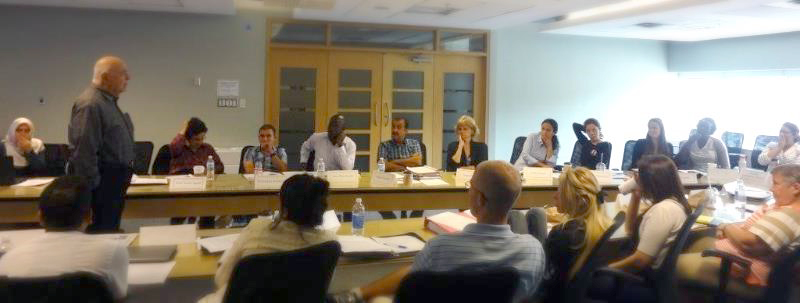
TORONTO — The running of the twelfth annual Genocide & Human Rights University Program (“GHRUP”) couldn’t have been timelier considering the atrocities and human rights violations currently taking place in Syria, Egypt, and several countries in the Middle East and Africa.
This year, 22 students came to Toronto from 10 countries to meet and study with ten distinguished genocide scholars. Many of the students came from backgrounds where gross violations of human rights and genocide are part of their national or personal experience, such as Kurds, Nigerians, Pakistanis, Armenians, Jews, Muslims, and Christians. There were several students who work to provide aid to affected communities, such as those of Guatemala and Sudan. Perhaps even more remarkable was the number of students who do not have a direct connection, yet are deeply motivated to understand human rights violations and genocide and how to raise awareness to prevent them around the world.
The Course Director, Prof. Joyce Apsel of New York University, noted, “Several students who are teachers commented on how much they learned from watching the pedagogy of different instructors, as well as from the course content. Other students consulted me and other instructors about which directions and schools to pursue for graduate education. They proved to be an outstanding group of students, and it was a privilege to have two weeks in and out of the classroom to exchange ideas and interests.”
Indeed, the students brought many diverse experiences to the classroom. One student who is a journalist by trade, described to the class, based on a personal visit to North Korea, the importance of maintaining a critical perspective on decades-old yet still ongoing human rights abuses there. Another student presented the current and historical human rights abuses of disabled peoples affected by policies of eugenics in the USA, a group she works with in her field of Social Work and Disability Studies. Yet another brought the class to tears by discussing her own family’s history of having suffered chemical attacks in the Halabja massacre of March 16, 1988. The GHRUP allows students the opportunity to voice these backgrounds, to analyze comparatively how genocides unfold, their immediate and transgenerational effects on people, and to explore how we can stop them.
It was remarkable to see descendants of perpetrator and victim groups in the Armenian Genocide—students of Armenian, Kurdish and Turkish background—find common interests with each other, and within the academic environment of the program and based on historical facts, explore issues of stereotypes, memory, denial and reconciliation together and see each other through the prism of humanity.
One student from Pakistan, currently a member of the UNAMID effort in Darfur, Sudan, brought to the course the perspective and the dedication of those who work to prevent genocide in the field.
This year, a business student audited the course. At the end of the course this student made a spontaneous and moving speech in which she said that the course restored her faith in humanity. The GHRUP evokes a powerful sense of enthusiasm and commitment from students and faculty alike, and makes them reflect on their own lives and the lives of all others in the world. This student’s feeling of connectedness to the students and the course was really a beacon of hope.
The sentiments of all the students who attended the course are perhaps best captured in their own words. Explaining their perception of the program’s greatest strength, one student commented, “I think the GHRUP does an amazing job of providing an incredibly comprehensive course in such a short period of time. The quality of the scholars and students, and the incredible range of experiences and backgrounds are unparalleled.” Another student wrote that “This program is life- and career-changing. It focuses on the history of genocide, the patterns of genocide, the denial and prevention of genocide.”
YEREVAN — Armenia and India have agreed to expand cooperation in defense technologies, research, innovation…
YEREVAN — Civil Contract parliamentary faction member Artur Hovhannisyan has criticized the Collective Security Treaty…
YEREVAN — Romanos Petrosyan, temporary manager of Electric Networks of Armenia (ENA), has outlined five…
BRATISLAVA — Armenian Greco-Roman wrestler Samvel Terteryan won the gold medal in the 77 kg…
By BERGE JOLOLIAN Look closely at this ancient Armenian coin of King Tigranes IV and…
YEREVAN — Armenia’s first Strategic and Systemic Sports Reform Forum was held today at the…