Coin of Tigranes IV and Queen Erato, Kingdom of Greater Armenia, c. 2 BC–AD 1. Bronze dichalkon, Artashat (Artaxata) mint. Obverse: jugate portraits of Tigranes IV and Erato. Reverse: Mount Ararat as seen from Artashat, with Greater Ararat and Little Ararat rising side by side, and the Greek inscription ΦΙΛΟΚΑΙCΑΡ (Philocaesar), “Friend of Caesar.” Image courtesy of Leu Numismatik AG.
By BERGE JOLOLIAN
Look closely at this ancient Armenian coin of King Tigranes IV and his sister and co-ruler, Queen Erato. At first, the king commands your attention. Look again, and a second face emerges behind him – Erato herself. Turn the coin over and another unmistakably Armenian image appears: the twin peaks of Mount Ararat, viewed from Artashat, the royal capital of the Artaxiad (Artashesian) Kingdom of Greater Armenia.
Yet alongside this profoundly Armenian imagery appears a Greek word carrying a diplomatic message toward the dominant power of the Mediterranean world:
ΦΙΛΟΚΑΙΣΑΡ – Philocaesar – “Friend of Caesar.”
In one small piece of bronze minted at Artashat around 2 BC-AD 1, more than two thousand years ago, we encounter Armenian sovereigns, Armenian geography, an international language, friendship toward Rome, and a kingdom navigating its relationship with another great power, Parthia – the Iranian empire to Armenia’s east. To modern eyes, these elements might appear contradictory. How could an Armenian ruler proclaim friendship with Caesar without surrendering Armenian independence? Why would Armenian money speak Greek? Did engagement with Rome make Armenia less Armenian, or relations with Parthia compromise its identity?
The coin offers a surprisingly modern answer. The foreign language did not erase the Armenian rulers. Friendship with Caesar did not remove Ararat. Engagement with powerful neighbors did not require Armenia to cease being Armenia.
Tigranes IV and Erato belonged to the Artaxiad dynasty that ruled Greater Armenia, a kingdom occupying valuable – and dangerous – ground between Rome and Parthia. Tigranes initially came to power with Parthian backing and without Rome’s approval. Rome subsequently supported a rival claimant, but within a few years Tigranes regained control of Armenia. Restored with Parthian support, Tigranes nevertheless sought accommodation with Augustus in Rome. The coin appears to record that diplomatic adjustment in a single word: Philocaesar – “Friend of Caesar.”
Think about what that coin represents: an Armenian king restored to power with Parthian support sending a message of friendship to Rome – “Friend of Caesar” – on a coin bearing himself, Queen Erato and Mount Ararat. Armenia was engaging both great powers without surrendering its own identity.
More than two thousand years later, the powers have changed, but the fundamental challenge is strikingly familiar:
How does a small state deal with larger powers without belonging to any of them?
It was not independence from geopolitics; no small kingdom between Rome and Parthia enjoyed that luxury. It was statecraft practiced within geopolitical constraints.
Armenia stood not only between rival powers but at the meeting point of civilizations. Its royal culture reflected centuries of interaction with the Iranian world, while the Artaxiads also participated in the Hellenistic political and cultural sphere. On this coin, Armenian sovereigns and Armenian geography appear alongside a Greek inscription carrying a diplomatic message toward Rome. Armenia did not fit neatly into a category called East or West. It interacted with both while remaining itself.
That makes Philocaesar especially revealing. The inscription communicated friendship or accommodation with Caesar, but Caesar’s portrait was nowhere on this particular coin. Armenia’s own sovereigns remained on its face. Ararat remained on its reverse.
It was diplomacy without the abandonment of identity.
The Greek inscription tells much the same story. Greek was widely used in diplomacy, commerce and coinage, while the Armenian alphabet would not be created by Mesrop Mashtots until approximately four centuries later. Using an international language did not make Armenia Greek. It allowed an Armenian state to communicate beyond its borders.
The language was international. The message remained Armenian.
The ancient and modern circumstances are, of course, vastly different. What endures is the geography – and the challenge of preserving freedom of action while larger powers pursue interests of their own.
For much of modern Armenian history, geography has felt less like an asset than a vulnerability – marked by invasion, closed borders, interrupted trade and dependence on outside powers. Armenians understandably learned to look at the map defensively: Who threatens Armenia? Who will protect it? Which great power can be trusted?
Perhaps the more useful question for the twenty-first century is different:
How can Armenia make its geography so useful to its neighbors and partners that a sovereign, stable and prosperous Armenia becomes valuable to all of them?
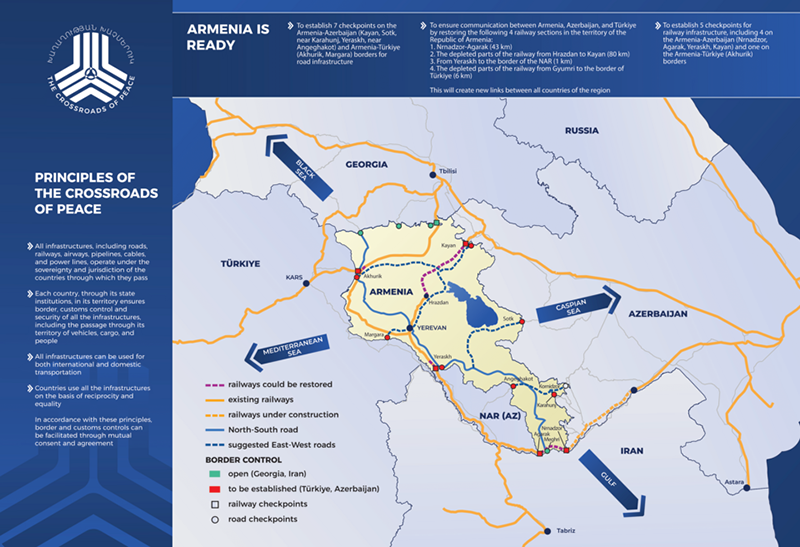
That is the larger promise of Crossroads of Peace: turning geography from vulnerability into strategic and economic value. Railways and roads can support trade, logistics and Armenian industry; energy and fiber-optic connections can increase resilience and strengthen the digital economy. The objective is not simply traffic passing through Armenia, but economic activity developing around that connectivity.
A train that enters Armenia at one border and leaves through another is transit. A transportation network around which Armenian companies, services, jobs and industries develop is economic transformation.
This is also the larger significance of the developing Trump Route for International Peace and Prosperity (TRIPP). Its potential value lies not merely in providing passage between Azerbaijan and Nakhichevan. The Armenia-U.S. framework encompasses railways and roads as well as potential electricity, oil and gas pipelines, and fiber-optic projects, while expressly affirming Armenia’s sovereignty and jurisdiction over the project areas within its territory.
That distinction is fundamental. Armenia retains its legislative and judicial authority, national-security and law-enforcement powers, border and customs control, and taxation authority within its sovereign territory. Connectivity has strategic value precisely when it strengthens rather than diminishes that sovereignty.
Connectivity without sovereignty creates vulnerability. But sovereignty exercised in permanent isolation creates vulnerability of another kind. The objective is connectivity protected by sovereignty.
The crossroads need not be limited to physical transportation. Armenia’s emerging AI and computing infrastructure points toward another possibility: a country that becomes not simply a passage for physical goods but a regional provider of computing capacity, artificial intelligence, cloud services and technological expertise.
Armenia’s greatest value need not be simply where it is located. It can also be what Armenia produces, computes, designs and provides.
The same logic extends to energy and digital networks that could connect Armenia more deeply with the South Caucasus, Central Asia, Türkiye and Europe. Foreign Minister Ararat Mirzoyan has been one of the clearest voices articulating this broader vision, extending connectivity beyond railways to electricity grids, internet cables and potentially future pipelines. At the Yerevan Dialogue in May 2026, he captured the strategic principle succinctly:
“When we share trade routes, energy grids, pipelines, digital links, we share risks and rewards.”
That is the deeper logic of connectivity. When countries share infrastructure and economic interests, they acquire a stake in one another’s stability. Armenia can become valuable not simply as territory through which something passes, but as a participant in networks others have an interest in keeping secure and functioning.
This leads to an equally important concept: strategic autonomy.
Diversification is the practice of creating options, not exchanging one patron for another. It means building enough partners, markets, transportation routes, energy sources, technologies and security relationships that pressure from any one direction does not leave Armenia without alternatives.
For a small state, strategic autonomy does not mean needing no one; it means never being left with only one choice.
Seen from that perspective, Armenia’s widening relationships with the United States, France, the European Union, Iran, India, Russia, the Gulf and others should not be viewed as competing geopolitical identities. They offer different sources of trade, investment, technology, energy, security cooperation and connectivity. Their collective value lies in expanding Armenia’s options rather than replacing dependence on one power with dependence on another.
A dependent Armenia needs someone. An interconnected Armenia has choices.
A crossroads, after all, is of limited value if it opens in only one direction.
The most difficult extension of that principle involves Turkey and Azerbaijan. Normalization with Turkey and a durable peace with Azerbaijan would not erase the Armenian Genocide, the displacement of the Armenians of Artsakh, Armenian detainees held in Azerbaijan, threats to Armenian cultural heritage or the painful lessons of recent history.
But memory and strategy are not the same thing.
A nation can remember injustice without making permanent hostility its foreign policy. It can pursue accountability and defend its historical record while also trying to ensure that another generation of Armenians does not inherit closed borders and another war.
Nor does peace mean trust without evidence. Durable peace requires sovereign borders, reciprocity, credible defenses and vigilance. Trade cannot substitute for deterrence, but peace can give Armenia the space to strengthen itself. For a country of Armenia’s size and geography, reducing permanent enemies while multiplying useful relationships is not naïveté; it can be hard-headed statecraft.
For generations, Armenian geography has too often been the ground across which other people’s rivalries were fought.
Perhaps the more ambitious goal is to make it the ground across which other people’s commerce travels.
Not simply a corridor. A crossroads.
Not merely transit fees. An economy built around connectivity.
Not dependence on whichever great power appears strongest at a particular moment. Relationships sufficiently diversified that Armenia retains alternatives when the interests of larger powers inevitably change.
And not peace as an act of faith, but peace reinforced by sovereignty, economic value, capable defenses and a growing network of countries with an interest in Armenia’s stability.
That brings us back to the little bronze coin.
More than two thousand years ago, Tigranes IV and Erato ruled an Armenia situated between competing powers and overlapping civilizations. Their coin carried Armenian sovereigns, Armenian geography, an international language and a diplomatic message toward Rome, while their kingdom navigated the competing influence of Rome and Parthia. None of those elements erased the others.
Modern Armenia can approach the world with the same confidence.
Friendship with the United States does not make Armenia American. Friendship with Iran does not make it Iranian. Trade with Russia does not make it Russian. Closer relations with Europe do not make it less Armenian. Normalization with Turkey does not erase the Genocide, and peace with Azerbaijan does not erase what happened to the Armenians of Artsakh.
The meaningful test of each relationship is not which geopolitical camp it appears to favor, but whether it increases the sovereignty, security, prosperity and freedom of action of the Republic of Armenia.
That is the Armenia worth building: not isolated in the name of preserving identity, not dependent enough to be controlled, and not condemned to permanent hostility – but connected enough to be useful, strong enough to protect itself, and sovereign enough to decide its own course.
The ancient coin expressed that confidence without surrendering either of its Armenian faces – or Ararat.
Many partners. Several open roads. One sovereign Armenia.
Zero permanent enemies – and zero foreign masters.
Yerevan, Armenia
(Watertown, Massachusetts)
Berge Jololian is an Armenian-American IT and cybersecurity specialist based in Yerevan, Armenia. He writes on Armenian statehood, sovereignty, regional security, and the geopolitics of the South Caucasus, with a particular interest in the strategic challenges facing small states in a changing international order.
BRUSSELS -- On October 16, Hamlet Batikyan, Secretary General of Armenia's Ministry of Defense and…
YEREVAN -- Armenia's Minister of Territorial Administration and Infrastructure, Davit Khudatyan, has announced that authorities…
Hollywood actor and environmental activist Leonardo DiCaprio has welcomed new initiatives aimed at recovering endangered…
ISTANBUL — A formal reception marking the 35th anniversary of the Republic of Armenia’s independence…
YEREVAN — A gala concert celebrating the 75th birth anniversary of internationally renowned Armenian opera…
Two-Day International Conference: “Resilience and Reconstruction: The Armistice Period in the Ottoman Empire (1918-1923)” Friday,…