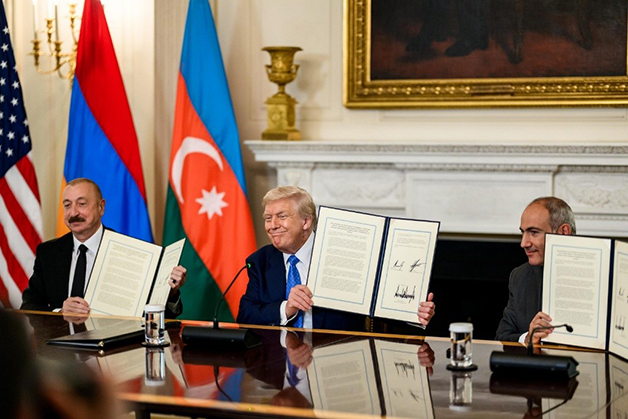
Armenian Prime Minister Nikol Pashinyan and Azerbaijani President Ilham Aliyev meet on the sidelines of the Shanghai Cooperation Organization summit in Bishkek on August 31, 2026. Photo: Office of the Prime Minister of Armenia.
By BERGE JOLOLIAN
In Washington, the words were peace.
On August 8, 2025, the leaders of Armenia and Azerbaijan signed a joint declaration at the White House, and their foreign ministers initialed the agreed text of a peace agreement. Roads would open. Trade would begin. One of the former Soviet Union’s longest conflicts appeared to be approaching its end.
But peace is not only what leaders sign.
It is also how leaders speak and behave when no ceremony is taking place – and whether they accept each other as sovereign equals.
Aliyev’s diplomacy has acquired a Jekyll-and-Hyde quality. In Washington, he speaks of peace, trade and connectivity. Elsewhere, he calls Armenia fascist, renames its territory and reminds Armenians what Azerbaijan could have taken by force.
But this is not a psychological split.
It is a political method.
One voice reassures the world. The other intimidates Armenia, reinforces a politics built around victory and keeps military pressure available for negotiations.
For Armenians in the Diaspora, this distinction matters. Armenia’s government must be held accountable. But Armenia’s security cannot be understood by looking only inward. It also requires listening to the leader across the border.
The Peacemaker
Practical steps have followed Washington. Azerbaijan is supplying petroleum products to Armenia and providing transit for third-country cargo. Business contacts and limited trade have begun. On September 1, Armenian Foreign Minister Ararat Mirzoyan said Azerbaijani companies had also purchased Armenian goods, making trade two-way.
At their August 31, 2026, meeting in Bishkek, Aliyev and Pashinyan discussed border delimitation, practical steps on TRIPP, expanded trade and energy cooperation, and confidence-building contacts. Their governments issued virtually identical accounts and agreed to continue direct engagement.
The following day, Pashinyan discussed TRIPP’s implementation with U.S. Senator Steve Daines and told the SCO Plus summit that practical work would begin on the ground “in the coming months.”
At the same gathering, Aliyev said the South Caucasus was becoming “a zone of peace” and that Azerbaijan and Armenia were working together to expand trade and create new overland transportation links.
These developments matter. They should be welcomed.
Aliyev says Azerbaijan has no territorial claims against Armenia and presents regional connectivity as an opportunity. That assurance should be taken seriously.
So should everything he says around it.
His treatment of Armenia’s own connectivity proposal earlier in the year offers an instructive contrast. At the Munich Security Conference in February 2026, Aliyev answered a question about Armenia’s Crossroads of Peace initiative not on its merits, but with sarcasm. Trump had launched TRIPP, he said, so Biden could relaunch Crossroads “when President Biden comes back.”
The answer did not engage Armenia’s proposal.
It dismissed it through ridicule.
The Victor
In January 2025, Aliyev called the independent Armenian state “a fascist state.”
Then he went further.
“Either the Armenian leadership will destroy it,” he said of what he called Armenian fascism, “or we will.”
This was not criticism of a particular decision. It was a threat directed at the character of the Armenian state itself.
In an interview with Al Arabiya shortly after the Washington meeting, Aliyev warned that any future Armenian government that departed from the understandings reached there would face “serious complications.” The balance of power, he said, was entirely in Azerbaijan’s favor.
“Who will win and who will lose?” he asked. “I think that’s a rhetorical question.”
He also said Azerbaijan could have taken by force the portion of southern Armenia separating mainland Azerbaijan from Nakhchivan after the 2020 war.
“There was no one to stop us.”
This is a strange language of reassurance.
In February 2026, France 24 asked whether Aliyev might pardon the imprisoned former leaders of Nagorno-Karabakh. He compared it to releasing Nazi leaders after Nuremberg and called the defendants “even worse.” He was referring to those former leaders, not every Armenian prisoner. But the words remain extraordinary.
Asked whether he felt compassion for the Armenians who fled Nagorno-Karabakh, Aliyev said they had preferred to leave.
Approximately 115,000 people left after a ten-month blockade, a military assault and the collapse of confidence in their safety. The European Parliament described it as ethnic cleansing; the Parliamentary Assembly of the Council of Europe said the circumstances raised a reasonable suspicion of it.
Yet Aliyev reduced their departure to a choice.
This is not the language of reconciliation.
It is the language of victory without responsibility.
For years, Aliyev threatened to resolve the Karabakh conflict by force. Azerbaijan went to war in 2020. In 2023, after months of blockade, it launched the operation after which almost the entire Armenian population fled.
Not every threat becomes policy, but Aliyev’s threats cannot responsibly be treated as theater.
His words should be heard before they become facts.
The Map Behind the Words
Aliyev calls present-day Armenia “Western Azerbaijan” and its southern Syunik province – its strategic border with Iran – “West Zangezur.” Yerevan becomes “Irevan” and Lake Sevan “Goycha.” He says much of the Republic consists of historical Azerbaijani lands.
History is complex. Azerbaijanis displaced from Soviet Armenia have rights – to memory, property, family history and, where possible, voluntary return. So do Armenians displaced from Baku, Sumgait, Nakhchivan and Nagorno-Karabakh.
Rights belong to people.
They should not become instruments for redrawing maps.
Aliyev has made Azerbaijani return a state-directed campaign. In January 2025, he said 300,000 “Western Azerbaijanis” should return to Armenia; counting their descendants, he later said, produced millions.
“We will not go there in tanks,” he declared. “We will go there in cars.”
He instructed state institutions and scholars to promote maps, exhibitions and historical place names so that return would appear “logical and fair.”
The words “not in tanks” do not make the message harmless.
They link a demographic program to a narrative that Armenia is built on Azerbaijani land – and ask Armenians to trust the government that emptied Nagorno-Karabakh of its Armenian population.
Even after Washington, Aliyev has retained the vocabulary of a corridor through Armenian territory. At the Shusha Global Media Forum in July 2026, he said the Trump administration understood the “necessity of the Zangezur Corridor” and had worked to persuade Armenia.
Yet the Armenia–United States framework governing TRIPP states that Armenia retains full sovereignty, territorial integrity and jurisdiction over every project area within its territory.
The difference between a route and a corridor is not merely semantic when one side has repeatedly invoked its military superiority.
If Aliyev intends only to defend displaced people’s rights and open transportation, there is a simple test.
He can affirm the same rights for displaced Armenians, stop calling Armenia “Western Azerbaijan” and state that no historical narrative or transportation project will challenge its sovereignty.
He has not done so.
Two Voices, One Strategy
Armenia has already crossed several lines that once appeared politically impossible.
It recognized Azerbaijan’s territorial integrity, including Nagorno-Karabakh, accepted that the conflict was over, joined Azerbaijan in requesting the dissolution of the OSCE Minsk Group and initialed the text of the peace agreement.
Yet the agreement remains unsigned. Azerbaijan has demanded changes to Armenia’s constitution before signing. It has also sought the departure of the European Union Mission, whose unarmed observers patrol entirely inside Armenia.
The Bishkek statement did not indicate that either position had changed.
Before the observers arrived, border shootings produced two incompatible accounts, with no permanent independent presence. The mission cannot prevent every shooting. It does something more modest.
It watches.
It records.
It makes denial more difficult.
This may help explain why the mission irritates Baku.
The contradiction sharpened at the July 2026 Shusha Global Media Forum, titled “The Mission of the Media in Promoting Peace: Restoring Truth and Rebuilding Trust.” Aliyev said peace with Armenia was established. Yet he also said Azerbaijan did not recognize decisions of the European Court of Human Rights and had considered leaving the Council of Europe.
Weeks earlier, its Parliamentary Assembly had condemned Azerbaijan’s silencing of critics and cited 328 reported political prisoners. Soon afterward, nine people associated with Toplum TV received sentences of twelve to fifteen years.
A government that treats independent scrutiny as betrayal is unlikely to welcome independent witnesses to its conduct toward Armenia.
That pressure now reaches abroad. On September 2, after Azerbaijan’s ambassador demanded cancellation of a Paris City Hall exhibition displaying portraits of nineteen Armenians detained in Baku – arguing that it contradicted the “spirit of the peace process” – City Hall withdrew from the official inauguration. The CCAF attributed the decision to Azerbaijani pressure and warnings that French nationals in Azerbaijan could be endangered. The exhibition remained, and the gathering proceeded.
In Israel, unanimous government recognition of the Armenian Genocide was not followed by the expected Knesset vote. Haaretz reported intervention by Aliyev adviser Hikmet Hajiyev, who later described an Aliyev-directed campaign that he claimed prevented further action; Israel’s foreign minister denied Netanyahu had intervened.
Turkey’s normalization with Armenia also remains tied to Baku. In June, Foreign Minister Hakan Fidan said it was proceeding “in close coordination with Azerbaijan.” Despite trade steps, the land border remains closed and a 2022 agreement to admit third-country nationals is unimplemented.
The circumstances differ, but the pattern is consistent: Baku uses strategic relationships not merely to negotiate with Armenia, but to narrow the diplomatic and political space available to it.
A genuine peace may also create a political problem for Aliyev.
For more than two decades, conflict with Armenia has helped define Aliyev’s rule, and victory has become a source of legitimacy. Without an Armenian enemy, harder questions arise: Why are journalists imprisoned? Why are elections not competitive? Why does a victorious country fear reporters and peace advocates?
Internationally, peace offers Azerbaijan trade, investment and legitimacy. Domestically, hostility preserves a useful enemy.
Aliyev appears to want the conflict closed on the map but alive in the public mind – the benefits of peace without surrendering the politics of enmity.
A Warning From 428
Armenian history warns what can happen when anger at a ruler overtakes concern for the state.
In the fifth century, Armenia stood between the Roman Empire and the Sasanian Persian Empire, centered in Iran. Though constrained, it retained an Armenian king, court and memory of sovereignty.
That king was Artashes IV, the last ruler of Armenia’s Arsacid (Arshakuni) dynasty.
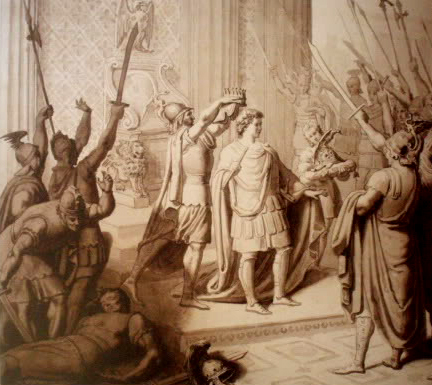
Artashes was not a great king. The Armenian nobles – the nakharars – accused him of misconduct and asked Catholicos Sahak Partev to support an appeal to Bahram V for his removal.
Sahak did not deny the king’s faults, but understood the danger. Historian Ghazar Parpetsi wrote that he wept when the nobles persisted, fearing the destruction of Armenia’s political order.
The nobles appealed anyway. In 428, Bahram removed Artashes, abolished the Armenian monarchy and imposed direct Sasanian rule.
The nobles succeeded in removing the ruler they disliked.
Armenia lost the crown.
Today’s Armenia is an independent republic, not a vassal kingdom, and political opposition is necessary.
But the warning remains.
There is a difference between opposing a government and weakening the state. A government can be replaced by Armenian voters. The Republic, once lost, cannot be so easily restored.
Armenian history does not ask us to excuse bad government.
It asks us to remember what must survive our arguments about government.
What Washington, Brussels and the Diaspora Should Do
The United States and Europe are right to support a settlement. Armenians and Azerbaijanis deserve secure borders, trade and life without expecting another escalation.
Abandoning diplomacy would be irresponsible.
So would confusing a diplomatic breakthrough with durable peace.
Washington’s relationship with Baku has deepened. In February 2026, Vice President JD Vance and Aliyev signed a strategic partnership covering connectivity, investment, energy, technology and security. Europe is investing too: on July 1, Commission President Ursula von der Leyen announced connectivity grants intended to mobilize €2 billion, plus €20 million for peace programs.
The announcement emphasized peace, connectivity, trade and energy – not the political prisoners highlighted by the Council of Europe one week earlier.
Investment in peace should be welcomed.
But economic partnership should increase Western leverage, not purchase Western silence.
Washington and Brussels should insist that peace include more than routes and signatures. Armenia’s territorial integrity must be affirmed without the shadow vocabulary of “Western Azerbaijan.” Border incidents need independent investigation. European observers should remain until the agreement is signed and backed by reliable arrangements – or be replaced by an equally credible mechanism.
The rights of displaced Armenians and Azerbaijanis should be protected as voluntary individual rights, not demographic claims. Armenian detainees need international access and fair legal review. Democratic governments should reject attempts to use their citizens’ safety against lawful advocacy.
Engagement with Azerbaijan is necessary.
Indulgence is not.
Armenians outside Armenia also have a responsibility.
Diaspora organizations possess relationships and access that Armenia cannot always mobilize. They should scrutinize Aliyev’s threats, defend independent observers, protect displaced Armenians’ rights, resist efforts to silence advocacy for detainees and reject historical revision of Armenia’s territory.
This does not require defending every government decision or abandoning criticism of Prime Minister Pashinyan.
It requires proportion.
A Diaspora that spends more energy attacking Armenia’s government than confronting the ruler who threatens it risks confusing political anger with national strategy.
Before every campaign or expenditure of political capital, one question should be asked:
Does this strengthen Armenia?
The Diaspora need not choose Armenia’s government; Armenians there can do that. Its task is to help ensure that Armenia remains strong, secure and free enough to continue choosing.
Peace Between Equals
Azerbaijan is stronger than Armenia.
Aliyev rarely allows Armenians to forget it.
But military superiority does not prove a commitment to peace. It makes restraint the true test of that commitment.
Peace is not the weaker country learning to remain silent. It is the stronger country accepting limits on what its power permits it to demand.
The Washington declaration, the movement of cargo and fuel, the Bishkek meeting and every peaceful contact are important.
These steps are reasons to continue the process.
They are not reasons to stop listening to what Aliyev says.
A treaty can end a legal state of war.
It cannot create trust while one country calls the other fascist, compares prisoners to Nazis, brands peaceful observers spies and renames a neighboring republic as ancestral land awaiting return.
Aliyev may be prepared to formalize peace.
The question is whether he will live by its meaning: restraint, reciprocity and respect for Armenia as a sovereign equal.
The West does not have to choose between diplomacy and vigilance.
Neither does the Diaspora.
Peace deserves support.
So does the vigilance required to ensure that Armenia enters it as a sovereign equal.
The question is not whether Aliyev can pronounce the word peace.
It is whether he can accept not only an Armenia that lost a war, but a Republic of Armenia that remains.
Berge Jololian is an Armenian-American IT and cybersecurity specialist based in Yerevan, Armenia. He writes on Armenian statehood, sovereignty, regional security and the geopolitics of the South Caucasus, with a particular interest in the strategic challenges facing small states in a changing international order.
By KRIKOR KHODANIAN Relations between the Republic of Armenia and the Russian Federation have entered…
Sunday attendance up 59% or 591. Young women 11% of total. Social media views over…
YEREVAN — Armenian Foreign Minister Ararat Mirzoyan has dismissed reports suggesting significant Iranian concerns over…
YEREVAN — Heads of state, senior government officials, and representatives of international organizations have gathered…
YEREVAN — Armenian Prime Minister Nikol Pashinyan met with Iranian President Masoud Pezeshkian on the…
YEREVAN — Armenian Security Council Secretary Alen Simonyan said Armenia and Azerbaijan are discussing the…