
Recently, Hikmet Hajiyev, Assistant to the President of Azerbaijan, accompanied approximately 150 foreign diplomats and representatives of international organizations on visits to the Gandzasar and Dadivank monasteries. He presented the monasteries as part of the “ancient Christian heritage of Caucasian Albania,” while Gandzasar’s Armenian history was portrayed as the result of later transformations.
Behind this episode lies a state policy that has been developed over many years.
In Caucasian Albania: An International Handbook, an academic volume published by De Gruyter in 2023, Oxford University researcher Hratch Tchilingirian examines this policy in detail, describing it as an effort by Baku to construct a new history of an “Albanian Church.”
The study argues that this is not merely a historiographical dispute. According to Tchilingirian, Azerbaijan’s state institutions have systematically developed a narrative linking modern Azerbaijan to the early Christian past of Caucasian Albania while gradually diminishing or excluding the Armenian presence from that history.
Following the 2020 war, this policy gained new momentum and became a more systematic instrument of the state.
In 2022, Azerbaijan’s then-Minister of Culture, Anar Karimov, announced the creation of a working group whose stated tasks included examining what Azerbaijani officials described as “fictitious traces” added by Armenians to religious sites. Months after the end of the war, President Ilham Aliyev, speaking before cameras at a Christian monument, referred to it as an “Albanian temple” and accused Armenians of creating a “false history.”
The structure of Baku’s official narrative is relatively clear: medieval Armenian Christian heritage is presented as the heritage of Caucasian Albania, while Caucasian Albania is portrayed as a historical predecessor of modern Azerbaijan. The Udi people are assigned the role of living successors to this heritage.
Tchilingirian’s research argues that this narrative is being developed with active state participation. According to his study, Azerbaijan’s presidential administration, state religious institutions, financial resources and diplomatic apparatus have all played roles in its development and international promotion.
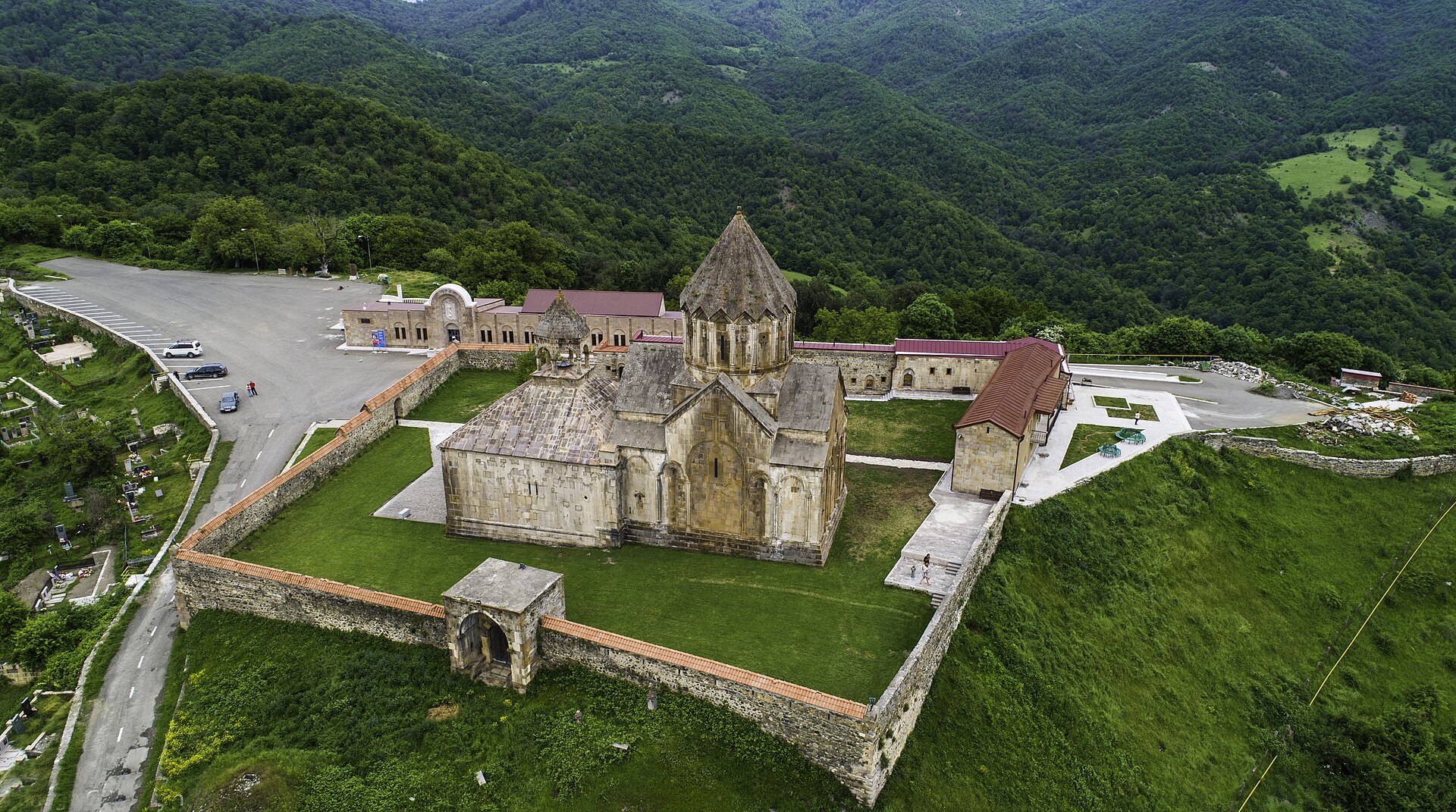
Gandzasar is one of the most sensitive sites in this historical dispute.
The same international academic volume associates the construction of Gandzasar with the Hasan-Jalalyan dynasty, the Armenian princely house of Artsakh. Hasan-Jalal was buried at Gandzasar in 1261. The monastery later became the seat of the Catholicosate of Aghvank. The spiritual leaders of that Catholicosate maintained canonical ties with the Armenian Apostolic Church, and in the 19th century it was ultimately reorganized as a diocese of the Armenian Church.
These facts also highlight an important distinction. The term “Albanian” refers to a historical identity that cannot automatically be equated with modern Azerbaijan. Gandzasar’s history developed within the Armenian princely, ecclesiastical and cultural environment of the medieval Caucasus. Today, attempts to incorporate this complex history into a single modern national narrative have become part of a broader political dispute over cultural heritage.
The Udi factor is also a central component of this project. Tchilingirian’s research notes that Azerbaijan’s small Udi community was viewed with suspicion by the authorities during the early post-Soviet period. Later, the state recognized and organized the Albanian-Udi Christian community and began presenting it as a basis for continuity with the ancient Albanian Church.
At the same time, the modern institution does not possess all of the characteristics traditionally associated with an independent historical church, including a complete ecclesiastical hierarchy, an established apostolic succession and broad international ecclesiastical recognition.
One of the most notable precedents involved the restoration of a church in the village of Nij. During a project financed by the Norwegian government, the removal of Armenian inscriptions prompted objections from the Norwegian side. Norway’s ambassador described what had occurred as vandalism, and a planned visit to the church by the Norwegian prime minister was subsequently canceled.
Against this background, Hajiyev’s latest tour takes on broader significance.
Since September 2023, the Armenian population that had lived in Nagorno-Karabakh has departed the region. The dispute has increasingly shifted toward questions of historical memory, names, inscriptions and the cultural origins of monuments. With the population gone, the churches and monasteries remain, and the interpretation of their history has become another arena of political contestation.
The dispute surrounding Gandzasar has therefore moved well beyond the boundaries of academic historiography. Baku is presenting its interpretation of history as an official state and diplomatic message, including directly to foreign diplomats at the monuments themselves.
The peace process alone is unlikely to resolve these disagreements. The treatment of historical and cultural heritage is also an element of the broader relationship between societies after conflict. A treaty may establish borders and political commitments, but disputes over historical memory can continue long afterward.
For Armenia, addressing this issue requires a long-term and coordinated policy encompassing academic research, documentation, digitized archives, international scholarly cooperation, sustained engagement with UNESCO and other cultural heritage organizations, high-quality publications in foreign languages, and active diplomacy.
Azerbaijan has long incorporated this issue into its state policy. Armenia’s response, the argument concludes, should likewise be systematic—presenting the history of Gandzasar internationally through documented evidence, authoritative scholarship and sustained diplomatic engagement.
Translated from 1in.am