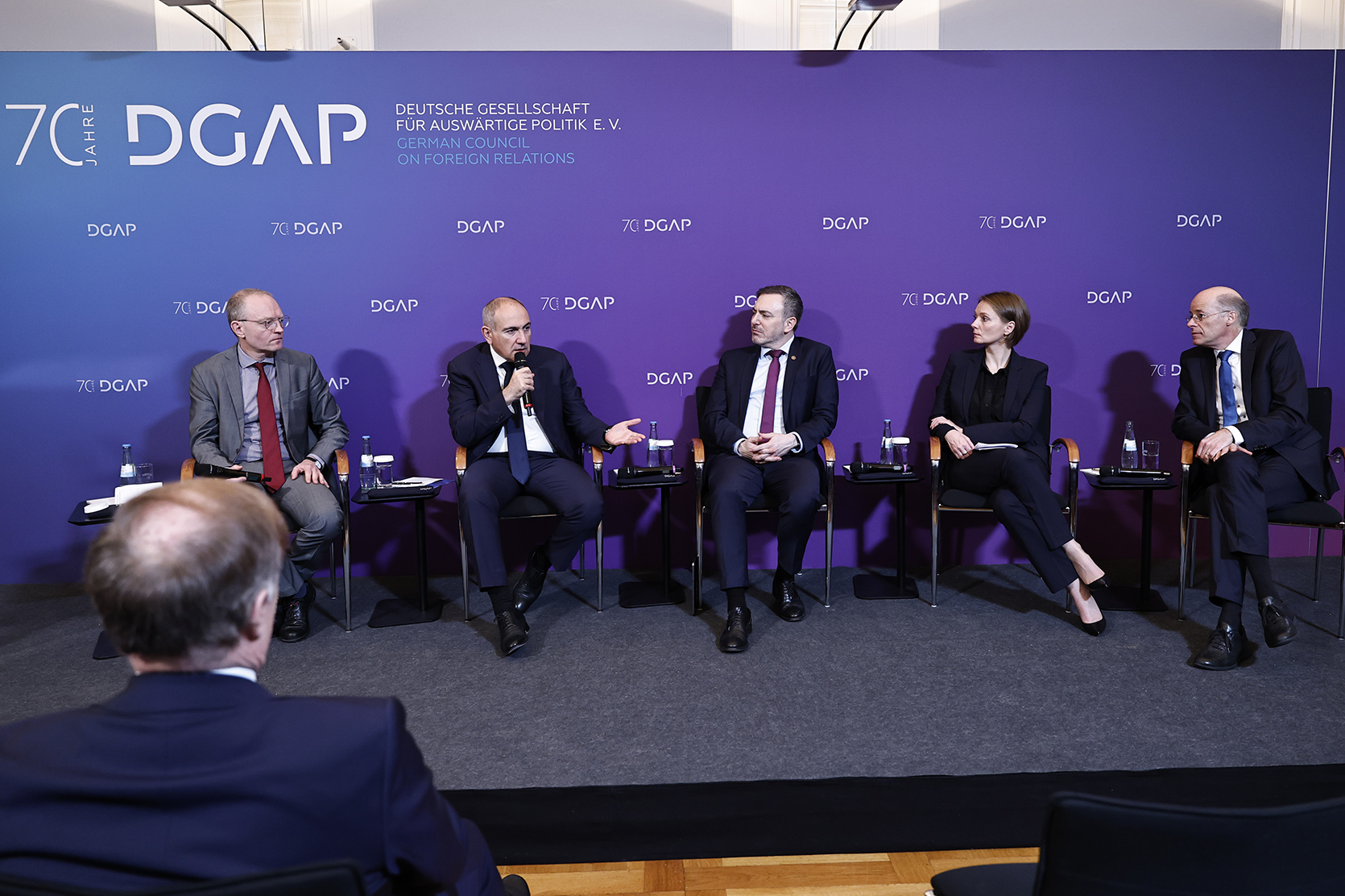
BERLIN — Armenian Prime Minister Nikol Pashinyan stated that Armenia’s long-term strategy is to develop into a country capable of living in its region without relying on external aid or support. He made the remarks during a discussion organized by the German Association for Foreign Relations.
“Our strategy is the following: to turn Armenia into a country that can live in our region without external assistance or support. I think this is a very important nuance,” Pashinyan said.
He stressed that this does not mean severing international ties or cooperation with global partners. Rather, the goal is for Armenia to be capable of discussing regional issues directly with its neighbors and fostering an atmosphere of harmony and solidarity “to the extent possible.”
Pashinyan noted that there will never be a “zero-problem” environment, as challenges exist everywhere—even within Europe. Leadership, he said, is about managing these situations, creating peace, and maintaining it.
“What is our message? We say that peace has been established, and we can see it on the ground. But on the other hand, it requires daily care—literally daily—because without such care and attention, it will inevitably be put at risk,” he added.
“Small Steps and Peacebuilding”: Pashinyan Speaks on the Return of Armenian Detainees Held in Baku
Addressing a question from a participant of the same event, Pashinyan commented on the issue of Armenian prisoners held in Azerbaijani prisons.
“This is a sensitive issue. Our position is that this matter can be addressed far more easily in an atmosphere of cooperation and peace than in an atmosphere of conflict,” he said.
Pashinyan emphasized that it is impossible to resolve such humanitarian issues while in a state of confrontation. However, as Armenia and Azerbaijan move toward strengthening peace, “small steps toward solving this problem become increasingly realistic.”
“That is our position. Establishing peace also means solving other outstanding issues. That is our understanding,” Pashinyan said.
Currently, 23 Armenian detainees are held in Baku’s prisons. Seven have already been sentenced to long prison terms, while the trials of the remaining 16—among them members of Artsakh’s former political and military leadership—are nearing completion. Many face the possibility of life imprisonment, as Azerbaijan accuses them of committing serious crimes.
YEREVAN -- Armenian Defense Minister Suren Papikyan has indicated that Czech-made military aircraft may soon…
MOSCOW -- A report prepared by representatives of Russia, Belarus, Kazakhstan, and Kyrgyzstan within the…
WASHINGTON, DC -- U.S.-based businessman and TRIPP+ Fund executive Konstantin Sokolov has outlined plans to…
YEREVAN -- Armenia continues to diversify its foreign economic relations by expanding the presence of…
YEREVAN -- Romanos Petrosyan, acting manager of the Electric Networks of Armenia (ENA), has announced…
BRUSSELS -- On October 16, Hamlet Batikyan, Secretary General of Armenia's Ministry of Defense and…